Who Is IronWolf?

Avatar by Wesley Hall

This blog is approaching its one year anniversary next month. It has been a good time writing the various articles here, exploring different fantasy RPG systems, reviews and other RPG related commentary. The Iron Tavern may just celebrate the upcoming anniversary with some form of contest next month! But that is not today’s topic.

When I started writing here I did so under the pseudonym of IronWolf. I have used that name in most RPG related places I have signed up with if it was not already taken. IronWolf was the name of one of my very first D&D characters. Many will also recognize it as the last name of the infamous Morgan Ironwolf, also from the D&D Basic Sets!

However, as time has gone on and my more frequent usage of Google+ I have become more accustomed to using my real name. The mixing of using my alias from various forum sites as my posting name here has also generated confusion on more than one occasion from someone not making the connection.

With much consideration and thought I think it is now time to bring things together under my real name as opposed to my posting alias. As my online social circles grow, The Iron Tavern grows in active readers and contribution credits increase I believe this consolidation will help keep things together a little better.

My posts here at The Iron Tavern will no longer appear as being authored by IronWolf, but as Jeffrey Tadlock now.

I have updated the About page here at The Iron Tavern to reflect the real name and added a few more things about me there. I have also updated my Twitter profile to display my real name as well, though my Twitter account is still under @ir0nwolf. I have also added more contact information to the About page to make reaching me easier.

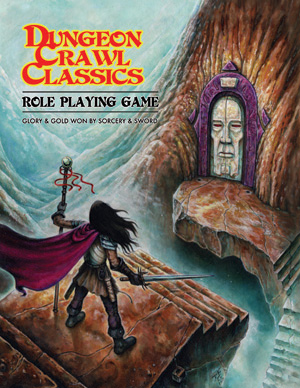
DCC RPG: The Dwarf

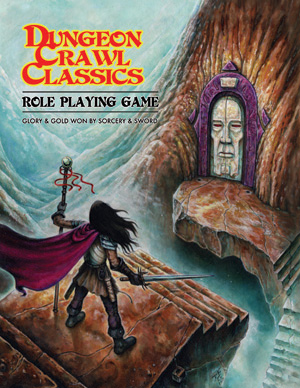
This is the third installment in my weekly series of looking at each of the Dungeon Crawl Classics RPG character classes. The first week I looked at the warrior and last week I looked at the thief. Be sure to check those articles out as well! This week I am taking a closer look at the dwarf character class.

The Class

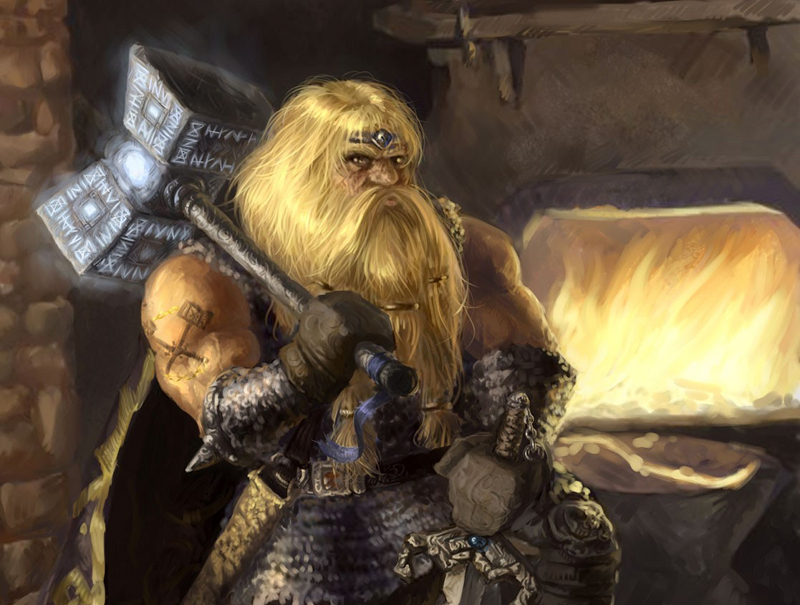
Dungeon Crawl Classics RPG returns to the mechanic of the case of the demi-human characters being your class, as well as your race. Elves, Dwarves, and Halflings are both race and class. In the Dwarf’s case he is very much like the warrior class with a few features to make him unique.

The DCC RPG dwarf is quite true to what I would consider a traditional feel for a dwarf in fantasy RPGs. They love the sight of treasure, short, stout, and strong, albeit wild, fighters. They live below the surface and tend to have excellent martial skills or craftsmen.

Dwarves start with a d10 hit dice, putting them a little below a human warrior, but still towards the top of the stack. Dwarves prefer battling with a weapon and shield and have a rather broad list of weapons they are trained in. They are free to wear whatever armor they can afford.

The same three alignments are available to the dwarf as the other character classes. The rulebook covers what type of dwarf might choose which alignment.

Dwarves have similar attack modifier mechanics as the warrior class does. They receive a deed die that they roll with each attack. This roll on the deed die applies to the attack and damage rolls and will vary depending on level which determines the deed die. At first level the dwarf would roll a d3 and add the result to attack and damage. As the dwarf levels, this die increases in the number of sides.

Also like the warrior the Dwarf can attempt a Mighty Deed of Arms. This allows them, like the warriors, to attempt special maneuvers during combat that succeed based on the value of the deed die. I am a big fan of this mechanic which I explain in my earlier warrior post. Be sure to check that post out for why I am a huge fan of the Mighty Deed of Arms.

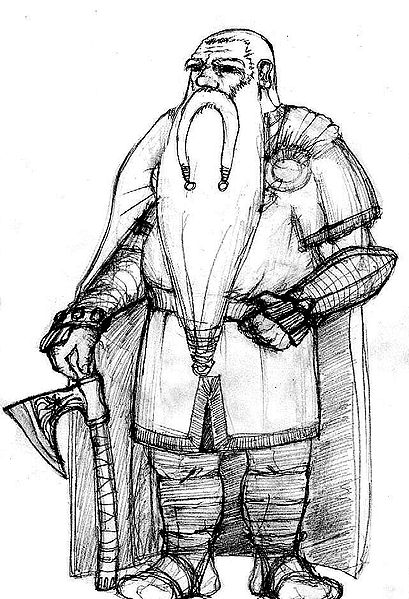
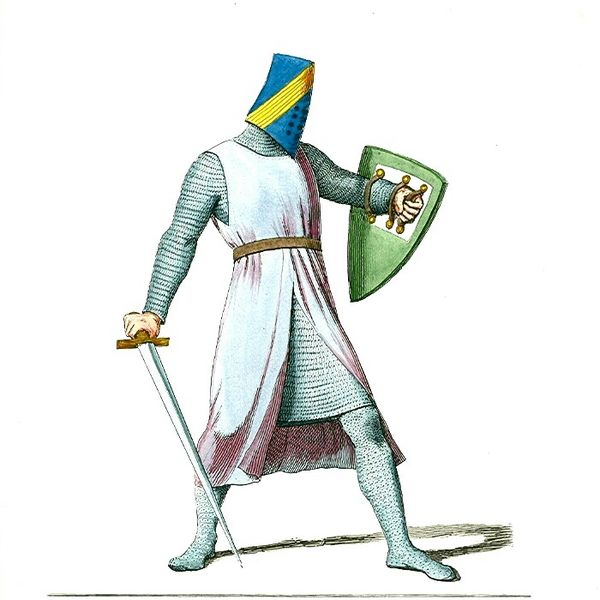
Image Courtesy: http://interartcenter.net

Next up we have the sword and board feature. Dwarves like to fight with a shield and a weapon. If a dwarf fights with a shield the dwarf gains shield bash as a second attack – even at first level. The attack with the shield uses a lesser die to hit and does a small amount of damage, but I like the flavor. A Mighty Deed of Arms can be used with the shield bash.

Dwarves of course have infravision due to their time spent below the surface. They also have the slow movement speed of 20′.

Due to their time spent underground Dwarves have a list of underground skills allowing them bonuses to several types of skill checks when made underground. Another interesting feature is that they can smell gold and gems and determine which direction they are in depending on the amount of gold or gems near.

Finally, the dwarf can apply luck to one specific kind of weapon as the warrior does. They also start the game knowing the dwarven racial language.

My Impression

I find the Dwarven class in Dungeon Crawl Classics RPG really hit the right feel for dwarves for me. I do not mind that they made the race a character class that predefines its role. Sure, we might not see Dwarven Wizards or Rogues, but those should be fairly rare to begin with. The class as presented in DCC RPG does a good job of representing the typical dwarf.

Much like the warrior, the Mighty Deeds of Arms is a very fun mechanic. It works equally well with the Dwarven class. It also allows a Dwarven character many options.

From Forgotten Realms novels I have always had a fondness for Thibbledorf Pwent, a dwarven beserker. In D&D 3.x games or Pathfinder games I have had a hard time emulating this type of dwarf. I think with the Mighty Deeds at Arms and a judge I trusted that I could build a dwarven beserker with less trouble.

The other mechanic I really like from the Dwarven class is the sword and board feature. I always think of dwarves in close formation, shield in one hand, hammer or axe in the other. The sword and board class feature helps keep the shield useful for more than just an increased AC and allows the Dwarf to use it in battle to cause damage. I like the feel this gives the DCC RPG dwarf.

I have judged for a couple of dwarves in actual play. The characters seemed to do well and with the use of Mighty Deeds at Arms were able to do some excellent things. I recall one battle where the two dwarves formed up a shield wall to help cover a retreat.

The Dwarven character class is yet another class in DCC RPG that hits the right notes for me. The character class feels like what a dwarf should be in fantasy RPGs!

Next Week

So far I have looked at the Warrior class, the Thief and now this week the Dwarf. What would you like to see me look at more closely next? Post here in the comments or on either Google+ or Twitter and let me know which class I should turn to next!

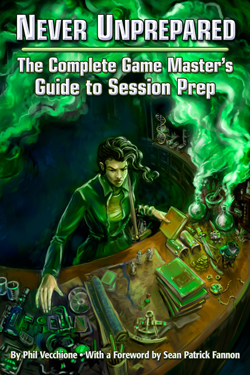
Review: Never Unprepared – The Complete Game Master’s Guide to Session Prep

Author:  Phil Vecchione
Publisher:  Engine Publishing
Price: Print+PDF Bundle $19.95 / PDF $9.95
Pages:   132 (digest)
Tankard Rating:  5/5

The Book

Never Unprepared: The Complete Game Master’s Guide to Session Prep is the third book out from Engine Publishing. The book is written by Phil Vecchione, a gamer with 30 years of experience and illustrated by Matt Morrow and Christopher Reach.

Never Unprepared is a guide to session prep of any type of system you like to play, whether that be a fantasy genre, sci-fi, modern, or any other genre. The process it works the reader through is applicable to your RPG system of choice. The book has three major sections as the author walks the reader through the process of session preparation.

What is Inside?

The first major section is about understanding prep. This area delves into the five phases of preparation – brainstorming, selection, conceptualizing, documentation, and review. Each of these sections cover the individual process and defines it, covers what happens if you spend too little time on that area, what happens if you spend too much time on that area and how to improve and strengthen this area of your prep. Each section closes with a short question and answer section to help give the reader a feel for their skill level for these areas.

The next major section covers the prep toolbox. This section talks about tools for prep. It does not try to steer you towards good old fashioned paper and pencil or to more modern electronic tools, but talks about pros and cons and knowing your own abilities. It also talks about what makes a good tool for each of the building blocks of prepping a session. This helps the reader make a good choice for themselves regardless of whether they prefer electronic or paper and pencil tools.

Another interesting portion of this section is mapping out your creative cycle. The author is a working professional with a family at home and knows what it is like to carve out prep time. He walks you through a technique to map out just how much free time you have and then figure out when you are most creative. Using this information you can more easily map out when you should be scheduling your prep time, yet still balance with work and your family life.

The final major section of the book covers evolving your style. This talks about various concepts to make your prep a little easier. It covers building templates for you to use to help guide your prep. These templates can vary based on when you consider your strengths as a GM and what you consider weaknesses. When prepping areas that hit your strengths you can get by with fewer details. When prepping areas that you feel weak in, including a little more detail can be good.

Using a prep-lite approach in for session preparation is also covered. This includes more tips for getting the amount of preparation you need as a GM just right, while using each of the five steps detailed earlier in the book.

The final portion of this section talks about what to do when the real world intervenes. We have all been there where something comes up that cuts even more into what little time we have to prep. Several scenarios are covered in this section and how various obstacles can affect your prep and how to adjust.

The PDF version of this book is wonderfully bookmarked and has an extensive index. It is good to see that Engine Publishing understands the value of a well bookmarked PDF and the value of a good index. These things do matter to RPG consumers.

But Is It Any Good?

This book was very good. This book should be standard issue to any new GM or any GM that says they simply don’t have time to run a game anymore as real life responsibilities increase. The author has been there like all of us, from the time where we could spend all afternoon evening prepping for games, reading about gaming and doing research for the game. Now, with careers and families there just isn’t the time to prep like we used to. This book shows you how to make the most of your time and get the prep done you need to run a quality game.

Session preparation is often looked at as a very large task. Never Unprepared breaks it down into reasonable chunks of preparation. Some of these chunks can be done in the shower, while you wait in line and other places with minutes of downtime. Other portions of prep do take more contiguous amounts of time, but the book helps you determine where you can find these chunks of time and how to reduce the stress sometimes associated with taking time out of your day to work on gaming prep.

I appreciated the fact that the tools section did not push you into one particular tool or style. The author spent the time to tell you what was required of the tool, leaving it to the reader to pick his or her preferred tool based on requirements, not on someone pushing you in one direction. Understanding what a tool needs to accomplish goes further to helping the reader choose the right tool than anything else.

I also found the mapping of your creative time in contrast with your free time very valuable. I have never sat down to map out my free time, much less apply a creative time peak map over that. These tips can go far to help reduce any tension you might have within your family for taking time to prep games. The methods outlined in this book do not require you to abandon your work of family responsibilities.

This book will help you better prep for your games and work this prep into your busy schedule. The techniques outlined in the book are very solid building blocks to making sure the time you spend prepping for your game is well spent.

The next time I hear someone say they do not have time to run a game I will immediately point them to Never Unprepared as a place to start. This is a high quality offering from Engine Publishing with invaluable advice to anyone trying to figure out how to more effectively prep for their game.

Tankard Rating
5 tankards out of 5 tankards

Note: The Iron Tavern was provided a review copy of this book.

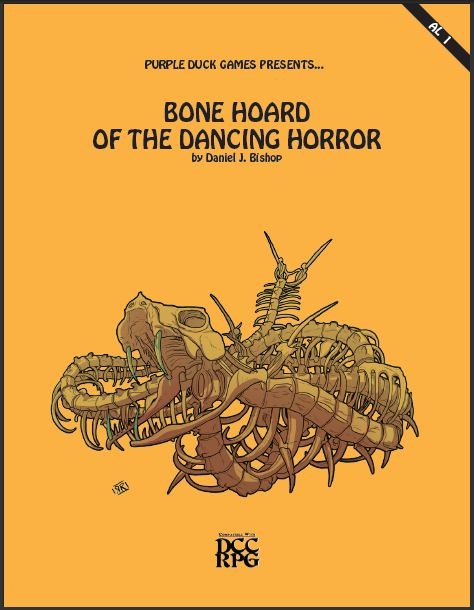
Review: Bone Hoard of the Dancing Horror

Author:  Daniel J. Bishop
Publisher:  Purple Duck Games
Price: PDF $2.75
Pages:   11
Tankard Rating:  4/5

Bone Hoard of the Dancing Horror is Purple Duck Games first release of an adventure to support Dungeon Crawl Classics RPG from Goodman Games. This line of adventures from Purple Duck Games is designed to be picked up and used alone in a DCC RPG game. This adventure is written for a party of second level characters.

From the teaser text at RPG Now we learn that terrible horrors lurk on in the long since missing Dellspero the Philosopher’s workshop. Do the magics he worked on yet remain in this workshop setup in what was once a temple of the Chaos Lords?

Bone Hoard of the Dancing Hoard is a single level dungeon. The judge is provided with some background text to reveal the history of the location. A section for the judge is also included that provided with hints on integrating the adventure with an existing campaign, the flow of the adventure and why the magic items within are handled the way they are.

Just before the module moves into the room descriptions the general overall feel for the dungeon is described to help provide the judge with the information he or she needs to keep things consistent. Each room in the dungeon is keyed, includes a brief “boxed text” description and then the details necessary for the judge to run the room.

The adventure includes new monsters, in fact none of the monsters used in the adventure are traditional by any sense. I found the monsters used within the module very fun to describe and use against the players! The monster aspect seemed to hit the prevalent “Appendix N” feel of DCC RPG quite well.

The adventure also includes several new magic items. Many of the magic items are single use items in efforts to keep with DCC RPG’s “magic items are not common” approach. For the one powerful item it does give away in the adventure, notes are included for the judge on how to handle that if it poses an issue.

I found this adventure well written and suitably twisted enough to fit right in with the DCC RPG feel.

One frustrating factor was the empty room factor to the dungeon. There were several rooms that were listed as empty rooms. I tend to not include many empty rooms in a dungeon. This is not a huge issue though, as these rooms could be spiced up a bit if one desired.

I ran this adventure for a group of people over Google+ Hangouts. It took us two sessions to complete, probably about 2.5 hours each session. A great time was had. One of the big differences with DCC RPG and the adventures that tend to be associated with it in comparison to most d20 type games I have played is that sometimes the characters run away!

This module was no exception. Early on there was an attempt to flee a particular threat, which did not pan out as the movement rate of a couple of the party members was abysmally slow. However, this did lead to a dramatic moment involving a shield wall put up by the dwarves and a rolling Halfling ball of death!

Later on in the module the party caught glance of one of the threats and made a conscious effort to avoid that encounter at all costs. They carefully skirted the area in question and managed to make off with the prize without facing the encounter they sought to avoid.

Overall this was a fun adventure and worked well as a one-shot and could have easily been dropped into an existing campaign as well. With the module being easily prepped it could also be picked up to fill a game session relatively last minute as well, especially given the price. I look forward to the future DCC RPG adventure releases from Purple Duck Games.

4 out of 5 Tankards

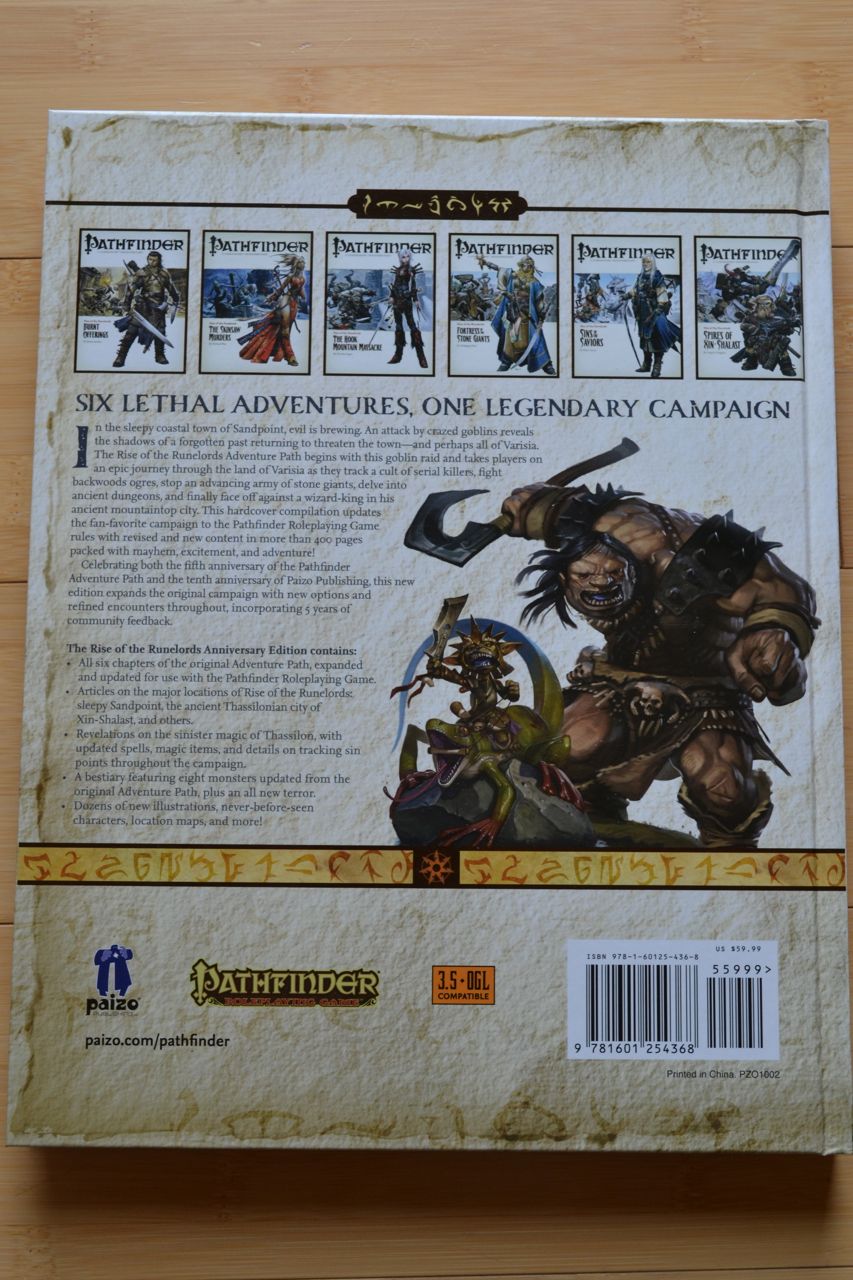
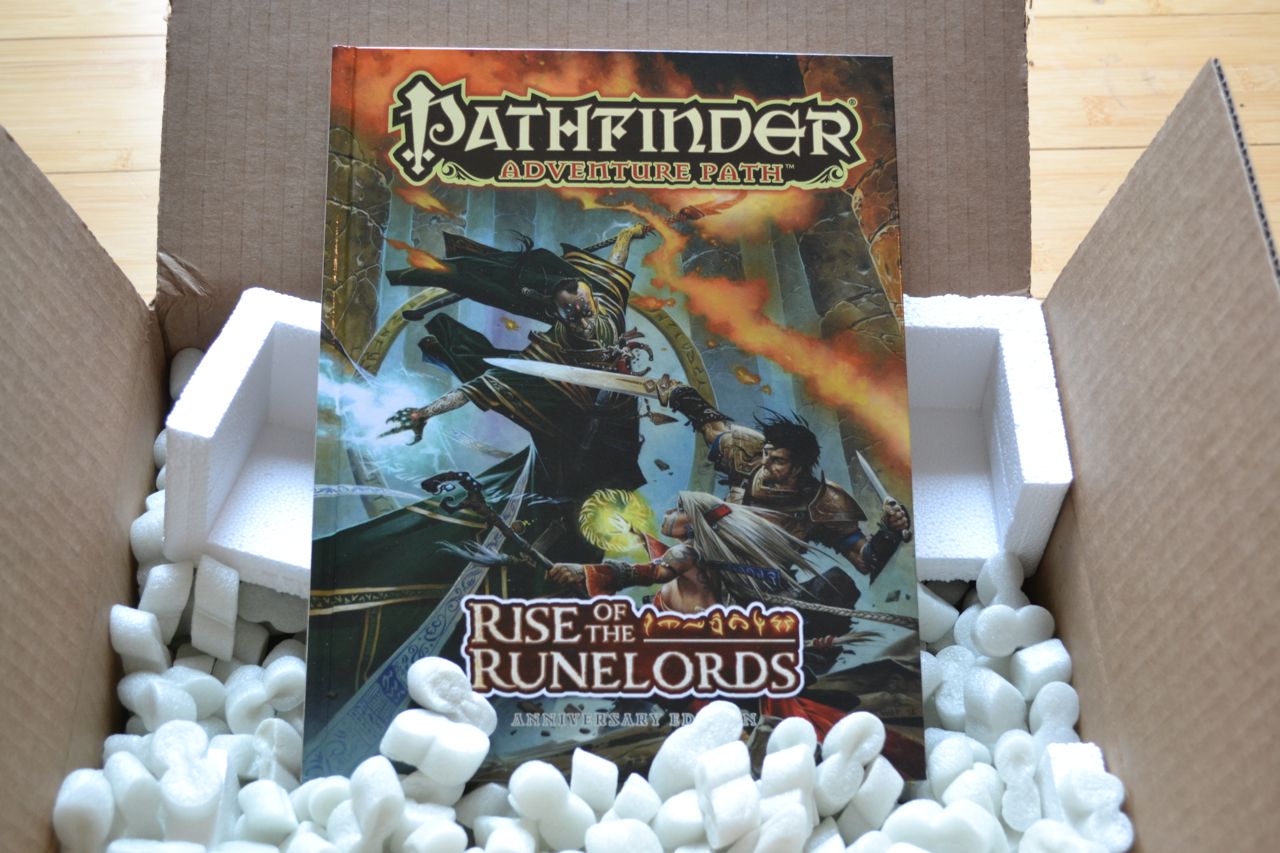
Rise of the Runelords Unboxing

I was a bit of a latecomer to Pathfinder Adventure Paths when they started. Well, more accurately, I was one of the ones thinking no way will this ever work. Of course a couple of years later as I start getting into the Pathfinder ruleset and checking out the Adventure Paths I realized the error of my ways. By that time however, Rise of the Runelords was already getting slightly more difficult to track down.

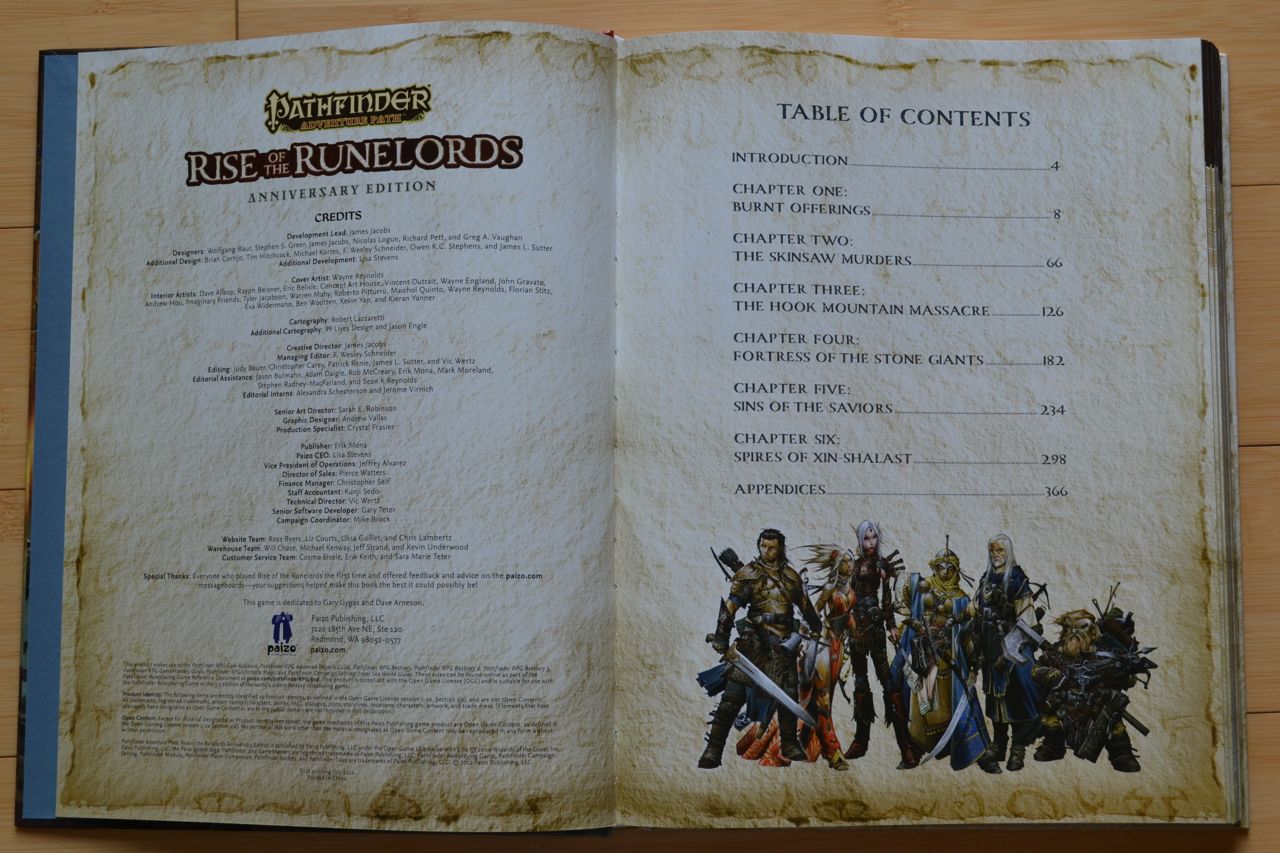
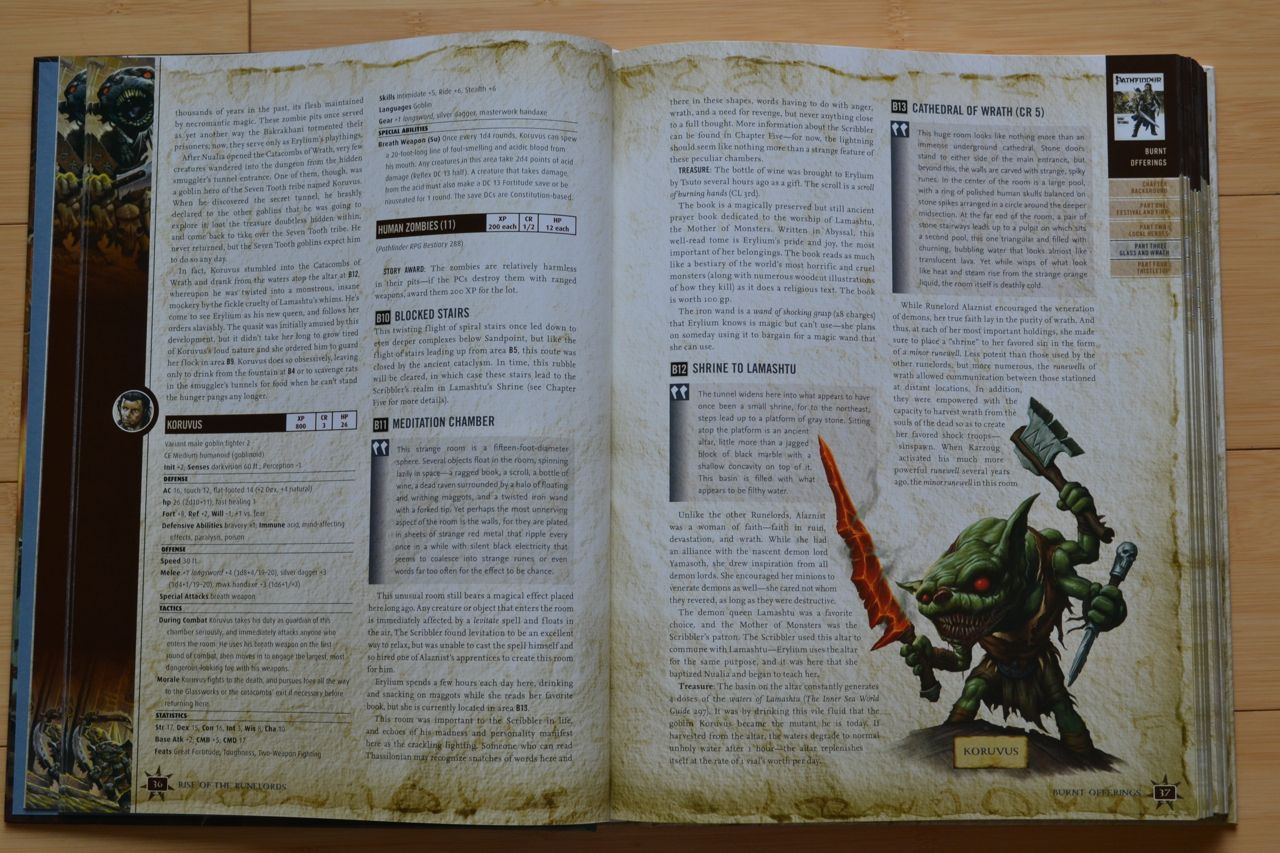
So when Paizo announced they were doing a Rise of the Runelords anniversary release to celebrate ten years in business and the five year mark of the Adventure Path product, I knew I had to get that book. Today my pre-ordered book arrived!

Technically the Rise of the Runelords Anniversary book is a hardback, not a boxed set. But the book arrived in a shipping box, so this post gets the title of unboxing! Plus I was excited to see it arrive!

Before I move to the pictures, here is what the book contains (from the Paizo product page):

  • All six chapters of the original Adventure Path, expanded and updated for use with the Pathfinder Roleplaying Game.
  • Articles on the major locations of Rise of the Runelords: sleepy Sandpoint, the ancient Thassilonian city of Xin-Shalast, and others.
  • Revelations on the sinister magic of Thassilon, with updated spells, magic items, and details on tracking sin points throughout the campaign.
  • A bestiary featuring eight monsters updated from the original Adventure Path, plus an all-new terror.
  • Dozens of new illustrations, never-before-seen characters, location maps, and more!

And now the unboxing!

DCC RPG: The Thief

This is the second post in my weekly series of looking at each of the Dungeon Crawl Classics RPG character classes. Last week I looked at the Warrior class and some of the unique ideas it brought to the table. This week I am taking a look at the thief character class.

The thief character class in DCC RPG can take the shape of the small, wily thief or the bigger, brute type of thief or anything in between. The thief will need to rely on their cunning though as their hit points are determined by a d6 at each level. Their trained weapon list is much smaller than the warrior I looked at last week as one would expect. Choice of armor will of course affect the skills of the thief as well.

The thief can choose one of the three alignments in DCC RPG. This choice will affect how their skills advance as their levels increase in the game.

Thieves’ Cant makes a welcome return in DCC RPG. The cant is spoken only and not written. I always liked thieves cant for those thieves in older editions that were members of a guild.

The thief class also comes with a more extensive list than the “your occupation determines your skills” methodology. We see 13 skills added to the thief class and include many of what I would call traditional thieving skills.  The list includes skills such as Backstab, Hide in Shadows, Pick Lock, Find Trap, and more.

The modifier progression for these skills are determined by alignment. A table outlines how much the modifier increases at each level for each of the three alignments. For example, a chaotic aligned thief has a Backstab skill that increases faster than either a Lawful or Neutral aligned thief. Whereas a lawful aligned thief has a find and disable trap modifier that increase faster than a chaotic aligned thief.

Finally the thief has a different luck mechanic than a typical character class. When a thief burns a point of luck they get to roll a “luck” die for each point of luck expended. The luck die increases as the thief increase in level, so from a d3 to a d4 to a d5 and so on. A thief can expend more than one point of luck to gain additional dice on a roll.

A thief also has the ability to recover luck. Each night the thief is able to recover a point of luck, not to exceed their starting luck score. This allows the thief character to rely on their luck and wits to make those crucial rolls due to the enhanced recovery of expended luck points.

The thief class in DCC RPG fits right in with my view of what a thief is. Surviving on luck and wits, access to thieves cant and a skill list that truly makes them the most skillful character class in the game while supporting traditional thieving roles, the thief in DCC RPG hits all the right notes for me.

The skill list helps boost the thief and make them a more skillful class than other character classes in the game. This skill list also gives the thief the ability to do the things thieves are known for – pick locks, pick pockets, move stealthily, and more.

The modified luck mechanic for the thief gives them the chance to use luck more frequently to boost an attack roll or make sure they succeed at a particularly important skill check. Due to their recovery of luck points they are able to do this just often enough to reinforce the notion of a lucky thief.

The last DCC RPG session I ran had a thief in it. The character seemed to work out pretty well in the party. I think the biggest adjustment for a player coming from 3.x/Pathfinder to DCC RPG is that the backstab skill does not quite equal sneak attack.

Backstab means you have to attacking with the target unaware. Simply flanking someone does not mean you are going to get the backstab bonus. The thief in the game I ran did work himself into positions where he could gain backstab, but after that initial attack, the opponent was obviously aware of him. I do not think this is a bad thing, but it is different from how sneak attack works in 3.x/Pathfinder.

As with the warrior I looked at last week, I think Dungeon Crawl Classics has again found the essence of the Appendix N thief and done a wonderful job emulating it with this ruleset.

What are your thoughts? Does the DCC RPG thief let you play the style of thief you would want? A brute? A skillful individual?

Review: Attack of the Frawgs

Author:  Stephen Newton
Publisher:  Thick Skull Adventures
Price: PDF $4.99
Pages:   9
Tankard Rating:  4/5

Attack of the Frawgs is the most recent adventure from Thick Skull Adventures for the Dungeon Crawl Classics RPG. The adventure is designed for 8-14 0-level characters, but can be adapted for a party of 1st level characters. The adventure is a locale based adventure and can be played as a standalone adventure or used as part of the Princes of Kaimai adventure series.

The adventure starts in a remote location in a small village nestled at the base of a mountain range. When reports of walking frogs the size of men start passing about the village followed by a wounded trapper returning to the village the people need heroes to learn the fate of his partner.

As noted this is a locale based adventure and allows the characters to investigate the fate of the lost trapper in whichever direction they choose. The detailed encounter areas are all centered about Dead Goblin Lake once the character leave town. There is a map of the area around the Lake and two additional maps of areas of the adventure that require additional detail.

I thought the encounters within the module all fit well together. They also meshed with the environment of the adventure quite well, while still offering an interesting variety of encounters.

The adventure also includes two new monsters for judges and one new item of magic.

The layout of the module is clean and well organized. I did notice that the module was a bit slow scrolling on my iPad (using Goodreader) and even a touch slow on my laptop. That is a minor complaint, though I am curious why it is a little sluggish even compared to much larger RPG PDFs.

This is my first look at a Thick Skull Adventures product and I was quite impressed with the offering. The module was easy to read and the way each encounter made sense in the larger scope of the adventure gave it a quality feel. While written as part of a series of modules, a judge could easily drop this into their own campaign world with minimal effort.

I look forward to reading future adventures from Thick Skull Adventures!

Tankard Rating
4 tankards out of 5 tankards

Note: The Iron Tavern was provided a review copy of this book.

AetherCon 2012

With the rapid advancement of technology the ability to play RPGs online has steadily improved. Improved voice and video chat tools, higher bandwidth at people’s homes and the growing choice of Virtual Tabletops have presented players and GMs with many options to play online. Ways that no longer require a high level of technical expertise to participate in online gaming sessions.

With this increase in available tools the idea of an online gaming convention has really taken off. Online gaming conventions seek to bring a large number of people together for gaming, seminars and more over the course of several days, much like a convention with a physical location.

The Iron Tavern has an avid interest in online conventions as they fit my busy schedule better than many in-person conventions. With that in mind, The Iron Tavern has agreed to help get the word out about AetherCon coming in the Fall of 2012.

So grab your virtual dice bags and mark down November 16-18, 2012 on your calendar, as the AetherCon Online RPG Convention is coming to your computer! Best of all, it’s FREE!

They will be featuring tabletop RPGs of all types throughout the weekend, highlighted by four three-day tournaments of Pathfinder Call of Cthulhu, Pathfinder, Savage Worlds, and Shadowrun. Game tables will be run on the powerful, yet easy to use, Roll20 browser-based virtual tabletop. Learn more with the Roll20 tutorials and the Roll20 Live Stream.

Additionally vendors, industry guests, and artists are also in our plans. They will be releasing free downloadable wallpapers throughout the months leading up to the con.

Currently Members of the Artists Enclave include Paul Abrams (TSR, Shadowrun); Alex E. Alonso Bravo (DC Comics, Pixar, AEG); Brent Chumley (AEG); John L Kaufmann (Shadowrun); Eric Lofgren; (Paizo, White Wolf, Mongoose Publishing), Chris Malidore (Fantasy Flight Games, PEG), Patrick McAvoy (WotC, AEG, Fantasy Flight Games), Brad McDevitt (Chaosium, CGL, Battlefield Press), Jesse Mead (Fantasy Flight Games), Aaron B. Miller (WotC, AEG, Open Design), and Stanley Morrison (AEG) among other up and comers in the field.

Additionally, to date game publishers confirmed as taking part in AetherCon either through prize support, supplying guests, or taking a vendors booth include:

Battlefield Press, Catalyst Game Labs, Chaosium, Chronicles of the Void, Flying Buffalo Inc., Immersion Studios, Imperfekt Gammes, Kenzer and Company, Paizo, Pinnacle Entertainment Group, Scrying Eye Games, Skirmisher Publishing LLC, Stardust Publications, Sundered Epoch, The Design Mechanism, Third Eye Games, and Vigilance Press.

Confirmed guests to date are Wedge Smith and Doug Bush (Chronicles of the Void), Steven ‘Bull’ Ratkovich (CGL), James Sutter (Paizo), and Lawrence Whittaker and Pete Nash (The Design Mechanism).

Confirmed games to date include:

  • All Flesh Must Be Eaten
  • A Thousand and One Nights
  • Atomic Highway
  • Call of Cthulhu
  • Castles & Crusades
  • Dark Heresy
  • Eclipse Phase
  • Fantasy Craft
  • Labyrinth Lord
  • Legend of the Five Rings
  • Leverage
  • Mouse Guard
  • Mutants & Masterminds
  • Paranoia
  • Pathfinder
  • Pathfinder Society
  • RIFTs
  • Savage Worlds
  • Serenity
  • Shadowrun
  • Time Lord
  • Star Wars WEG D6
  • Swords and Wizardry

with more to come.

If you’d like to play in a game use our Player Pre-Registration Tool.

If you’d like to run a game use our GM Pre-Registration Tool.

If you don’t see your game in our lineup, would like to lend a hand, or need to inquire for any other reason, feel free to use our Contact Us page to do so.

The Iron Tavern will post the occasional update as information is released. Also keep checking back to see what we will be running at AetherCon!


The One Ring Extended Index

Last week Cubicle 7 announced the release of an extended index for The One Ring RPG. This is not just any index though, this is a 19 page index that was created by a team of volunteers.

One of the complaints frequently levied against The One Ring was that while an index was included it was not entirely useful during game play. This prompted Cubicle 7 to form this volunteer team to create this extended index for The One Ring RPG.

The extended index has been posted in full color version and a printer friendly version and placed on The One Ring downloads page.

Even after a brief look at the extended index it is readily apparent how thorough this index is. The index contains extensive cross-referencing to ease finding the information you seek. It clearly denotes which book the information you seek is in, the Adventurer’s Book or the Loremaster’s Book and it highlights the pages with the most material by underlining the page number.

It is wonderful to see such an index released to such quality post-production. Cubicle 7 and the community support that went into this via volunteers deserve to be applauded for this effort.

RPG publishers should take note of this. Gamers value their indexes! Wizards of the Coast used to take flak for leaving out indexes several years ago from some of their source books. This should have been the indicator smaller publishers needed to realize indexes are needed. Not only are they needed, but they also need to be good indexes that are actually useful.

There are many RPG books that are released with inadequate or even without any index! (DCC RPG, I am looking at you!) While creating a good, useful index can be time consuming, please do not shortcut this area in your book.

DCC RPG: The Warrior

I thought it would be interesting to take a look at some of the character classes in Dungeon Crawl Classics. Each week I am going to choose one of the DCC RPG character classes and take a closer look at it. This week I am going to start with the Warrior class.

Many people new to an RPG system take a look at the fighter class or equivalent of that class to get a feel for the game. The primary melee class of a game can tell you a bit about combat and comparing fighter’s from one system to another can be a little simpler than comparing some of the magic using classes who may have vastly different systems of magic from one RPG system to another.

In DCC RPG the primary melee class carries the name of warrior. The warrior entry in the rulebook only covers three pages including the tables that cover level advancement over the course of the game.

The warrior gets the highest starting hit die of any class, which should come as no surprise. In addition the warrior has the broadest choice of trained weapons at their disposal.

The warrior class also has a higher chance of scoring a critical hit, starting at 19-20 and then increasing that threat range as they advance higher in level. In addition, when a warrior does score a critical hit they get to roll on a critical table that has effects of greater impact.

Additional perks of the warrior class include getting to add their class level to the initiative roll and getting to apply their Luck modifier to one weapon type that is chosen at first level.

The piece that really makes warriors (and dwarves which we will talk about in another post) is the Mighty Deed of Arms feature of the warrior class. But lets back up a step before we get into Mighty Deeds.

A warrior in DCC RPG does not get a static modifier such as a Base Attack Bonus we would see in D&D or Pathfinder. Instead they get an extra dice called a deed die. When a warrior makes an attack roll they roll their action dice (typically a d20) and a deed die, which starts as a d3 and then increases as the warrior increases in level. This deed die determines the warrior’s bonus to hit instead of a static BAB mechanic. This roll also determines extra damage.

I find the deed die mechanic interesting as it shakes things up a bit for the warrior. One attack may find you only getting an additional +1 to hit and damage, while the very next round the warrior might get a +2 or even +3 to hit and damage. It is a small detail, but one that keeps things a little different from one round of combat to the next.

Now, back to the Mighty Deed of Arms. The Mighty Deed of Arms mechanic is what lets a warrior do cool stuff! There are not complex trip attack, disarming rules, or combat maneuvers in DCC RPG. Instead, the player can be creative for their warrior and come up with the action they want to attempt and then use the Might Deed mechanic to determine success.

To succeed at a Mighty Deed the player only needs to roll a 3 or higher on their Mighty Deed roll. If they meet or beat that target number their action succeeds. Want to disarm someone? Declare it your Mighty Deed action and roll away. Want to jump from the balcony down into the theater seats below? Declare it your Mighty Deed action and roll away!

This one simple mechanic gives no one a reason to declare a melee only class boring. You are only limited by your own creativity. Come up with something out of the ordinary and you have the chance to try it with an easy to remember mechanic to determine success. To make it even better you can use a Mighty Deed of Arms every round if you wish.

This is the mechanic that really stands out to me in regards to the warrior class. No more memorizing complex rules or only having a short chart of options to see what your fighter or warrior can do. Now a player is only limited by their imagination as the rules provide the mechanics to resolve these creative actions.

During a DCC RPG session earlier this week that I ran on Google+ one could see Mighty Deeds in action. I was running for a group of 2nd level characters and they had encountered what was essentially a swarm of rats. The warrior in the group wanted to attack one rat and then use a Might Deed to knock that rat into another rat, either in attempt to knock the second rat off course or outright damage it.

As the judge I only had to say go for it and watch what the deed die came up as. The warrior was rolling really well that night and he managed to take more than one rat this way to great success. I felt the mechanic allowed the player to get creative and rules wise still have an easy way to resolve the action.

Overall I really like the warrior class in DCC RPG. It is not hamstrung by a lot of complex rules and keeps the warrior from being limited by some set of tables declaring what special moves they can make. Instead the player is given creative license to have fun with the class and an easy to use mechanic to back it up. The warrior is finally heroic again!

What do you think of the warrior? Have you liked how it has played? How do you think it compares to primary melee classes from other systems?