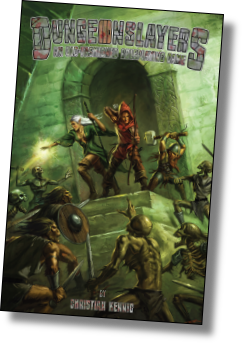
Dungeonslayers – So much for so…nothing.
Review by Guest Blogger Kelly Davis
 While the dinosaur in the fantasy RPG room is going through yet another edition change, its former third party provider fills the void with an ever increasing pile of books, and yet others attempt to recapture the old school, GM focused days of yore – we the consumers are left with many, many options to satisfy our fantasy RPG cravings. I don’t think we’ve had this many choices in quite some time.
While edition wars rage on, supplements fill the shelves and 70’s van art enjoys a renaissance – most of our lives haven’t changed. The economy still stinks, we have kids, demanding jobs, and houses under the curse of entropy itself. Many of us simply don’t have the money to spend on another pile of books, or the time to invest in a game where fights take an hour or more to complete and you need to be an engineer to devise an encounter.
One German gamer apparently felt the same way, and unlike most of us, he did something about it. Christian Kennig made his own roleplaying game; his own FREE roleplaying game. It’s on the web. It’s in PDF and printable, and most importantly, it’s under the Creative Commons. That means that not only can we play it, we can help contribute to its future.
It’s called Dungeonslayers and while the title may put the game into a box, the rules system does anything but. Designed to be simple, quick to teach and learn, and customizable; the Dungeonslayers rulebook clocks in at 170 pages, and only 10 of these are rules. The rest is character creation, equipment, talent and spell lists, a bestiary, treasure, game mastering tips, a sandbox campaign world and a trio of adventures.
The Basics
The game only uses one die: The 20 sided. It’s used a little differently than you may have used that die before. You are looking to roll equal to or under a target number, usually determined by combining a primary and secondary ability score (plus or minus various modifiers). A success is a success, but you are really shooting to get as close to your target number as possible. Why? Well, in combat – your roll, the one you used to roll to hit? That’s also your damage.
What’s that, you say? Let’s say you have a melee attack score of 14. You want to attack that goblin. You roll your d20 and get a 12. You do a potential 12 points of damage to the goblin. He gets to roll a defense roll, using his defense stat as his target. He has a defense of 7. He rolls a 2. That reduces your 12 by 2, or 10 damage. Since he only has 8 HP, he goes down!
Remember the joy of rolling a 20 in D&D? That’s a critical hit! Not so in DS. A 20 is a fumble. You drop your weapon, your skill check fails, sometimes other bad things can happen – like your shield breaks. (Yes, you can fumble defense rolls too.) If there are fumbles, you know there are critical successes, too. They are called ‘coups’ in DS and it’s whenever you roll a 1. When you roll a coup, you get your target number as a result. Have a 14 melee attack score, it’s like you rolled a 14.
DS doesn’t require a battlemap, figures, tokens or things like that, but it also works well with them. Everything is in meters. Dungeon maps use 1 meter squares, movement is in meters, so it’s pretty straightforward. There are optional rules for sighting, multiple opponents, wielding two weapons and more. So if you crave that tactical detail, you can have it.
Characters
The character choices are deceivingly simple. You pick from one of three races: Dwarf, Elf or Human. Each race grants you certain perks. They follow the expected tropes familiar to fantasy gamers. Dwarves are tough, Elves are nimble, Humans are skilled. Your choice grants you a bonus to your abilities, too. If you feel too pigeonholed by only three races, there are race creation rules in the back of the book.
 After you select your race you choose your class. There are three classes to choose from: Fighter, Scout and Mage. If you select mage, you must select from Healer, Wizard or Sorcerer (Think white, gray and black magic). “Where is the ranger?” “What, no paladin???” you might be asking. Hold on. I’ll get to that. Think of your character as your swim lane for future specialization. Right now choose if you want to be ‘fighty’, ‘shooty/sneaky’, or um…’magicy’. Your class grants you yet another bonus to ability and helps determine what talents you can select as you advance in level (We’ll get to talents in a moment).
You have 3 primary Attributes – Body, Mobility and Mind. These values will most likely never increase. Each attribute has two related traits. These 6 traits should sound somewhat familiar to most gamers: Strength, Constitution, Agility, Dexterity, Intelligence and Aura. These are the abilities that your race and class bonuses are assigned to, and you can increase through advancement.
There are also several derived stats called “Combat Values” that use cute little icons to help you identify them on your character sheet and in the bestiary. The calculations are explained both in the rulebook and on the character sheet and you may refer more to these than your attributes and traits while playing. Things like Hit Points, Defense, Initiative, Movement rate, attack values and spell casting ability – some of which affected by the armor you wear.
In almost every action you perform in DS, you determine your target number by adding the values of an attribute and a trait, modified by conditional effects, equipment modifiers, and more. So when you are choosing your race, class and assigning your abilities, you need to think about the typical actions you’ll be performing and adjust accordingly.
You also start with a talent (or 2 if you are human). These are somewhat like feats in some editions of D&D. There is a large list of talents, both combat and non-combat in nature, that grant bonuses to tasks. You can take some of these multiple times as you advance, increasing the bonuses.
Leveling
Advancement comes very fast at lower levels, you get experience from defeating enemies, exploring rooms, achieving adventure related goals and even some for roleplaying. When you level, you get points to spend to raise your traits, your hit points and gain/improve talents. When you reach 10th level you may choose to change to a ‘hero class’. These classes represent some of the traditional themes we love so much in our fantasy gaming. There are 3 heroic classes for each base class. Fighters can become Berserkers, Paladins or Weapon Masters. Scouts: Assassins, Rangers and Rogues. Each type of mage (Healer, Wizard and Sorcerer) have three as well, like Druid, Elementalist and Blood Mage! Picking a Hero class opens up some talents unavailable to any other classes and really helps you define your character’s role in the party.
Game Mastering
The game master has a lot of help in designing adventures for DS. First, there is a large bestiary filled with some of the traditional creatures encountered in any good fantasy game. There are guidelines for creating tougher, more seasoned version of monsters. Each monster has a “Foe Factor” to help you determine if your adventuring party is ready to fight them and if so, how many at once.
Treasure tables abound, making on-the-fly gaming much easier, as you can roll random loot after the encounter. The monster ‘stat block’ includes suggested treasure table choices as well.
The rulebook includes a brief introduction to the DS campaign world “Caera”. It’s a small but varied world filled with all the types of locations you’d expect. The game designers intentionally made it a small world, to encourage you to run a forest game one week, a city game the next, a desert adventure after that – and avoid explaining how your characters trekked thousands of miles to get there. There are lots of interesting little ruins and enticing locations on the map, guaranteed to start the seeds of adventure.
There are also three adventures in the book as well. Each one designed to be played in one session. On the DS website, there are about a dozen more adventures, each one page in length. Most are simple dungeon crawls and they provide a night’s entertainment. The maps and icons are common among these adventures so they are easy to pick up and run without ANY prep time on the GM’s part.
Licensed to Create
The creative commons license (which basically says make what you want for this game as long as you offer it for free) really inspires people to design more cool stuff for DS. It’s been around in Germany for a few years, so there is a lot of material in German waiting translation. Some of the materials are promoted on the DS website. There is a whole new spell system you can try out, for example. In Europe, people have taken the skeleton of the DS system and used it for other classic RPG genres including: Zombieslayers (modern zombie apocalypse), GammaSlayers (mutant future apocalypse), and DS-X (an X-Files/conspiracy/MIB type setting). I can’t wait to see these translated into English! Play with this system a few times and you will want to create something with it too.
Summary
What can I say? I love this little game. I love that it’s one booklet, I love that it’s free, I love the open license, I love how quick it plays and what little time it takes to prepare for. There is absolutely no reason not to download this and let your gaming group know about it. Will it replace all those other fantasy games out there that we’ve shelled out hundreds of dollars for? Maybe not, but I guarantee you that you will have as much fun (or more) playing it. It is a great ‘go to’ game for when your gaming group can’t all get together, or for when your GM needs a break, and it would make a great game to run at conventions. So what are you waiting for? Go to www.dungeonslayers.com today.
Bio
Kelly Davis has been playing roleplaying games for most of his 40 something years. Most of that time has been spent as a game master. He works as a contract system analyst for General Motors and is happily married with two creative kids who he is hoping will take up his hobbies. His favorite games include D&D (all editions), Gamma World, Savage Worlds and now Dungeonslayers!