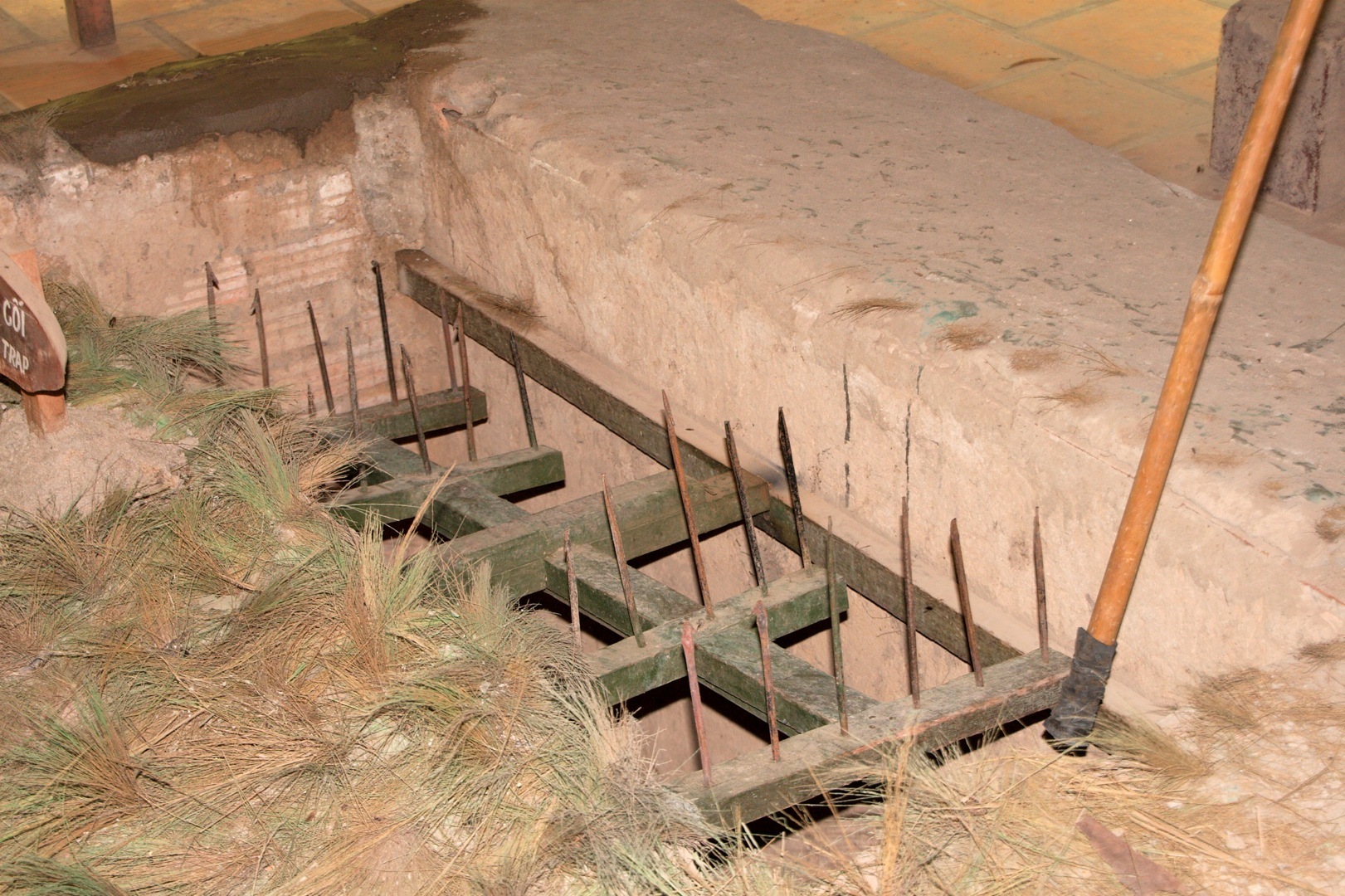
Traps for DCC RPG

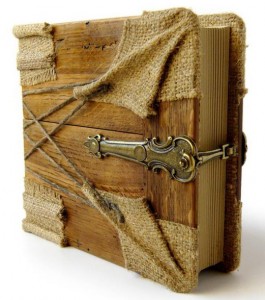
photo courtesy Christian Haugen

I have been going through some of my writing folders and finding some of the gems that have yet to see print.

Today it is a series of traps I wrote up to go along with the Critical Hit Trap Table I wrote back in early August. I actually have cleaned that table up a bit since its original publishing, I will post that update in the near future.

The traps below all use Attack rolls, making them perfect candidates for use with the critical hit trap table!

The Traps

Spiked Step: A pressure plate is engineered on a step (find / disable trap DC 15) on a flight of stairs, when depressed multiple spikes punch horizontally outwards (Atk +4, dmg 1d6) from the step behind the person’s leg.

Pit Trap, Spiked: A 10′ pit is concealed with a faux stone cover (find / disable trap DC 12). PCs that do not find the trap must make a DC 12 Reflex save or fall into the trap for 1d6 damage. The pit has numerous spikes at the bottom. 1d4 spikes could impale the falling character (Atk +3, dmg 1d4 per spike).

Poison Needle Lock: An intricate lock (pick lock, DC 16) that is also protected by a poisoned needle (find / disable trap DC 13). A failed pick lock or disable trap check will trigger the needle (Atk +6, dmg 1d4 plus poison: DC 14 Fort save or -1d4 Stamina).

Scythe Hall: Four slender scythe blades are recessed in the ceiling of this hall in 5′ intervals (find DC 20). A portion of the floor under the fourth scythe is weighted in a manner to cause all four scythes to swing downwards at the same time (find / disable trap DC 18). Failure to find the trap or disable it triggers the trap, each scythe targeting the character in that square (Atk +8, dmg 1d12)

Falling Block: A large stone block is rigged above the doorway of a closed door. Opening the door without finding the hidden lever (find / disable DC 15) triggers the trap. The large block falls from the ceiling potentially crushing the character opening the door (Atk +15, dmg 4d6).

Poison Arrow Trap, Repeating: Failure to find or disable (find / disable DC 16) this trap results in one arrow being fired every round for 6 rounds. (Atk +6, additional +4 if standing in doorway, dmg 1d6 plus poison: DC 13 Fort Save or -1d3 Stamina)

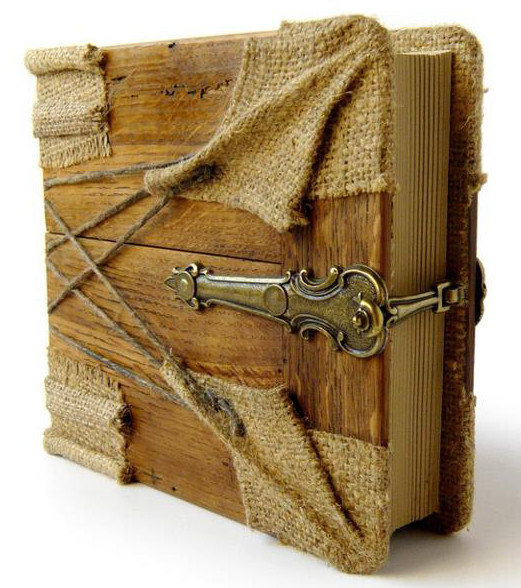
Grimoires for DCC RPG

What follows is a write-up I did a couple of months ago on Grimoires. It is time it saw the light of day!

About the Grimoire

Wonderful opportunities are often lost when characters find a grimoire of a vanquished wizard or left long forgotten in a subterranean tomb. All too often the Judge simply says “you find his grimoire, it has, uh… a red cover and some pages in it. It is sort of thick… and smells old.” He then rattles off a list of spells it has or maybe makes the character spend some time and resources to read the magic within before rattling off the spells within.

Grimoires have a myriad of appearances and they have history. Who used to labor over this book? Who made the notes and diagrams within? Who eventually created this book after long hours and days of research that finally resulted in a usable spell?

The grimoires detailed below are a tool for the Judge to use when he needs to drop in a found grimoire. The books have names, sizes and enough description to make them different from each other. Each grimoire also has a short history with it, sometimes with the name of the previous owner and others with a vague look at its history. Finally each grimoire has a list of spells it contains, each from the DCC RPG rulebook.

These are tools. The judge is free to modify as they see fit. Too many spells in the book or ones you do not like? Replace with what you feel is more appropriate or perhaps more of the pages are damaged than I thought, rendering some of the spells unusable. The history portions should fit in with a multitude of campaigns, but freely adjust to something more appropriate for your campaign or use the details here to start off a new quest. Use these tools in their entirety or modify as needed to fit your campaign. 

The Grimoires

Manual de Rattus
Dimensions:  9″x12″x1.5″
Weight: 3lbs
Description: Fine fur of a rat, dusty brown with flecks of white, cover this grimoire on the front and back cover. A cured rat’s tail acts as a leather thong to clasp the book closed, wrapped around a small brass post on both the front and rear cover.

The pages within the tome are thin sheets of leather, the writings of magic scrawled across the vellum-like sheets. The contents appear to be a mix of half-finished formulas and diagrams amongst what certainly appear to be complete spells. The majority of spells appear intact, though some damaged and torn pages litter the book.

History: Master Endgellan, a naïve wizard who sought the power of the rat-men from ancient times, previously owned this grimoire. Master Endgellan long-sought the location as proof of this ancient races existence and finally recovered it from the long lost burrows far beneath the Old City. Within months of discovery Master Endgellan succumbed to disease before unlocking the secrets of this tome.

Spell List: Level 1: Animal Summoning, Spider Climb, Ward Portal Level 2: Monster Summoning, Strength Level 3: Haste

Grimoire of the Void
Dimensions: 6″x9″x1″
Weight: 1lb
Description: The cover of this grimoire is composed of a fine-grained soft leather, blacker than the black between the stars. The cover of this pitch-black grimoire appears to absorb the light of an illuminated room, casting it into shadowy light regardless of light source.

The pages within the grimoire are also black. The legible writings are a cross between white and silver in color easily viewable even in darkness. There appear to be several complete spells amidst the partial work of the book. A large amount of the notes in the grimoire appear to be diagrams of the stars at various points of the year. Several constellations depicted in the tome do not exist in the present day sky.

History: Few have been able to retain ownership of this tome for more than a year or two. Finders are frequently puzzled by this grimoire for its innate ability of the book to seemingly absorb light. Upon further study over time the owners of this tome are driven to madness and frequently choose to abandon this grimoire of their own accord before unlocking its secrets.

Spell List: Level 1: Chill Touch, Force Manipulation, Patron Bond Level 2: Detect Invisible, Phantasm, Scorching Ray Level 3: Dispel Magic, Planar Summoning Level 4: Wizard Sense

Ironbound
Dimensions: 1.5’x2’x4″
Weight: 15lbs
Description: This massive grimoire is immense in size and weight for a wizard’s tome. Thick iron bands edge the corners of this red leather grimoire and two thick clasps with locks keep the tome shut (Pick Lock DC 18). The iron bands have bizarre etchings in them, a series of intricate patterns and symbols.

The pages have rust-red gilded edges and the paper appears woven with thin strands of metal that glint under any source of light. The words of the spells are written with great care, extremely neat and legible.

History: Arcane master Tzekien Carlastra had a deep interest in the manipulation of the elements. His studies were meticulous in nature and he always sought to retain control of his magic and not fall whim to the powers that he called upon. Tzekien managed this delicate balance between knowledge acquisition and self-control for many long years. His career was ended when an elaborate heist was planned in a raid on his laboratory that resulted in his untimely violent death and the disappearance of his primary grimoire.

Spell List: Level 1: Ekim’s Mysical Mask, Flaming Hands, Read Magic, Magic Missile Level 2: Fire Resistance, Scorching Ray, Shatter, Phantasm Level 3: Fireball, Gust of Wind, Lightning Bolt Level 4: Control fire, Transmute Earth Level 5: Magic Bulwark

The Black Flower
Dimensions: 7″x7″x1″
Weight: 1.5lbs
Description: A black lotus upon a white background decorates the cover of this square grimoire. The cover of the tome is soft like the petal of a flower, though not nearly as fragile. An almost sweet, though stale, smell rises from the open pages of the grimoire.

The grimoire’s pages are surprisingly thin and quite fragile in appearance, though only in appearance, as the pages are quite resistant to tearing. The stale, sweet smell is quite strong near the pages themselves. The pages are full of writing all the way to the edges. The ink used is slightly raised and black as pitch on the white pages.

History: This grimoire was lost to the Cult of the Black Lotus decades ago. Previously having belonged to one of their high arcanists, the grimoire disappeared shortly after his assassination from within the cult. The tome never surfaced after the assassination and its disappearance a mystery to those of the Cult of the Black Lotus.

Spell List: Level 1: Feather Fall, Mending, Ropework, Sleep, Color Spray, Chill Touch Level 2: Levitate, Locate Object, Spider Web, Wizard Staff Level 3: Demon Summoning, Lightning Bolt, Slow Level 4: Control Ice

Grimoire of the Root
Dimensions: 9″x12″x2″
Weight: 4lbs
Description: This bark covered grimoire emanates a distinct cedar smell. The grimoire is quite rough to the touch and has several thin vine-like tethers keeping the tome shut. Of a manageable size the heft of this volume seems added to by the thick bark cover of the grimoire.

The pages inside are quite rigid with very little give. They feel more like smooth balsa wood than paper. The words scrawled across the pages are carved into the pages as opposed to written upon the pages.

History: The grimoire formerly belonged to a neophyte follower of the world root. The tome became ownerless due to an unfortunate accident to neophyte follower involving sudden flames and destruction of the follower’s laboratory. The grimoire found its home with another world root follower, but was eventually misplaced becoming lost for several years.

Spell List: Level 1: Charm Person, Comprehend Languages, Magic Missile, Mending

When the Dice Turn Against You

The Scenario

In my last session of Dungeon Crawl Classics RPG I ran, what I thought was going to be a fun encounter almost turned into a TPK. With that said, it was still a fun encounter, just much more deadly than I had thought it would be.

I am running the group through Sepulcher of the Mountain God from Purple Duck Games. It is a fun little module and I worked it into the Sunken City campaign by staging a little “favor” the two wizards owed their patron. The patron did not really give them much of a choice about it.

We started last night’s session off with the group plunging deeper into a set of caverns. One character got caught up in a nasty trap, but the group recovered and continued on. While investigating a precipice they were ambushed by several creatures. The creatures had surprise and then won initiative. That right there should have been a sign that things were about to head south quickly.

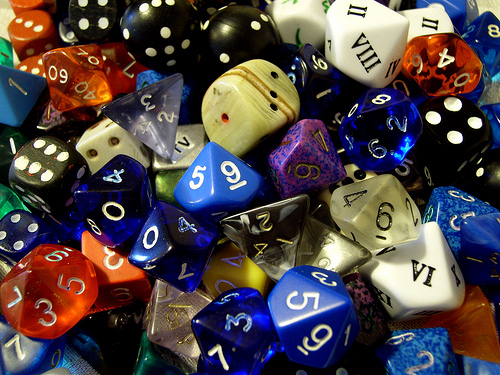
In addition to the creatures winning init and effectively getting two attacks in a row, my dice rolls were on fire. I don’t think I ever rolled much below a 17 and when I did it was a 14 or so against a low AC wizard. Before the party ever really had a chance to act, three of the characters were bleeding out on the ground. None of the enemy combatants were down.

When the PCs did get their chance to act, they couldn’t roll above a 5 or 6 it seemed. Certainly not high enough to actually hit one of the creatures. The next round was another round of my rolls being high and theirs being low, though not quite as bad, they still couldn’t take any of the creatures out.

The group started getting desperate and several heroic attempts were made through lots of Luck being spent and wizards spellburning their lives away. I was nearly ready to have the creatures do something unusual flee into a pit, as if they were just passing “through” the party, but my players are hardcore and wanted the dice to fall where they may.

So we did. The wizard managed to get a nice Invoke Patron off which helped get another combatant on the field and draw some of the attacks. Then he enlarged it the next round which also helped. The others took advantage of the newfound cover and the party did turn the tide.

In Dungeon Crawl Classics RPG there is a “recover the body” rule that allows a body to be “rolled over” up to an hour after they fell. The character makes a luck check and if successful it turns out they were only knocked out. They awake with one hit point and lose a point from a physical ability score determined at random.

Each of the three characters made their Luck check, so in the end it worked out okay. The party was pretty beat up and did end up spending a good amount of time resting to recover some health, spellburn damage, and spells.

The Thoughts

I am not a judge or GM that is necessarily afraid of killing characters. I am probably softer than I was in my initial comeback to gaming, but I certainly like for their to be risk for characters and for them to feel like they earned something. As it turns out my players for this particular campaign are pretty content to let the dice fall where they may – even if it means a TPK at the hands of an encounter that really was not intended to be a pinnacle encounter of the adventure.

During the game I think this is what made me hesitant as it looked like this encounter was going to be a TPK. It wasn’t that the characters had made bad decisions that led to this. It was that bad luck moment where their dice went cold and mine went hot.

The combination of those two things can be a deadly turn of events for characters and campaigns. It was that combination that made me feel a little guilty for how things looked to be headed. Who wants to see their characters die at the hands of a few 2HD chumps?

As it turns out, the remaining characters were able to regroup and pull things back out of the fire. They saw my hesitation as judge, but acknowledged to let the dice fall as they may.  I did that. The creatures kept up with their attack and by the end the heroes were once again victorious. And I think by the end they felt like they had really earned that victory.

From here on out I know with this particular group that they want no holds barred. I think that is great and I am happy to run that game for them. I am not sure all groups would have been okay with how things were headed and might have wanted some GM fiat to bail them out. Not my DCC RPG group, which is probably why we are playing DCC RPG.

What would you have done?

So what would you have done? Killing a party is well and good, but when that bad luck combo of the player’s dice going cold while the judge’s dice go hot? Does that make you think of altering the creatures’ actions a bit or would you have stuck with it?

How about as a player in that situation? Would you have preferred the judge intervene a little bit or would you have wanted to roll with it like the group I run for on my Tuesday night game?

Review: Crawl! Issue #5

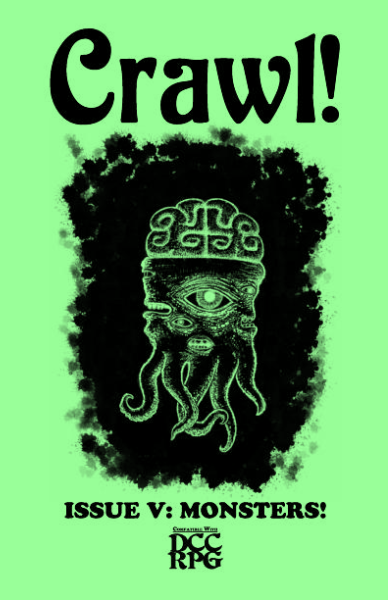
This issue of Crawl!, the Dungeon Crawl Classics RPG fanzine wrangled by Reverend Dak was released in early November. I am running a little behind on getting my review of it posted! This issue is the monster themed issue and weighs in at the standard 24 pages in length. Crawl! is only available in paper form, though it is a welcome form of mail when my subscriber issue arrives!

What is Inside?

The issue opens with an article called Monsters with Class by Reverend Dak himself. This article covers adding class abilities to NPC monsters. These are guidelines to quickly apply class abilities to monsters that do not otherwise have them. They include boosts to Hit Dice, Saves and some additional abilities depending on how many Hit Dice the monster has. This is another example of keeping things simple and manageable with a minimum amount of prep time for an upcoming session.

Next up we have an Orc class. With a brief background on the orc culture the article moves into the mechanics of hit dice, weapon training, rage abilities. The article is complete with orc titles and a level progression chart.

Jeremy Deram’s DCC Monser Helper is included as the center spread in this issue. A series of charts that allow one to generate monster stats quite quickly based on type of monster (animal, dragon, fey, giant, undead, etc). Hit die values, attack bonuses, and which saves are good and which are bad are all noted. An additional chart helps calculate the saves and attack bonuses based on the initial table. I have used the web version of this table before and it is quite handy.

Consider the Greenskins is an article that puts a twist to classic D&D monsters – goblins, hobgoblins, and orks. This is just one example of how standard monsters can be “tweaked” a bit to make them unique to your DCC RPG campaign. Efforts such as these keep the players guessing and offers built-in plot points on how these creatures came to be.

Wandering Monster tables are included for levels 1 through 5, an article previously published by Jeff Rients on his blog. Certainly handy to have and a starting point for a judge wishing to tailor some wandering monster tables for their own campaign.

The final pages include four new monsters from two authors, Brad Littman and Colin Chapman. We get one page write-ups on the Fung-Eye (I will leave the visualization up to you!), the Stonecrawler, and a pair of monstrous canines.

The Standouts

As usual there are several standout articles in this issue of Crawl!. Monsters with Class is a good article that will help those who might be uncomfortable adjusting things on the fly. Just enough guidelines to let people know you don’t need pages and pages of complex rules to give short-lived monsters or NPCs class levels.

Wandering monster tables and the Quick Monster Stat articles are also useful articles, though both have been published on the web via blogs in the past. For those that have not discovered them previously they will prove quite useful.

I really enjoyed the monstrous canines which include the blood hound and gloom hound. Both are well-described and interesting monsters. Each includes a possible seed for a judge to use to introduce them to their game as well.

Several new art pieces were sprinkled about the issue. I really enjoyed Daniel Bishop’s piece Jason Adam’s artwork.

I was not a huge fan of the orc class for PCs. I should note that I think the write-up was good, I am simply not a fan of classes that stray too far from traditional classes. Perhaps simply naming it half-orc would have helped me clear that mental hurdle! I am sure some will be fans of the article and appreciate the new class.

The stonecrawler monster struck me as a little unusual and of questionable use. With its very slow movement rate and little inclination to attack, much less defend itself I am not sure it has a lot of value. Interesting concept, just not sure it merited more than an environmental hazard.

Overall, another fun issue of Crawl!. Looking forward to Issue #6!

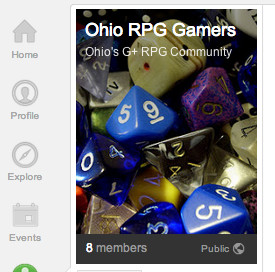
Ohio Gamers G+ Community

Quick post on this Thursday night that actually has limited audience appeal. Google+ released their Communities feature tonight. Likely if you are a G+ user you have been inundated with invites for various RPG groups. The RPG community is very strong on G+.

I have created a community for Ohio RPG Gamers on Google+ Communities. If you are an Ohio gamer or have friends in Ohio, give them a heads up. The group has categories for major regions in Ohio. Feel free to use this group to discuss RPGs, plan meetups in your area, plan meetups at local cons, or even plan some online games made up of Ohio folks!

The Ohio RPG Gamer community group is here:

https://plus.google.com/u/0/communities/101745044949056769846

Rolemaster: Playing with Magic

The post below is written by UbiquitousRat, a guest blogger for The Iron Tavern.

Having played a few sessions with the new Rolemaster playtest rules it’s probably time to tell you a little about how the new system’s magic has been working out.

Spell Law, as described in the earlier article, presents magic through three distinct yet interconnected Realms of Magic. These are the Essence, Channelling and Mentalism realms. In our campaign we have five heroes, four of whom have access to spells; the Ranger and Paladin are both of the Realm of Channelling, the Dabbler is of Essence, and the Mentalist is (unsurprisingly!) of Mentalism.

Low-Level, Low-Power… Yet Useful…

We’re playing at Level 2 right now, having taken the heroes quite quickly up from Level 1. This means that the spells available to our heroes are relatively limited in power.

In Rolemaster you can have a maximum number of Ranks in a Spell List equal to twice your current character Level. Thus, at Level 2, our heroes can potentially know each Spell List up to the 4th Level Spell. Casting spells above your character level is harder but possible, so some of the heroes have taken advantage of this. It’s important to realise, however, that each Spell List must be developed in the same way as any other skill: by spending precious Development Points as you ascend the Levels; this increasing your Rank in each Spell List can be expensive, especially for professions like the Ranger or Paladin who pay more than, for example, the Mentalist per Rank.

So, how useful is the magic proving? In short, very useful.

There has not been a single session so far in which each spellcaster has not opted to use their Spell Lists at least once. Magic in Rolemaster augments the abilities of the heroes, so it is sometimes a minor benefit… but any benefit is precious, especially at low-level.

An example:

Lykos (the Mentalist) is absolutely dreadful in a stand-up fight: as the son of a merchant family with minimal interest in the matters martial, the character can barely manage a Short Sword with a +10 bonus. In combat, however, Lykos has been standing back and using his Mind Attack spell list (which he has 3 Ranks in).

Mind Attack includes three great spells for combat: Jolts I, Hesitation, and Minor Pain. The first of these, most commonly used by Lykos, stuns the target should they fail to resist it. This means they can’t act for a round… which allows Lykos’ compatriots to clobber them without much threat of reprisal. It might not seem like much but in a fraught and dangerous fight, Lykos can actually deliver this spell repeatedly against a lone target with little trouble, effectively neutralising them. The other spells, while more potent, deliver similar augmenting effects: Hesitation slows reactions in Initiative, and Minor Pain zaps 25% of the target’s Concussion Hits. Ouch!

Risky, but Not That Risky

The other main thing to note about magic is that it always carries the risk of a Spell Failure, and thus a roll on the Spell Failure tables to see what happens… but only rarely disrupts play in a significant way. Thus, even with riskier higher-level castings, the players are able to make an attempt and judge the risks for themselves. We’ve had one disastrous moment when the Ranger found himself reasonably harmed by a spell failure, but nothing (yet) big enough to really deter spell use. This has meant that the guys feel their spell lists are worth the investment.

No Pesky Spell Limits

Finally, it’s worthy of note to say that the artificial spell limits of old D&D, such as so many spells per day, is not a part of Spell Law. The limit is set by your Power Points total, which you can invest in to improve and which is easily managed.

Certainly, sooner or later, your hero will run out of juice and have to stop casting. This is good game design which simply forces players to manage a resource. Yet you don’t ever feel desperately short of a spell unless you’ve been utterly reckless with your casting.

Magic used when needed, wisely and with care, is a constant support to the group. So far, at least, we’ve not come close to running out of Power Points.

Verdict?

We remain positive about the new Rolemaster. There are little niggles, such as the Initiative system, which we opted to simplify using the options in the game, but on the whole it’s playing well.

As for magic… well, it’s potent in a non-flashy kind of way.

Just take it from us that a well-placed yet seemingly innocuous power can prove decisive. And, to our minds, that’s the stuff that good roleplaying is made of.

Game on!

Revised Bio:

UbiquitousRat is a long-time roleplayer and gamesmaster who has a history with gaming going back to 1979. In 1994 he joined Games Workshop, spending 12 years in the gaming industry at the coal-face of tabletop wargaming. In 1998 he founded the Friday Night Roleplay group at his home in suburban Nottinghamshire, UK, and ever since has been the primary GM. Oh, and he’s also a high school teacher during the daytime.

Teach Your Kids to Game Week

Teach Your Kids to Game

Teach your kids to game week started yesterday. By now you have surely seen posts from various blogs, social media networks, and forums mentioning this occasion. This is the second year for the event that was started by DriveThruRPG.com. DriveThru has a product page up with several options to help you get started with teaching your kids to game.

I am most familiar with Argyle and Crew written by Ben Gerber and published by Troll in the Corner. But there are several more options there, some free for download. The list also includes rpgKids which always seems to get positive comments on Twitter.

Kids and Gaming in Practice

My two kids both game and both started at an early age. Games can be anything from RPGs, to Uno, to Carcassonne, to Zombie Dice, and more. Given this is primarily an RPG blog, I will focus on on the RPG aspect of gaming.

My older son got his start with playing a loose form of D&D minis several years back. This quickly evolved into actual RPG gaming. His first experience was with the D&D 3.5 Starter Box which as a little hit or miss.

A little later I introduced him to my own simplified Pathfinder game. By simplified I mean I chose his feats and skills after asking him how he pictured his character. Using that feedback I helped build him a character to fit that image. This worked pretty well and the interest was sparked.

Eventually his sister became interested and we did the similar thing with her. She’d describe what kind of hero she wanted to play and I built it for her. We handled more of the dice rolls from her, but she had a good time playing.

Later on the Pathfinder Beginner Box was released and we switched from my heavily modified Pathfinder for kids rules and went to that product. We had great success with this and within a short period of time my son was running his own games for his sister and I (and doing a good job!).

From there my son has played a couple of different systems. Over Thanksgiving weekend I introduced him to larger group gaming with a Dungeon Crawl Classics RPG one-shot and this past weekend he helped me playtest a module I am working on. He is quite the budding gamer!

Benefits

If you are reading this blog you are most likely an RPG gamer. Sometimes it is easy to get caught up in our own gaming and forget to spread the hobby around a bit. You would be surprised at how young a kid can be and start to pick up the gaming bug. I’ve had my son playing since about the age of 5 or 6. His sister has been playing since just before she was 5 (admittedly, she does it more to be social than love for the game at the moment).

Gaming is a great way to be creative and to tear the kids away from the screentime of television or computers. It is sometimes a gateway to them wanting to learn more about areas of history or technology.

Beyond all of that, it is a wonderful way to spend time with your family. It is moments like these that will really count for your kids or even kids in your extended family. I know I am guilty of sometimes spending too much time writing or prepping for a campaign. Take a moment to breathe and share the gaming bug with your kids or your nieces and nephews. They will be moments they will always remember and it will help grow their world.

Holiday Gift Guide 2012

With gift giving season in full swing, The Iron Tavern releases its inaugural Gift Giving Guide for the 2012 Holiday Season. If you have a gamer on your gift buying list or are a gamer looking for some ideas perhaps there is something on this list you do not have yet.

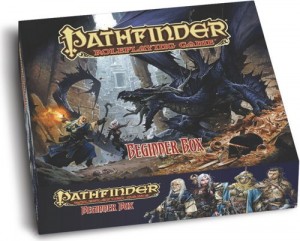
Pathfinder Beginner Box

Leading off the list is Paizo’s Beginner Box. It was about this time last year that The Iron Tavern was playing this game frequently. I used it as an introduction of an eight year old to the game and he was soon running his own games based on the rules in this boxed set.

This is the strongest boxed set offering to get new people into RPGs since the old D&D Basic Red Boxes. Others have tried, but Paizo has succeeded with this release. With easy to read, colorful rule books, flip mat, monster tokens, and dice this box has what a new gamer needs to get started playing the game. The Beginner Box can also offer an easier point of entry to the Pathfinder rule system if the size of the core rulebook has made you hesitant.

Give this generation of kids the same chance to start gaming as you had. Get this boxed set under the tree for a youth on your Christmas shopping list.

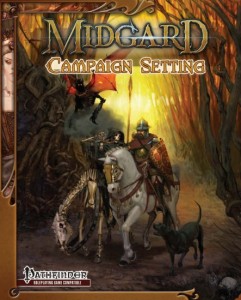
Midgard Campaign Setting

For the established gamer or even a new gamer looking for a published campaign setting to start out in, the recently released Midgard Campaign Setting from Kobold Press is a great offering. This is Open Design effort to bring Wolfgang Baur’s home campaign world over the years to life. The result is a wonderful balance between providing the framework for an interesting world and leaving room for the GM to create within.

With the Seven secrets of Midgard revealed up front a GM is brought up to speed on what makes Midgard unique quickly. Ley Lines, clockwork races, airships, and more all add to the setting.

The book is a wealth of adventure ideas for a GM whether they choose to use the campaign setting in its entirety or not. This book is sure to provide a GM with inspiration for their own homebrew setting or a home for their players. Certainly one of the top campaign settings available today.

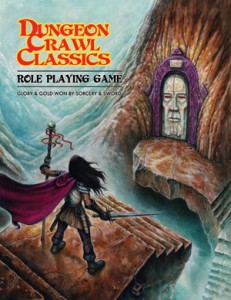
Dungeon Crawl Classics RPG

Need a break from your regular d20 game? Maybe a change of pace? Or simply yearning for the dungeon crawling days of our youth? Take a look at the Dungeon Crawl Classics RPG from Goodman Games. Best summed up from the product page:

You’re no hero

You’re an adventurer: a reaver, a cutpurse, a heathen-slayer, a tight-lipped warlock guarding long-dead secrets. You seek gold and glory, winning it with sword and spell, caked in the blood and filth of the weak, the dark, the demons, and the vanquished. There are treasures to be won deep underneath, and you shall have them.”

I have been playing this game since mid-summer through a series of one-shots and a campaign I am running on Google+. The game has proven very fun. The randomness of magic, critical hit tables, fumble tables, and more really push the established gamer out of their normal routine. The result is great roleplaying and exciting encounters.

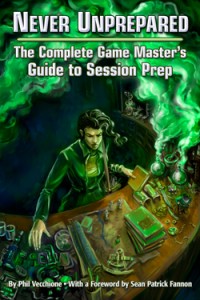
Never Unprepared

Never Unprepared – The Complete Gamemaster’s Guide to Session Prep is the latest release from Engine Publishing. The book is a handbook to preparing for gaming sessions a GM when time might be limited. Many of us have jobs, families and other responsibilities that all make claims to our time. As GMs we need to do more than just show up to game night, we have to have a session ready to run.

This book helps break down the elements of session prep into manageable chunks. Many of these chunks can actually be done while waiting in line at the store, driving to work, showering, or a myriad of other places. Leaving a handful of tasks that require more blocks of time. This book helps make the most of these blocks of time. Several of the tips in this book can be applied to other areas of your life as well – either as an aspiring writer or simply getting home projects done.

GMs tend to focus their buying on RPG materials that provide content or rules for their systems of choice. Never Unprepared fills a niche often overlooked by GMs and makes a great gift for your harried GM.

Chessex Battlemat

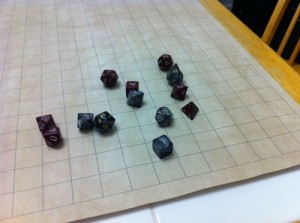
There are many battlemat options out there and I have tried a lot of them. From Tact-Tiles to flipmats a good old fashioned wet-erase battlemat remains high on my list of preferred battlemats. They roll up and handle transportation to the game well. Wet-erase lends itself well to pre-drawing the maps prior to the game session without fear of smudging. Nothing seems to beat my Chessex Battlemat.

The Chessex mats come in three different sizes from their smaller Battlemat to their mid-sized Megamat to the super-sized Mondomat there is a mat that fits your need. While a good many of GMs have battlemats already, if your GM lacks one, the Chessex battlemat is an old reliable mat that will be there for you when you need it.

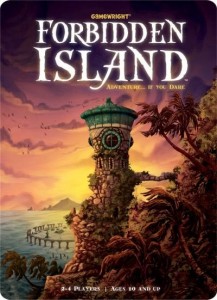
Forbidden Island

The last entry in the Holiday Gift Guide is actually a board game. There are always those nights where the game gets some last minute cancellations and the remaining members of the group needs something to do. Forbidden Island is a cooperative game that is easy to learn. Designed by Matt Leacock for Gamewright the game has been a success anytime I have broken it out.

Your group of explorers must recover the four lost artifacts from the flooding island before it sinks. Working together the players recover the artifacts and meet at Fool’s Landing to be flown off the island. As the game progresses the island begins to flood even faster.

I have played this game with non-gamers at family gatherings and with kids as young as 5 and had a great time. I enjoy the collaborative nature of the game and there is enough strategy to keep it entertaining.

Wrapping it Up!

And that is this year’s 2012 Holiday Gift Guide from The Iron Tavern! I think there is something in the list for varying types of gamers on your list – from seasoned veteran to someone new to gaming.

Kickstarter Musings

Over at Tenkar’s Tavern, Erik has been keeping track of the timeliness of many of the Kickstarter projects he has backed. He puts each Kickstarter he has backed into one of three categories – significantly overdue, late and has shipped or looking like it is going to be late, and finally on-time. It is good to see someone keeping track of this and posting updates. I know at least one or two of the projects backed that we have in common have been more forthcoming with updates.

I am not going to try to replicate what Erik already has going on. For one, the number of projects I have backed is significantly smaller and he is doing a great job already.

I will post up some of my musings on Kickstarter though. I do think Kickstarter is a very useful tool. It allows people with ideas to present them to a much larger crowd and if folks agree, throw some money their way to make it happen. A great concept and one that does help get some great new content out there.

I think a lot of the smaller operations doing this bite off more than they can chew or fail to accommodate for unexpected success. A couple of things to remember for these smaller operations. This is your moment to shine. Depending on how you handle the delays and hurdles that come up as you attempt to get a product out the door are going to set an impression on a lot of people in a niche hobby.

Updates. Kickstarter provides you with a great way to keep people updated on progress. Use it. So you’ve missed your initial goal. That’s fine, it happens. A lot of people who back things on Kickstarter understand these are people dealing with production processes for the first time. We can be patient. But keep up informed! Tell us it took two weeks longer to get something done or something shipped to you. We’ll understand that.

Maybe you had a family medical emergency involving yourself or relative. Give your backers a heads up. It happens. You might be a one person operation. Just send your backers an update to let them know you have not forgotten them. It is important and will buy you more goodwill than hoping people won’t notice the delay.

How many updates are appropriate? For me if you are running behind on a delivery date, I think seeing a well-stated update every two weeks would be enough to keep me pretty patient. Enough should have happened in the period of two weeks that there should be some progress or reason as to why there wasn’t any progress made in a period of two weeks.

Keeping your backers updated is the single most important thing you can do in my opinion if you are running behind.

There are some things you shouldn’t do too. Or reasons that you are running behind that probably won’t buy a lot of good faith.

The biggest? Don’t start another project and announce it – whether you are kickstarting it or not. People will interpret that as a reason why things are delayed on the kickstarter. That may or may not be true of course, but that is what folks will think. Sure you might be waiting on someone to deliver something to you for you to wrap something up. And maybe you do have some time to get that other project rolling. But announcing that to the public is just going to generate ill-will.

Con crud. We see that one listed as an excuse in an update a lot. Unexpected sickness is a legit reason that something might be delayed. But we’ve all been gamers for a long time and many have attended our share of cons. Build that into your delivery date! Even if you do not pick up some sickness at the con, you know will come off that con-high and have a couple of days getting back in the groove. Remember that if you are planning your delivery date for your Kickstarter.

Set good expectations and keep people updated. These are the biggest things you can do to keep a reputation intact if you see yourself missing delivery dates.

I have a lot of patience with small operations, I really do. I want to see you succeed and I know you might be going through a steeper learning curve than you initially expected. Just keep communicating with us and eventually we will get our product we wanted and you’ll come out with reputation reasonably intact at the end.