Roll20: TSR Endorsement and Tabletop Forge

Roll20, the virtual tabletop, has been having a busy couple of weeks. Last week they released a press release announcing they had surpassed 100,000 users. This week Roll20 has released a press release announcing their endorsement by the newly launched TSR as their “official tabletop”. This week’s press release also announces Tabletop Forge ceasing development and joining in with Roll20!

My comments, particularly on the Tabletop Forge news, follow the press release presented here in its entirety.

ROLL20 GAINS THE SUPPORT OF TSR, TABLETOP FORGE
Application solidifies its status as the preeminent long distance gaming solution
Roll20 LogoWichita, Kansas (January 29th, 2013) – This week two major announcements regarding the popular online roleplaying program Roll20 became public.  The first involved the newly launched TSR company endorsing Roll20 as their “official tabletop,” the second pertained to the lead developer of competing game space Tabletop Forge announcing he was halting production on the program to instead help with future enrichments to Roll20.

“The most flattering part of all this is that they both came to us,” said Roll20 co-founder and lead developer Riley Dutton.  “It really helps make us feel like we must be doing something right.”

The new TSR was formed by Jayson Elliot to cover multiple aspects of gaming, beginning with the launch of “Gygax Magazine” next month.  Elliot was one of the first adopters of Roll20 in the Kickstarter phase.  Additionally, a feature by Roll20 co-founder Nolan T. Jones’ brother, Nevin P. Jones, will be in the initial issue of Gygax Magazine covering Nevin’s first roleplaying experience which was accomplished using his brother’s application.

Tabletop Forge was begun as a Google Hangout application by Joshuha Owen with the purpose of helping the vibrant Google+ roleplaying community to better realize their games.  The Google+ page for Tabletop Forge boasts over 11,000 members, many of whom supported the program’s KIckstarter last year.  However, Joshuha decided that the community would best be served by a single HTML5 solution.

“There are lots of options for roleplaying over the internet, but it became redundant to have both Roll20 and Tabletop Forge, as in many ways they were serving the same community and had similar features including a common goal of being lightweight and easy to use,” remarked Joshuha.  As such, the creators of both programs say they will be treating all Tabletop Forge’s Kickstarter backers as if they had made their pledges to Roll20, migrating Tabletop Forge assets to Roll20, and be working with a multitude of RPG artists to bring their content to the platform.

Roll20 began as an effort to keep developers Dutton, Jones, and Richard Zayas in touch via long distance gaming.  Their project went public with an eighteen day Kickstarter campaign in April of 2012.  Since then it has attracted over 100,000 users as a free service.  The program continues to be funded by subscribers who receive features that assist advanced gameplay.

The news of the TSR endorsement from Saturday’s Gygax Magazine unboxing has been out there for several days already. The TSR endorsement does not come as a big surprise to me. Roll20 is very easy to use and has remained so even as they continue to add more features. I have had very little trouble getting people connected and up and playing with Roll20. Congrats to Roll20 on this endorsement though, it can only grow their player base.

The Tabletop Forge news is the big item for me. My first experiences with VTTs in a Google+ Hangout environment was with Tabletop Forge. Several of my early G+ games were done over G+ Hangouts and Tabletop Forge. TTF development moved at a very rapid pace in the beginning. When they ran a Kickstarter for TTF I pitched in and I pointed several people to the Kickstarter to help support them.

Since then things slowed down from the TTF side. Development appeared to have slowed, art assets were slow to get released, etc. My groups ended up playing on Roll20 and really did not look back.

Joshuha Owen did a good job of communicating in the aftermath of the Kickstarter. Several of his developers who had been helping him left, leaving him with the Kickstarter ball. And though the process was slow, he did get the art assets to people via Google Drive, even if they weren’t integrated with TTF.

I think this move to bring content that was Kickstarted to Roll20 is a good move on Joshuha’s part. It seems like a very eloquent way to bring the TTF Kickstarter to a close and attempt to make everyone happy in the end.

This move will also likely benefit Roll20 rather significantly with an influx of art assets, map tiles, and such that were funded as part of TTF. And it will likely bring them an influx of more users as word gets out that Roll20 is the VTT that will continue moving forward.

BareBones Fantasy in Print

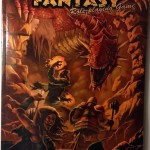
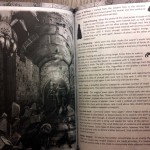
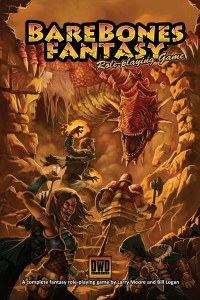
My print copy of BareBone Fantasy arrived today. I ordered it from RPGNow and this is actually the first time I have ever ordered something in print from RPGNow. I am not sure if every experience is like this, but I received my print copy in a very timely manner. Looking back at my order history, I just ordered this on 1/21 and I had it in my mailbox today. Great turn-around in my opinion.

If you hang out in some of the same social media circles I do, you have likely seen mention of BareBones Fantasy. I will be doing a write-up of my initial thoughts on the system based on running a game this past weekend. But for those unfamiliar with the system it is a complete fantasy role-playing game contained in 80-ish pages. It uses a d00Lite system in that it is based on 10-sided dice. Attack rolls, skill checks, weapon damage, and more are all based on rolling under a certain percentage. One golden rule covers the gray areas – “The GM is in charge!”.

I’ve had the PDF since about mid-December. Since I wanted to play this with my son, I wanted to pick up a paper copy. He is not a fan of PDFs and if I want him to read the system he wants to have it in print. Plus the print copy is easier to hand around the table while I run off of the PDF on the iPad.

More in-depth commentary will be coming later this week, but I couldn’t hold off on posting up the pictures of my soft cover copy. hard to believe the whole system is packed into this lightweight book!

Until later this week, enjoy!

Gygax Magazine Unboxing

Gygax MagazineToday’s post was going to be a review of the new Gygax Magazine. I thought along the way they had announced the magazine would be available digitally on Saturday the 26th as well. Looking back over some older interviews, I appear to have misunderstood. It looks like the PDF release will be in about two weeks on February 7th. That is a little disappointing in this day and age. It seems they want the print version to be people’s first experience with the magazine instead of a digital copy.

So instead of a full review of the magazine it will be some of The Iron Tavern’s thoughts on the new magazine based on the unboxing videos from Saturday. First, the look of the magazine will make anyone that read Dragon magazine from the 1980’s do a double-take. The cover, the fonts, and even the table of contents all look remarkably similar to the old Dragon of past years.

I consider the look and feel a good thing. When I think of Dragon magazine my mind always recalls images from the 80’s. The new Gygax Magazine certainly hits some of those same chords.

At this point I can only judge the book by its cover. The content of the magazine will be what reveals whether they also strike the same feel the Dragon magazine of the past had. I hope they do. Kobold Quarterly had been filling the gap for a print periodical and now it looks like Gygax Magazine might be positioned to step into that void rather quickly.

The Table of Contents has been floating around in the Internet for several weeks now. I will not list it in its entirety, but rather highlight a couple of articles I am looking forward to.

Leomund’s Secure Shelter by Lenard Lakofka promises to do some math and reveal which is better, a +1 to hit or a +1 to damage. Even from the unboxing video one could see there were some tables that went along with that. While not a power gamer, I do find the math behind the game interesting and always like reading about it when someone else does the math for me!

Gaming with a virtual tabletop by Nevin Jones lands in an area of interest for me. I play a good amount over a VTT. I always like to see what other people are doing in the virtual space. Perhaps I will pick up some new tricks or maybe it will cover things I already know. But I am always curious to hear how people are using tech in their games.

DMing for your toddler by Cory Doctorow will be interesting to me as well. As readers of The Iron Tavern know, I’ve been playing RPGs with my kids for a couple of years now. I like to see if other people’s experiences match up with mine or not.

There are several other articles that look interesting, but based on a scan of the Table of Contents those three are at the top of my list.

I took the risk and signed up for a subscription to the magazine. Given that US residents get free shipping if they sign up for a subscription and I will want to see at least a couple of issues before I make my final call on the magazine, it seemed like the way to go. I am already looking forward to my first issue arriving in my mailbox.

Once I receive my first issue and read it, you can be sure I will post a more in-depth review on the new Gygax Magazine here at The Iron Tavern.

Mini Review: D&D Basic PDF

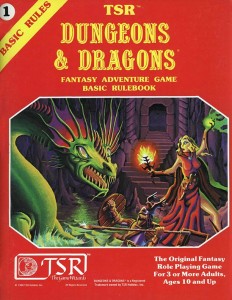
D&D Basic - MoldvayMost RPG fans are aware by now that Wizards of the Coast has started putting their PDF catalog up at DriveThruRPG.com or accessed via dndclassics.com. The latter option is the easiest to just browse the PDFs currently available. I believe they are going to continue putting product up on the site, so if you do not see your favorite product yet – just keep checking back.

In my other posts about D&D reprints, I have said if the Moldvay D&D Basic book was made available I would snatch it up without hesitation. While not quite a reprint, the PDF of the Moldvay rulebook for D&D Basic was one of the PDFs released. Once the server meltdown from the traffic to DriveThruRPG let up, I purchased the PDF that night and spent some time checking out the PDF.

Most are familiar with the D&D Basic set, so this mini-review is less about the content within and more on how does the PDF look and feel. I could not offer an unbiased review of the content, it is the D&D I started with and nostalgia would trump any objective review I could do. Moldvay D&D Basic is my D&D.

The PDF comes in at 7.9MB for my download. That makes it nice and portable, as well as quick to render on both the computer and older iPad model.

The PDF is extensively bookmarked. That makes navigating the PDF very easy. The text is also searchable as we have come to expect from PDFs.

I have seen several praise these PDFs for their scan quality. The scan quality is certainly decent and legible, but on my iPad and computer they do seem a little fuzzy. You can see the text start to break apart on zooming in. Even at 119% in Adobe Reader you can start to see some of the fuzziness creep in. Apparently still a huge improvement over the previously released PDFs and as far as scans go, quality scans. I am just not sure I would rave about their quality unless directly comparing them to the previously released PDF’s quality. Perfectly legible and usable though.

I paid $4.99 to pick up the D&D Basic rules in PDF. I think the price point was very fair for the product. Certainly a reasonable value for my money.

Overall I am quite pleased to have access to PDFs of the older D&D products. I am very happy to have a legal copy of the Moldvay D&D Basic Rules in electronic form that does not involve subscriptions or gimmicky software to access. I will certainly be picking up some more products in the future.

I think this is a great move by Wizards of the Coast and I am quite happy to see them step into the digital era of RPG publishing.

D&D PDFs at DriveThruRPG

drivethru_logo

It appears the news that leaked last week is indeed true. This morning several D&D PDFs from editions past showed up on DriveThruRPG.com’s site.

A quick glance through shows the old green covered campaign sourcebooks (the HRx series) are available. The Basic Rulebook from the 1981 release of D&D Basic is up there. In Search of the Unknown is available for free. Several fun ones to look through.

The PDFs are also available through the dndclassics.com site as well. dndclassics.com is a DriveThruRPG site, so your logon works at it too!

I have not had a chance yet to really do a close look, I am sure social media will be alive with commentary today on this move.

wizards_logo

Roll20 Passes 100,000 Users

Today the folks at Roll20, the Virtual Tabletop, put out a press release announcing they had passed the 100,000 user mark! Here is the press release in its entirety:

FOR IMMEDIATE RELEASERoll20 Logo

ROLL20 “VIRTUAL TABLETOP” PASSES 100,000 USERS

Wichita, Kansas (January 21st, 2013) Just under a year ago, Wichita, KS programmer Riley Dutton had grown envious about the gaming joys of his former college roommate Nolan T. Jones, now of Las Vegas, NV.

“We’d talk on the phone, and he’d talk about how much fun he was having getting back into tabletop roleplaying games. And I realized how much I wanted to play with my friends again, but we were literally spread across the country. That’s when I had the idea, and tried to get Nolan to talk me out of it,” said Dutton.

But Jones talked Dutton into pursuing his idea, and with the help of another former roommate — Richard Zayas of Arlington, VA — they started testing a system to play table based games online. After two months of testing they took their program to Kickstarter, an online “crowdfunding” platform where entrepreneurs pitch projects for funding to users that only expect a working product and input in return for their investment. They made over $39,000 in an eighteen day campaign at the end of April 2012. By June they moved the program into an open beta test and in September declared Roll20.net to be in regular service. Today Roll20 has logged its 100,000th account, with over one hundred and fifty-four years of gametime amassed by their users.

“We knew we were filling a need– both in reuniting people across long distances and giving potential newcomers to tabletop gaming a safe way to try these games from home. But I don’t think any of us knew this would become so popular so quickly. The community that’s rallied around this program has been incredible,” said Zayas.

The system is free to use, but has subscription options for those who desire more advanced features. The creators say that the most popular games used in Roll20 are various editions of “Dungeons & Dragons” and “Pathfinder”, but the system is capable of handling a variety of popular card and board games. Currently the group is working on expanding the social elements of their website along with making game setup faster.

“Our success to this point has been based in being easy to use– which is a result of us building Roll20 for our own use. We intend to keep using it, so we intend for it to keep getting easier to pick up and play,” said Jones.

Contact: Nolan T. Jones
http://www.roll20.net

Congrats to the folks at Roll20 for this milestone! I have been using Roll20 on a near weekly basis since about July or August of 2012. It has been a wonderful tool and has done a marvelous job of lowering the technical barrier to effective play over the Internet.

New Year, New Game 2013

New Games 2013

Photo by StarsApart – Flickr

This post was written for the second annual New Year, New Game blog carnival hosted by Gnome Stew as part of the 2013 New Year, New Game challenge.

Looking Back

The Iron Tavern participated last year in the New Year, New Game blog carnival. Last year I talked about some of the things that made it hard for me to get out of my groove and try out new games. I also listed the three games I wanted to try at the table in the year 2012. They were:

Fiasco
The One Ring
Dragon Age

How did I do? Well, I did not get the chance to play any of the games on the list I made last year. The year was not a loss however! I did play two new RPG games in 2012 and added several others to my collection.

New Games for 2012

What games did I play? First up was Dungeon Crawl Classics RPG. This one is obvious to regular readers of The Iron Tavern as I have made many posts about it. I bought the book because I wanted it for the artwork. Then I started reading the book and I wanted to play it. I ended up in a brief game on Google+ Hangouts and was hooked. From there I started running a few one-shots on Google+ Hangouts and finally broke down and started running a weekly DCC RPG game on Google+ Hangouts and Roll20.

A little later in the year one of my DCC RPG players mentioned a game available for free download called Dungeonslayers. I ended up playing in a Christmas themed Dungeonslayers game that he ran. The game was a good time, something about the opposed roll mechanic that made each round of combat something a little more than rolling a 20-sider and seeing if you hit and then rolling damage. That game has evolved into a regular weekly game as we moved into 2013.

Added to my collection in the year 2012 were numerous Castles and Crusades books and Barebones Fantasy. Only the lack of time prevents me from playing either one of those. I would actually like to see one of those systems replace my default Pathfinder game, but I need to try them out to see which seems a better fit for my go-to game.

New Games for 2013

Despite not playing any of the games I mentioned wanting to play in my post last year on this topic, I am going to risk listing the games I want to play in the upcoming year. I have already mentioned two of the games from the list of three. First:

Castles and Crusades. This game has been around for quite some time. I’ve started collecting most of the hard covers, I am just waiting for an opportunity to play it. I am attracted to it because it is a lighter than my current go-to game of Pathfinder, but so close to the D&D feel that it seems a really good fit. Add in I can easily convert 3.x/Pathfinder adventures down to it and 1e and 2e stuff up to it, I’d have modules to select and choose from for a very long time.

Barebones FantasyBarebones Fantasy. This game has been getting excellent reviews over at RPG Now and across several of my social media circles. A rules-light game with simple mechanics and an interesting “skills” system as class. I’ve done a read through of this book and really want to give it a spin this year. Just waiting for a time that a G+ game opens up at a time that I can participate.

Fiasco. This game was on my 2012 list as well, but I am keeping it around for 2013. This one doesn’t seem to be catching the same talk on social media it was last year, or maybe I have gravitated to different circles. In either case, I would like to try it out to see what it is all about.

New Games, New Year

New games, New Year was a good thing for me. It got me thinking about breaking out of my normal groove. And though I did not play the games I had listed in 2012, I did get out there and play some new games. Not only were these new games a great time, but I met a lot of great people playing them. I

I have made new online friends and met several of them in-person at Gen Con. I’ve drifted to new social circles that are full of people doing cool things. So even though I did not actually play a single game on my list from 2012, I did get out there and play some new games, met some new people both virtually and at cons. I call that a success.

So, get out there and play some new games! Break out of your rut of playing whatever your game of choice is now and try something a little different. It has been a blast for me and I have met a lot of great people by expanding my gaming circles a bit!

D&D 2nd Edition Reprints

PHBb 2nd ReprintAs seen on Tenkar’s Tavern this morning (seriously if you want up to date news on items in the OSR niche of the RPG world, you need to add Tenkar’s Tavern to your feed), the 2nd edition D&D reprints have popped up at Wizard’s site. The Player’s Handbook, Dungeon Master’s Guide, and Monstrous Manual are all there, going for $49.95 per book. Looks like the currently advertised release date is 5/21/2013.

Reprints

So far we’ve seen the 1st edition D&D reprints, the 3.5 D&D edition reprints and now the 2nd D&D edition reprints surface. It certainly seems Wizards is going through their back catalog and re-releasing older editions to the market. They likely have little choice but to do this. It is a relatively easy way for them to get some revenue while they are in this lull between editions. By announcing D&D Next so early for the sake of the playtest, they certainly have made a large dent in their 4e sales.

Reprints and Me

I’ve picked up the 1st edition reprints. I was most attracted by those when they were first announced, but then decided I did not want to pay that much. Not that the price was bad, it was more my frugal side than disagreement with their pricing. Amazon tempted me with their prices, but I resisted. Then at Gen Con I found a booth that was selling them for slightly less than one could get them at Amazon. I could not resist and picked all three of the 1e reprints up.

I wasn’t tempted at all by the 3.5 reprints. I have my 3.5 books still and Pathfinder fills any need for this era of gaming for me. I have picked them up at the local Barnes and Noble, but still did not feel the need to purchase them.

MM 2nd ReprintThe 2nd edition reprints falls into the same area as the 3.5 ones did with me. I still have my 2e books and do not really feel the need to replace them with the reprints. I am sure that many have their roots in 2e though and will feel compelled to pick them up.

There are two products if re-released in this manner I would purchase. The Rules Cyclopedia and a re-release of the Moldvay boxed set. Moldvay is what I cut my teeth on and I have somehow never picked up a Rules Cyclopedia. The local Half Price Books had one marked up to $50, but it was in horrible shape.

The Reprint Decision for Wizards

I understand why Wizards has chosen to release reprints. They need something to generate revenue while folks wait for D&D Next to come out. Given the amount of 4e books I see at the local Half Price Books, I suspect a lot of folks have been unloading their 4e books. I also suspect it is hard to sell a 4e book at the moment with the new version on the horizon. Selling reprints gives Wizards an easy way to generate some short term revenue while the playtest continues.

I do have to wonder if they further fracturing their market though with all of the previous editions coming back out to the market. I would suspect they are bound to lose sales to these older editions. Of course, maybe they folks they are selling these to would never have made the move to D&D Next, so they are just subsidizing D&D Next development with the dollars of gamers who likely would not have made the move to the new edition to begin with.

I do not have a horse in this race, so for me the reprints work out just great. I managed to get my 1e reprints for a great price and I have hope they will at least release a Rules Cyclopedia. With talks of some of the older module series coming back in print, I can use those with whichever system I am playing at the time. So it is a win situation for me. We’ll see if it is a win situation for Wizards of the Coast when D&D Next is released in 2014.

DCC Monster: Thaggnaerian Snare-Beast

Things have been a bit hectic for me this week, but luckily one of my Dungeon Crawl Classics players stepped up with a creature he created for a one-shot game he ran! Continuing The Iron Tavern’s apparent tradition of posting DCC RPG related content on Fridays, I introduce Dustin Clark’s Thaggnaerian Snare-Beast for your game!

Thaggnaerian Snare-Beast

Init +2; Atk tentacle +1 (1d3) and tentacle +1 (1d3); AC 12; HD 1d8+2; MV 20’; Act 2d20; SP Infravision, half damage from non-magical weapons and fire; SV Fort +2, Ref +2, Will +2; AL C

The Thaggnaerian Snare-Beast is a minion of the demon lord Thaggnaer, not quite a demon itself but the spawn of the Breeding Pits of Thaggos. Thaggnaerian Snare-Beasts feature the head of a featherless, crimson skinned four-beaked bird with three eyes, and have the torso, legs, and shell of a turtle and reddish tentacle arms like those from an octopus. The Snare-Beast walks upright but hunched over, with its pitch black shell not quite allowing it to stand straight. It can see perfectly in the dark, and is partially resistant to fire damage and damage from normal weapons.

This hideous cross-breed of featherless bird, turtle and octopus lurches forward, struggling against its shell to walk upright and lashing out with fierce, strong tentacles. It’s four-beaked mouth chatters and clips incessantly as it drags itself across the floor towards you.

Greater Thaggnaerian Snare-Beast

Init +0; Atk 4 (four) tentacles +1 (1d6); AC 13; HD 2d8+4; MV 20’; Act 4d20; SP Infravision, half damage from non-magical weapons and fire, constrict automatic (1d8 dmg if two or more tentacle attacks hit); SV Fort +2, Ref +0, Will +2; AL C

The Greater Thaggnaerian Snare-Beast is a larger, slower and even more aggressive brother to its smaller namesake. This greater form of outsider is nearly a demon in strength, and has two additional tentacles for arms, and a slew of smaller tentacles hanging grotesquely from its neck and stomach.

Interview: Dave Gross

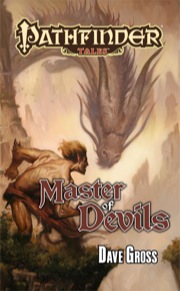
Master of Devils CoverThis interview is a repost from a past interview I did for the Seekers of Secrets Pathfinder blog. The original interview on that blog is no longer accessible, I wanted to preserve the interview here at The Iron Tavern.

Seekers of Secrets recently had the privilege to interview Dave Gross, the author of the upcoming Pathfinder Tales novel Master of Devils. Pathfinder Tales is the fantasy fiction line published by Paizo. Master of Devils is the fifth novel in the line and is due for release on August 4th.

Dave Gross has a strong presence within the Pathfinder Tales line with his tales featuring Count Varian Jeggare and his bodyguard Radovan. Dave wrote the first novel to kick off the Pathfinder Tales novel line with Prince of Wolves. He also has written Hell’s Pawns (appeared in the Council of Thieves Adventure Path), Husks (appearing in the upcoming Jade Regent Adventure Path) and the short stories The Lost Pathfinder and A Lesson in Taxonomy which appeared in the web fiction published weekly on Paizo’s site. He also co-wrote Winter Witch with Elaine Cunningham.

Master of Devils finds Count Jeggare and Radovan in Tian Xia, the far side of Golarion on a mission for the Pathfinder Society.  The Count sheltering in the Dragon Temple and Radovan trapped in the body of a devil, held hostage by the Quivering Palm, learning the secret of conquering an immortal enemy culminating in an ultimate showdown with the Master of Devils. The book is an excellent read and certain to thrill fantasy readers of all types!

And with that, let the interview begin!

_______________________

Your work for Pathfinder Tales is written from a first person point-of-view perspective and in addition alternates between characters with this style of perspective. What led you to choose this perspective in your writing? What advantages do you find this perspective brings? What challenges do you find this perspective bring to your writing?

When Paizo’s fiction editor, James Sutter, first talked to me about writing Pathfinder fiction, we batted around a few ideas, one of which became “Hell’s Pawns,” a novella that introduced the characters of Radovan and the Count.  My initial thought was to tell the story from the points-of-view of both characters, alternating between their experiences in low and high society. As the outline took shape, however, I began to feel there wasn’t room in six chapters to do that effectively, so I decided to limit the narrative to a single point of view.

I focused on Radovan, who in the pitch was a kind of Watson to Jeggare’s Holmes. Around that time I’d been watching a lot of film noir, so “Watson” soon became a tough guy in the mold of Sam Spade or Philip Marlowe. At that point it seemed natural to tell the story from only Radovan’s point of view—in first-person and in present tense, like a hard-boiled detective story.

When James asked for novel pitches featuring the same characters, I wanted to add Jeggare’s POV to the story. That way I could take the reader places where Radovan wasn’t welcome, and I could sometimes show the same scene from conflicting perspectives. Also, alternating POVs gave me another tool for building suspense.

After outlining Prince of Wolves, I wasn’t sure first-person would work for Jeggare, and I suspected present-tense was wrong for him too. In fact I wrote the first four or five chapters in third-person, once in present tense and once in past, before switching to the alternating first-person past-tense once I found Jeggare’s voice. The flash-forward prologue remains in present-tense, which I figured was a good way to establish that it appeared out of sequence. It was my idea of a teaser movie trailer.

What I like about the alternating first-person is that it lets me switch from hard-boiled detective to Merchant Ivory period dramas, both of which I love. It lets me emphasize with voice the different worlds in which Radovan and the Count live, and it helps me demonstrate their different reactions to the same characters and events.

One challenge I face with this approach is that I notice each character’s voice intruding sometimes on the other’s narrative. That’s the first thing I look to revise after the first draft, but every once in a while I try to use it to build the relationship between the two men. If I catch a high-falutin’ word in a Radovan chapter, for instance, I might rewrite the line ironically: “It was what the boss might call ‘copious’ bleeding,” for example.

Count Jeggare and Radovan and appear to be quite popular characters amongst the followers of Pathfinder fiction. What do you think explains their popularity among the Pathfinder Tales fans?
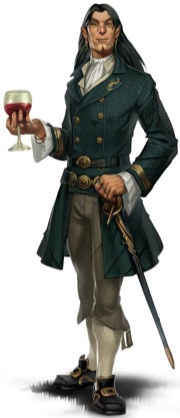
Varian Jeggare I can’t really speak for others, but what I like about them is that they’re the classic odd couple. Their differences offer me lots of opportunities for both drama and humor. And neither of them is a sidekick, even though Radovan is the Count’s employee. Either one could be the hero of his own story. In fact, one of the pitches for the novel that became Prince of Wolves was a Radovan-only novel.  I get the impression that while many readers like them both, most everyone has a favorite.

You note that your impression is that many readers have a favorite, Radovan or Count Jeggare. Are you willing to reveal your favorite?

Especially in the beginning, it seemed that Radovan got a lot more love, but over time I’ve heard from more and more people who prefer the Count and also from quite a few who can’t choose between them. It seems that Radovan still has the edge, but I wonder whether that balance will shift after Master of Devils, since some of the early readers have told me this book makes him more sympathetic.

I’m perfectly willing to reveal my favorite, except I truly don’t have one. I think Radovan is easier to like, but if you’ve known someone with Jeggare’s flaws long enough-or if you’ve had them yourself-he becomes more sympathetic over time.

I have heard you mention that a dollop of whiskey helps you write Radovan. What helps you write Count Jeggare? Who do you find it easier to write – Radovan or Count Jeggare?

Radovan is tons easier to write, and despite my joke at the reading, it’s usually four hot cups of black coffee and some death metal that gets me in the mood for writing his chapters.

That said, there are times when I’m just more in the mood to write from Count Jeggare’s point of view. I do sometimes approach his chapters with a glass of malbec and a classic jazz mix.

When you write, do you write several chapters as Radovan and then switch to Count Jeggare, or do you alternate between the two as you write, keeping the timeline more in sync as you go?

My intention is always to write the story chronologically, alternating points of view. But sometimes I wake up in the morning and just don’t “hear” the voice I need for that day, so I skip ahead. I can almost always call up Radovan’s voice, but Jeggare’s is fickle.

In Master of Devils especially, Count Jeggare’s story is more of a progressive arc, while Radovan’s is more episodic. Thus, I often went straight from finishing one Jeggare chapter to starting the next because it was more important to keep the continuity fresh in mind.

The voice of the third POV character didn’t come easily at first-as with Jeggare’s early chapters in Prince of Wolves, I ended up rewriting Chapter Five a few times. Also, for reasons you understand when reading the story, the voice evolves over its six chapters. So when I felt that I had that voice in my head, sometimes I wrote past the current chapter to keep it going.

Venture-Captain Jeggare is becoming quite the prolific character. Is there any possibility of him making an appearance in Pathfinder Society scenarios?

That’s something that’s never come up, but I suppose it could happen one day if the game developers wanted to do it. I love seeing elements of the novel appear in the game, but I’m seldom much aware of it before publication.

You’ve edited magazines for TSR, Wizards of the Coast and Paizo Publishing. What was your first big break into fantasy writing? How did you get involved with writing for Paizo Publishing?

My first real professional sale was a short story that I pitched in response to an open call for new writers by the TSR book department. I did that once or twice more before being invited to write a short novel, and that snowballed. My first full-length novel was Black Wolf (2001), one of the Sembia novels from Wizards of the Coast. I revisited those characters in Lord of Stormweather and a couple of short stories around that period.

A few years after I’d left Paizo, I ran into Erik Mona and Pierce Watters at the World Fantasy Convention in Calgary. Erik told me of his plans to launch a Pathfinder Tales line, now that Paizo had some experience in book publishing via the (wonderful, fabulous, check them out now) Planet Stories line. I expressed enthusiasm, he put me in touch with James Sutter, and the rest of the story is in the answer to your first question.

Tell us a little about your gaming experience. Do these experiences color your writing?

A middle-school friend and his elder brother introduced me to D&D when they were still using the tan saddle-stitched rules. I was soon hooked and began DMing my own games throughout high school and college. The latter was probably my favorite period of gaming, since my group took turns DMing in our shared version of the Forgotten Realms setting.

Once I began working for TSR, I had less time for a regular game. But there my gaming experience broadened. When I worked for the RPGA, I was the guy who was happy to edit the non-D&D tournaments, so I fell in love with a lot of different games. And while editing the magazines, I often sat in on playtests. Among my favorites were those run by Lester Smith, whose love of dark and creepy games I share.

If gaming influences my writing, it’s probably in that I like many of the same things about gaming that I like in fiction. A good horror game can make the hairs on my nape stand up, so I like to go for a good scare in stories. I love romance and intrigue in both media. I love questioning the morality of the violence without sucking the life out of it. I love using familiar creatures and magic in unfamiliar ways.

Your upcoming novel, Master of Devils, takes place in Tian Xia, a region that has not been covered in Pathfinder Campaign setting materials to any significant degree yet. Did you find working in this relatively undefined region challenging? Did Paizo give you relatively free reign in this area for your work?

Working without more than a few sentences of source material was about 1% frightening and 99% exciting. The Pathfinder developers offered me huge trust and freedom once I narrowed the setting of Master of Devils to a single country in an area roughly analogous to a region in China.

It probably also helped that they believed in the pitch: “Radovan & the Count versus Every Kung Fu Movie Ever.” That set the action far from Minkai—the Pathfinder analog to Japan, where the latter half of the Jade Regent Adventure Path takes place—and established a different paradigm for what the boys would face. There was no question of my needing the as-yet-unwritten rules for samurai and ninja, because there would be no such characters in the novel. (That said, the serial novella “Husks” in the Jade Regent Adventure Path is full of both samurai and ninja.)

In Master of Devils you add a third perspective to the normal Count Jeggare and Radovan perspective we saw in Prince of Wolves. I found this perspective extremely enjoyable, what drove you to take on adding another perspective for this novel? Is this third perspective one we can look forward to in future novels centered on Count Jeggare and Radovan?

In kung fu movies, there’s a vast range of styles and settings, from fairly realistic war dramas to high fantasy. I wanted to include it all. Adding the third character gave me a little more room to show off the incredible variety of Chinese-style fantasy adventures.
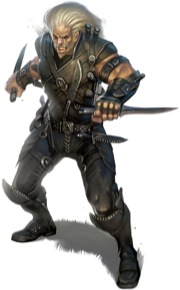
RadovanThus, Count Jeggare’s story is more a journey of romance and intrigue. Radovan faces battle after battle with increasingly powerful opponents. And the third character travels in a world of reincarnated spirits, whispering spiders, cloud-eating goblins, and a few classic monsters you might recognize from your earliest RPG sessions. The three stories still take place in the same world, and there are elements of magic and action in all three, but each has a different sensibility.

Also, both Radovan and the Count are pretty flawed heroes. I wanted to add a thread of undiminished heroism through their story, and to my mind that third POV character is that kind of perfect—if unorthodox—hero.

While that third POV fits this story, I don’t know whether I’d automatically include it in a future novel. I love the idea of a third POV character to act as a foil to the boys, but who that is depends on the nature of the story. What seemed a good fit in Master of Devils might not work in another novel.

But never say never.

From reading your blog it seems Master of Devils was influenced heavily by kung fu or wuxia movies. For readers of the novel whose interest is piqued by this novel, what top three wuxia style movies would you recommend to someone relatively new to the genre?

My approach to the novel was to write it for readers who’d never seen (or even haven’t liked) a kung fu movie. I hope those who enjoy the book will check out some of the films I recommend at frabjousdave.blogspot.com. I’ve only about a hundred more to post.

Three of my favorite films representing different aspects of the kung fu genre include Hero, The 36th Chamber of Shaolin, and The Bride with White Hair. It’s hard to recommend just three, because there are so many other must-see movies, especially for gamers. I’ve written a “Kung Fu Movies for Gamers” article for Kobold Quarterly, and I’ll link to more such articles at my blog.

With Prince of Wolves we saw riffle scrolls introduced and Tian Xia seems continue to add to Count Jeggare’s bag of tricks. Do you enjoy finding new ways to use magic within your novels?

I definitely do, although I like it best when the magic is essential to the character—as it is with Jeggare and his fraught history as a wizard—and when it helps make the story more mysterious. If you use only magic whose rules your readers know by heart, it becomes ho-hum. I want the magic in these novels to feel as though it belongs in the Golarion setting but also to keep the readers guessing. Usually I have the game rules in mind, but I try to describe the effects in fresh terms. For example, when Azra heals Radovan in Prince of Wolves, she performs a dancing ritual that reveals a bit of her personality and hints at her unusual background instead of simply “casting cure serious wounds.”

With Master of Devils officially releasing at Gen Con Indy this year, what other projects do you have in the pipeline?

This month paizo.com posts “A Voyage to Absalom,” a free four-part mystery that takes place between Prince of Wolves and Master of Devils. Also, in the Jade Regent Adventure Path, Radovan and the Count follow a trail of bodies through a city in Minkai in “Husks,” the Pathfinder Journal.

The one other project I can mention is a short story in Robin D. Laws’s anthology Shotguns v. Cthulhu, coming out this fall from Stone Skin Press. My contribution is a twitchy little revisionist history centered on the destruction of a famous Seattle landmark in 2002.

____________________

Seekers of Secrets wants to thank Dave for taking the time to answer our questions. It was a pleasure interviewing him. Be sure to follow Dave Gross at his blog to learn more of his upcoming works and to hear more on his kung fu movie recommendations!  He has also posted his Gen Con schedule for those who will be at Gen Con. Be sure to swing by the Paizo booth at Gen Con and pick up a copy of Master of Devils and chat with him in person!