Castles and Crusades Sale

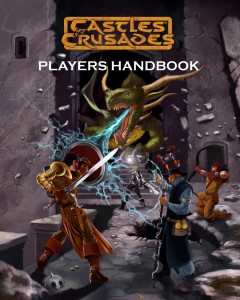
Castles and Crusades Players Handbook CoverI just received an email tonight that Troll Lord Games is running a 40% off sale over at RPG Now. The sale is to celebrate the launch of their most recent Kickstarter for Codex Celtarum. The Codex Celtarum is a 144 page book for Celtic Mythology and includes over 150 new spells and more for your Castles and Crusades game. Castles and Crusades is of course a rules-light fantasy RPG game making use of the Siege Engine.

In addition to offering a large portion of their catalog at 40% off, they are also offering a bundle where any purchase of the Players Handbook comes with a free copy of Gods and Monsters.

Whether you are an existing player of Castles and Crusades or a new to the system, this is a great sale to take advantage of to build up your collection!

Malloc: A DCC Patron

photo by: dmahr on flickr, gimp filters by jft

photo by: dmahr on flickr, gimp filters by jft

I seem to have a trend of posting Dungeon Crawl Classics RPG related content on Fridays. Continuing that trend, this week I present a patron write-up I did for my online campaign. The idea source for this patron came from materials from Purple Sorcerer Games written by Jon Marr.

Malloc made an appearance in one of the early Purple Sorcerer Games adventures. Jon provided me with some additional insight for how he saw Malloc and his motivations which I morphed into this complete patron write-up. I have two wizard characters that claim Malloc as their patron, sometimes much to their dismay!

And with that, I hope you enjoy Malloc the Creeper!

___________________________________________________

Malloc the Creeper

Also known as the Dark World Tree, Malloc works his roots into dark nooks of the world with intent to gather knowledge and further increase his preparedness to exert his power and control on worldly affairs. Malloc has a near insatiable desire for knowledge and information and uses those that call him their patron to gain this knowledge. Malloc is not beyond exerting his own destructive power to broker exchanges of information for safety of entire towns and structures.

Malloc’s jealousy also leads him to be locked in a bitter rivalry with Yddgrrl, the World Root. Though Malloc is often thought to be uninterested in nature, he seems to have a certain affinity towards particular trees and seeks to protect them with destructive force when necessary. Some say Malloc is jealous of Yddgrrl’s much closer bonds to nature than Malloc’s own.

Malloc expects his followers to search out forgotten knowledge and report it to him using whatever means, including force, are necessary to gain this knowledge. Malloc rarely communicates his desires in a forthcoming manner to his followers preferring cryptic messages through speaking trees, faceless figures, and scrawled messages in flesh. Malloc is prone to jealousy if any of his patrons seek to stray from his patronage. Feeling it as a loss of an information source he will frequently strike out in a devastating display of power to rein in or punish a follower from leaving his patronage.

Invoke Patron check results:

12-13 Malloc responds to the call but is quickly distracted by something else that comes to his attention. Before he leaves he grants the caster significant insight into the weakness of the creature the caster is fighting. This insight provides a +4 on spellcaster checks for the next 1d4 rounds.
14-17 Malloc is annoyed and admonishes the caster severely before begrudgingly causing the caster’s skin to become bark-like (AC +4) and an increase of 2d3 to the caster’s Strength ability. These effects last for 1d4 turns and the ability score increase can be spellburned.
18-19 Malloc responds to the call and appreciates the dire circumstances that led to his calling. He grants insight to the situation the caster and his allies are in and grants each a +4 to attacks, skill checks, and spell checks for 1d4 turns.
20-23 Malloc sends forth root-like tentacles that burst forth from the ground regardless of the type of surface and grapple nearby objects and creatures. The roots cover a 20′ radius centered at a point the caster dictates.  These summoned roots slow the enemy’s movements by half and causes a -2 to all attack, skill, and spellcraft checks. Those trapped in the grasping roots must make a DC 18 Strength check to escape their grasp.
24-27 Malloc sends a pair of dark roots out of the ground near the caster’s legs. These dark roots wrap around the caster’s ankles with some strength. From the initial round and for each round the caster does not move from this position the caster receives 1d4 hit points in healing and 1d2 ability point damage healed. Once the caster moves, the root-like tendrils curl back down into the ground.
28-29 Malloc calls forth several powerful roots to press forth from the ground at a location dictated by the caster. These roots will target the creature closest to that point and attempt to grab them (Atk +10, plus grab). Once a root has successfully grabbed the victim they will work together to pull the victim back beneath the ground. It takes 1d3 rounds for the roots to suffocate the victim underground. A DC 20 Strength check escapes the roots.
30-31 A massive tree is summoned forth by Malloc at the location desired by the caster. This tree (see below), with a great, gaping maw, erupts from the ground over the course of 1d3 rounds. When fully surfaced it stands 40′ tall with numerous leafless limbs. 8 of these limbs proceed to make attacks on any opponent the caster orders it to. The caster can dictate each of these 8 attacks but can perform no other action on his turn when doing so. The tree remains summoned for 1d4 turns.Tree, avatar: Init +2; Atk bite +10 melee; Dmg 2d12 and swallow on critical; AC 15; HP 58; MV 5′; Act 8d20; SP: Free bite attack if victim delivered by limb. SV Fort +8; Ref +0; Will +8; AL NOne of three things (1d3) happen when an opponent is struck by one of the limbs.1)     The limb grabs the victim and then proceeds to hurl the victim with great force. The victim takes 2d8 damage (DC 16 Reflex Save for Half).2)     Upon grabbing the victim the limb begins to squeeze the victim with tremendous force. The victim takes 4d4 squeezing damage (DC 15 Strength Check to take Half damage; DC 18 Strength check to escape the root)3)     The limb grabs the victim and begins squeezing. The victim takes 4d4 squeezing damage (DC 15 Strength Check to take Half damage; DC 18 Strength check to escape the root). On the 2nd round the root will deposit the victim in the tree’s maw.
32+ Malloc’s ire has been raised and he unleashes his destructive force in a startling display to protect those who call him patron. An earthquake caused by many roots and tendrils erupts all around the spellcaster and his allies. The earthquake focuses on a 400′ radius area around the caster, though the caster and his allies are shielded from the effects of the earthquake.Outside this protective sphere all must make DC 22 Reflex saves to avoid falling into deep fissures causing 3d6 damage from the fall. For those that succeed on their Reflex save they must make another one each round until they are outside the area of effect.Once in the fissures they begin to close and shift causing 6d6 crushing damage over the next 6 rounds. Two successful (not necessarily in a row) DC 18 Strength checks are needed to begin escaping the crushing forces of the fissure. For each round in the fissure the victim is subject to another 6d6 damage.This quake also causes structural damage to any buildings caught in the ferocity of the thrashing roots causing this earthquake.  Towers and multi-level structures are likely to sway, possibly collapsing in ruin.  Foundations of one-story buildings are sundered, heaving portions of the building up and others sinking below the earth’s surface.


Patron Taint: Malloc

Malloc strives to turn his petitioners to be more like him in resemblance and form. When patron taint is indicated, roll 1d6 on the table below. When a caster has acquired all six taints at all levels of effect, there is no need to continue rolling anymore.

Roll Result
1 The caster’s skin become rough and almost scratchy to the touch. If this result is rolled a second time, the caster’s skin transitions from being scratchy to appearing and feeling like smoothed bark (-1 Agility checks, +1 AC). If this result happens a third time, the caster’s skin transitions to that of actual bark (-2 Agility checks, +2 AC).
2 The caster’s hair begins to become stiff and bristly to the touch. If this result is rolled a second time, small twigs become part of the caster’s hair with small leaves. If this result is rolled a third time, the caster’s hair becomes composed entirely of small twigs and leaves. If the caster chooses to shave their head, the small twigs and leaves will return in their entirety by morning.
3 When the caster casts a spell the immediate area (20′ radius) tremors. No damage is caused, but items rattle and clink if they are not secured. If this result is rolled a second time, when the caster casts a spell the immediate area (20′ radius) trembles, small cracks appear in the ground and small, non-secured items topple over. If this result occurs a third time, when a spell is cast by the caster the immediate area (20′ radius) suffers a minor quake, the ground heaves from roots thrashing about in the ground causing the area to become difficult terrain. DC 12 Reflex saves are required by those in the immediate area to avoid falling prone and there is a chance of minor structural damage.
4 The caster finds himself becoming more possessive of his belongings. Being asked to share his belongings are met with great annoyance. If this result is rolled a second time, the caster shows much more annoyance and vocal distrust of others wanting to borrow or use his things. The caster will refuse to share or let others use his belongings. If this result is rolled a third time, the caster refuses to loan his belongings out. The caster also become always suspicious that people are after his belongings. When situation arise that others are pressuring him to share his belongings, the caster must make a DC 15 Will save to avoid the incident from escalating into outright conflict.
5 The caster finds himself unable to hydrate orally and must resort to pouring water or other beverages on his feet. Liquid poured on the caster’s feet is readily absorbed and used by the caster’s body for hydration. If this result is rolled a second time, the caster finds it more difficult to obtain nourishment orally. Though the caster can eat and obtain some nourishment the caster obtains more nourishment by pouring nutrient rich liquids on his feet. If this result is rolled a third time, the caster can no longer eat or drink normally for sustenance. All nourishment must be through some form of liquid or nutrient rich liquid poured on his feet and absorbed by this body.
6 The caster has an insatiable desire to venture forth after a piece of lost knowledge. The caster receives a vision of the object that holds this knowledge and a vague idea of location. The caster must retrieve the object from the vision and study it (Minor Quest – 5-7 days in duration). If this result is rolled a second time, a revelation comes to the caster regarding the object retrieved from the first occurrence. The caster must now find a second piece of information that will help determine the meaning of the first. (Medium Quest – 25-30 days in duration). If the result is rolled a third time, the caster receives another cryptic vision which the caster must decipher involving the two objects previously obtained. (Major Quest – 3-6 months).


Patron Spells: Malloc 

Malloc grants the following three spells to those that petition him:

Level 1: Snarling Roots

Level 2: Forest Perception

Level 3: Quaking Roots

Spellburn: Malloc

Malloc exacts a cost for those that seek his aide at times of need. When a caster utilizes spellburn, roll 1d4 on the table below or build off your own ideas to create an event specific to your situation.

Roll Results
1 Malloc needs blood. Roots push their way up through the ground and wrap around the caster’s legs for 2 rounds. During this time the caster is unable to move, though he can still cast. The roots drain blood from the caster (expressed as Stamina, Strength, or Agility loss).
2 Malloc is creating another avatar of himself and requires teeth as a component. The caster must remove one or more of his own teeth as an offering to Malloc which will be used to bring the maw of Malloc’s avatar to life. For every 2 points of spellburn the caster must sacrifice one tooth.
3 Much as tree limbs and roots crack, Malloc wishes to exact this punishment through the cracking of bones in the caster’s body (expressed as Stamina, Strength, or Agility loss).
4 Malloc seeks to exact his mark on the caster and carves the word Malloc on the caster’s body. The depth and size of this mark is determined by the amount of points expended in this spellburn.


                                                                               Snarling Roots
Level: 1 (Malloc)              Range: 125′            Duration: 1 turn per CL                       Casting Time: 1 round
General Malloc has creeping roots beneath the ground ready to be summoned when the need presents itself. The caster conjures forth an area of snarling roots that impede his enemy in both movement and actions.
Manifestation Roll a 1d4: (1) thick gnarled roots, cluttered with dirt pierce the ground; (2) thin, brownish green roots with freakish agility and speed protrude from the ground; (3) a large ball of roots shoot from the caster’s hands and arcs through the air to the target area; (4) a swirling mass of greenish brown vapor is hurled from the caster’s hands exploding into a mass of roots at the target area.
1 Lost, failure, and patron taint.
2-11 Lost. Failure.
12-13 A 10′ radius area becomes entangled with roots coming up from the ground. No prior vegetation is needed. Creatures within the area lose 5′ from their movement rate and suffer a -1 to attack, skill checks, and spell checks. A DC 13 Strength check allows targets snarled to move and act without penalty for one round.
14-17 A 20′ radius area becomes entangled with roots coming up from the ground. No prior vegetation needed. Creatures within lose 5′ from their movement rate and suffer a -1 to attack, skill checks, and spell checks. A DC 15 Strength check allows targets snarled to move and act without penalty for one round.
18-19 A 20′ radius area becomes entangled with roots coming up from the ground. No prior vegetation needed. Creatures within move at half their normal movement rate and suffer a -2 to attack, skill checks, and spell checks. A DC 17 Strength check allows targets snarled to move and act without penalty for one round.
20-23 A 40′ radius area becomes entangled with roots coming up from the ground. No prior vegetation needed. Creatures within move at half their normal movement rate and suffer a -2 to attack, skill checks, and spell checks. A DC 17 Strength check allows targets snarled to move and act without penalty for one round.
24-27 A 50′ radius area becomes entangled with roots coming up from the ground. No prior vegetation needed. Creatures within move at half their normal movement rate and suffer a -4 to attack, skill checks, and spell checks. A DC 18 Strength check allows targets snarled to move and act without penalty for one round.
28-29 A 60′ radius area becomes entangled with roots coming up from the ground. No prior vegetation needed. Creatures within move at half their normal movement rate and suffer a -4 to attack, skill checks, and spell checks. A DC 20 Strength check allows targets snarled to move and act without penalty for one round.
30-31 A 60′ radius area becomes entangled with roots coming up from the ground. No prior vegetation needed. Creatures within move at one quarter their normal movement rate and suffer a -6 to attack, skill checks, and spell checks. A DC 20 Strength check allows targets snarled to move and act without penalty for one round.
32+ A 80′ radius area becomes entangled with roots coming up from the ground. No prior vegetation needed. Creatures within are unable to move and suffer a -6 to attack, skill checks, and spell checks. A DC 22 Strength check allows targets snarled to move and act without penalty for one round.


Forest Sensing

Level: 2 (Malloc)          Range: 500′ (+500′ per CL > 1)        Duration: 1 turn per CL        Casting Time: 3 rounds
General Despite Malloc’s often loose ties to nature, he is fully capable of bending the will of nature to serve his needs in the quest for knowledge and information. With the power of Malloc the caster is able to tap into the senses of nearby plants and trees, hearing what the plants hear as if the caster was present.
Manifestation Roll a 1d4: (1) The caster’s ears turn into leaves for the duration of the spell; (2) A thin root sprouts from the ground and gently wraps itself around the caster’s leg for the duration of the spell; (3) a globe of green, misty light is conjured during the casting of the spell erupting in a fine spray of water; (4) the caster’s skin turns a mottled greenish-brown for the duration of the spell.
1 Lost, failure, and patron taint.
2-11 Lost. Failure.
12-13 Failure, but spell is not lost.
14-15 The caster indicates an area with some form of plant-life within the casting range of the spell. The caster is now able to hear normal conversations and ambient sounds occurring near the target plant for the duration of the spell. Once a plant is chosen the spell cannot be redirected.
16-19 The caster indicates an area with some form of plant-life within the casting range of the spell. The caster is now able to hear normal conversations and ambient sounds occurring near the target plant for the duration of the spell. If the caster wishes to change the target of the spell, he may do so until the duration of the spell expires.
20-21 The caster indicates an area with some form of plant-life within the casting range of the spell. Through the plant the caster has amplified hearing allowing the caster to hear normal and whispered conversations and ambient sounds. If the caster wishes to change the target of the spell, he may do so until the duration of the spell expires.
22-25 The caster indicates an area with some form of plant-life within the casting range of the spell. Through the plant the caster is able to hear normal conversation and ambient sounds. In addition, if the caster does not normally know the language spoken, the caster understands the language for the duration of the spell. The caster can retarget the spell until the duration of the spell expires.
26-29 The caster can indicate multiple targets that listen (up to CL). Through each of these plants the caster is able to hear normal conversation and ambient sounds occurring near each of the targeted plants. The caster is able to supernaturally make out and process each of these conversations without difficulty. Once chosen the targets cannot be re-selected.
30-31 The caster is able to select multiple plants for listening and retarget as desired for the duration of the spell. The caster can also choose to have a particular person followed from plant to plant for the duration of the spell automatically. Through the plant the caster is able to hear normal and whispered conversation and ambient sounds. In addition, if the caster does not normally know the language spoken, the caster understands the language for the duration of the spell.
32-33 The caster is awash in overheard conversations and sounds from all plant-like entities within range of the spell. Within the first minute of casting the caster much choose the number of targets equal to his CL and amount of points spellburned to continue listening to for the duration of the spell. Once the targets are chosen the caster can continue to hear normal and whispered conversations, ambient sounds and comprehend the language spoken from that target for the remaining portion of the spell. Targets can be re-chosen until the spell expires.
34+ The caster is able to listen to all surrounding plants in the range of the spell. The caster is able to supernaturally able to process all of this information without difficulty and does not need to choose targets. All normal and whispered conversations and ambient sounds are heard and the caster is able to comprehend all languages obtained in this manner. These effects last for the duration of the spell.


Quaking Roots

Level: 3 (Malloc)                  Range: 225′                  Duration: 1 round per CL                    Casting Time: 1 round
General Malloc’s ire has been raised and his wrath shall be felt. The caster calls upon Malloc’s power to summon forth powerful roots to thrash about causing the very earth itself to quake.
Manifestation Roll a 1d4: (1) A tangled ball of roots is conjured between the caster’s hands which is hurled to the target area of the spell; (2) a spiraling vortex of roots is launched from the caster’s position to the target area of the spell; (3) a sphere of fine, black dirt showers upwards from the ground at the target site immediately prior to the quake starting; (4) the sound of multiple stones cracking echoes sharply through the air around the caster.
1 Lost, failure, and patron taint.
2-11 Lost. Failure.
12-15 Failure, but spell is not lost.
16-17 In an area of the caster’s choosing within range of the spell powerful roots erupt from the ground in a 20′ radius. These roots flail about possibly striking creatures in that area (3d6 damage, DC 12 Reflex for half). In addition the ground begins to shake from the thrashing, -1 to attack rolls, skill checks and spell checks.
18-21 In an area of the caster’s choosing within range of the spell, large, powerful roots erupt from the ground in a 20′ radius. These roots flail about, actively seeking to strike creatures in the area (4d6 damage, DC 15 Reflex for half). In addition the ground begins to shake from the thrashing, -1 to attack rolls, skill checks, and spell checks.
22-23 In an area of the caster’s choosing within range of the spell, very large and powerful roots erupt from the ground in a 30′ radius. These roots flail about, actively seeking to strike creates in the area (5d6 damage, DC 16 Reflex for half). In addition the ground begins to shake violently from the thrashing, -2 to attack rolls, skill checks, and spell checks.
24-26 In an area of the caster’s choosing within range of the spell, very large and powerful roots erupt from the ground in a 40′ radius. These roots flail about, actively seeking to strike creates in the area (6d6 damage, DC 18 Reflex for half). In addition the ground begins to shake violently from the thrashing, -2 to attack rolls, skill checks, and spell checks.
27-31 In an area of the caster’s choosing within range of the spell, extremely large and powerful roots erupt from the ground in a 45′ radius. These roots flail about, actively seeking to strike creatures in the area (8d6 damage, DC 20 Reflex for half). In addition the ground begins to shake violently from the thrashing, -3 to attack rolls, skill checks, and spell checks.
32-33 In an area of the caster’s choosing within range of the spell, very large powerful roots erupt from the ground in a 50′ radius. These roots flail about actively seeking to strike creatures in the area (10d6 damage, DC 22 Reflex for half). In addition the ground begins to shake violently from the thrashing, -4 to attack rolls, skill checks, and spell checks. Structures within the effects radius begin to exhibit signs of minor structural damage.
34-35 In an area of the caster’s choosing within range of the spell, very large powerful roots erupt from the ground in a 60′ radius. These roots flail about actively seeking to strike creatures in the area (15d6 damage, DC 25 Reflex for half). In addition the ground begins to shake violently from the thrashing, -5 to attack rolls, skill checks, and spell checks. Structures within the effects radius begin to exhibit signs of major structural damage.
36+ In an area of the caster’s choosing within range of the spell, very large powerful roots erupt from the ground in a 80′ radius. These roots flail about actively seeking to strike creatures in the area (20d6 damage, DC 30 Reflex for half). In addition the ground begins to shake violently from the thrashing, -6 to attack rolls, skill checks, and spell checks. Structures within the effects radius exhibit significant structural damage up to and including collapse.


New Beginnings… Or Campaign Reboot

RPG Blog CarnivalThis month’s RPG Blog Carnival to open the year 2013 is aptly themed “New Beginnings” hosted by Kobold Enterprise. Suggested topics to get folks thinking are,

  • Retcons/New Ages in home brewed or commercial settings.
  • Epiphanies about projects and their new directions.
  • New starts for characters, or even whole campaigns.
  • Insights on the hobby, or aspects of it.

It only seems fitting for me to post on new starts for campaigns with recent changes in my local group’s game.

How we got here

Regular readers of The Iron Tavern know I have been running a Dungeon Crawl Classics RPG campaign for several months now online. Meanwhile I’ve been playing in a regular Pathfinder campaign in my local face-to-face group. My local group rotates dungeon masters with most of the duties falling to me or another individual in the group. To be fair, the other person runs much more than I do, but I’ve done my share of running.

I started a Kingmaker campaign in 2010 for the local group. From there we moved to Council of Thieves and then on to Serpent’s Skull – all played under the Pathfinder ruleset. The Serpent’s Skull campaign came to a close in December of 2012.

Adventure Paths

In actuality the Serpent’s Skull campaign sort of fizzled out. I think I group was burning out on Pathfinder to some degree. If not on Pathfinder, we were at least burning out on adventure path style campaigns. By that I mean in adventure paths your course as characters is laid out pretty clearly before you. There are side-treks the characters can take and other areas to explore and many GMs will encourage this. But in order to continue with an AP the GM has to get you back on track along the way at some point. So while there might be diversions along the way, ultimately you have to get back on track. Almost like traveling from waypoint to waypoint.

Over the course of time I think this nature of adventure paths wears on the GM. While nice to pick up the six adventure path installments and know you have nearly a years worth of gaming material at your fingertips, it takes some work from the GM to keep things on course. As a player there can be a sense of what you do doesn’t matter as at some point your characters have to be at a certain place for the next book to be applicable.

Now don’t get me wrong. The Pathfinder APs are great. I think they are well written and layout exciting stories and adventures to play. The NPCs are frequently interesting and some of the monsters within have unusual tweaks to make them stand out. The APs always include interesting material that is tangentially related to the campaign and can be used elsewhere too.

However, after playing several and running one Adventure Path, I think it comes down to feeling like you are playing someone else’s story. Someone else’s adventure. I think having played three of these in a row started to lead our group to a bit of burnout.

New Beginnings

This brings us to our group’s new beginnings. Several in my local group have heard me talk about Dungeon Crawl Classics and how much fun I was having with my online group. The other DM in the group found a copy of the Limited Edition DCC RPG book at the local Half-Price books (I hate him for that). He started reading and thought it might be a good change of pace for our group.

Add in that he is a tax accountant with a schedule that goes crazy from January through April and that my wife is amidst a bone marrow transplant procedure for the next several weeks and a lighter rule system starts to look even more attractive. DCC RPG is rules-light with a lot of the “work” being looking up critical hits, spell results, and such on tables for wild and crazy results. That “work” does not take a  lot of prep reducing the load on the GM.

The GM for our DCC RPG game is also planning for it to be more episodic in nature as well. I think that will lead to a less pre-determined path and our characters can once again take the story where we want it and not where a campaign arc planned out for multiple levels necessarily wants to take it. It also allows for some player misses with less impact on the story overall.

Our group’s new beginning for 2013 is the start of a new campaign with a new ruleset. I know I have felt re-energized by this change of systems and I think several others in our group are looking forward to the upcoming campaign. Time will tell how the change plays out for us!

Review: Dungeons of Golarion

This review is a repost of my original review of this product for the Seekers of Secrets Pathfinder blog. The original review is no longer available on that site and I wanted to preserve the post here at The Iron Tavern.

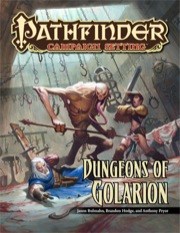
Dungeons of GolarionPrice: Print – $19.99 / PDF – $13.99
Audience: GMs
Crunch: 3.5/5
Fluff: 5/5
Overall: 5/5 (not an average)

Dungeons of Golarion is a 64 page book that is part of the Pathfinder Campaign Setting series of books from Paizo. The book looks closely at six different megadungeons within the Inner Sea region of Golarion, the Pathfinder Campaign setting. These megadungeons include Candlestone Caverns, Gallowspire, Hollow Mountain, Pyramid of Kamaria, Red Redoubt of Karamoss and Zolurket Mines. It also lists 17 other dungeons within Golarion each with a short paragraph about the dungeon.

The six megadungeons each get ten pages that include an overall layout map of the dungeon, history, descriptions that cover the entrance and brief overview of each level, a section on denizens, traps, treasures and finally adventure hooks.

While the descriptions of each level are brief, there is plenty of information to help a GM discover the feel of each level. The balance between having the feel for the dungeon and being able to design your own level is excellent. Just enough information to get the ideas flowing rapidly without forcing the GM into being restrained by overly defined levels.

The book is heavier on the fluff side, but there is some crunch sprinkled in to keep the more crunch inclined interested. Amongst the chapters on the six megadungeons there are new denizens, new traps and new magic items and such to work with. For the Numeria fans there is also some information on robots that comes from the section on Red Redoubt of Karamoss.

The art and cartography are up to the usual Paizo quality. The maps and dungeon layouts look great, though one of the dungeon layouts includes a key that indicates each square is 10′ when really the map is not entirely to scale. Minor issue and does not affect the quality of the map itself. The art work has several images that are sure to inspire heroics within the dungeon!

I have very little to complain about in this book. While not a huge fan of the amount of technology in Red Redoubt of Karamoss with its Numeria based technology, it is a well done section and I am sure fans of technology from Numeria will enjoy it! And the book does warn for those that are not fans of the fantasy blending into technology it is might be best to avoid that dungeon or the book offers a couple of alternatives of how to scale down the technology if desired by the GM.

I found the Gallowspire write-up very interesting and certainly a dungeon to challenge the highest level Pathfinder characters. An interesting sidebar in this section notes that several of the levels in Gallowspire contain threats beyond levels the currently published Pathfinder ruleset cover with some levels going to CR24+.

I found the Dungeons of Golarion a very enjoyable read. It offers a plethora of plot hooks for all of these dungeons and really gets the GMs mind turning. There is enough detail on the dungeons to give a GM a solid start to designing a megadungeon to haunt their players for an entire campaign. And for those who might not game in Golarion the dungeons within could easily be dropped into your campaign world of choice.

I rated the crunch portion of the book a 3.5 out of 5 simply due to the amount of crunch in the book. What was in the book was good, but those looking for a crunch heavy book are apt to be disappointed. From the fluff perspective I rate the book a 5/5. There is history included behind each dungeon and enough plot hooks to keep a GM busy for a long time. This leaves me with an overall rating of 5/5 as I do expect the Campaign Setting series of books to be much more about the fluff than the crunch!

Dwarven Cleric for DCC RPG

DCC RPG Limited Edition CoverJust before the holidays, Dak (of Crawl! Fanzine fame) posted in the DCC RPG Google+ community about expanding some of the demi-humans race as class options. The one that intrigued me was allowing the Dwarf as written to be the dwarven fighter or warrior and adding a dwarven priest or cleric.

I found myself with a bit of time over the holidays and took a stab at the dwarven cleric class option for Dungeon Crawl Classics RPG. I tried to blend the dwarf class with the cleric class without ending up with something too powerful. I think I am close on the right blend while maintaining some dwarven flavor.

If it needs toned down a bit more I would look at the number of spells again. I’ve reduced them some, but I think I might have room to reduce those some more. Of course, I cut down a lot of the base dwarven class, really keeping a much slower progression rate for Mighty Deed of Arms than a standard dwarf as an ode to being a dwarf.

I have not been able to run this through an actual playtest yet. I am hoping to talk the judge for my new DCC RPG local game to letting me try it out. In either case, give this class a read through and let me know what you think. Feedback is welcomed!
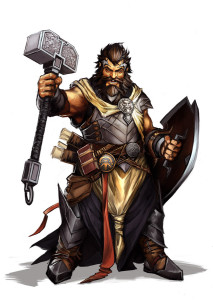
                                                                                                             

CC License, Arty by *YamaO at Deviant Art

CC License, Arty by *YamaO at Deviant Art

Dwarven Cleric Class 

Like their fellow dwarves, dwarven clerics were raised far underground in dwarven mines, strongholds, and great cities. Subscribing to the orderly and rigid life that keeps dwarven society functioning, the dwarven cleric took an interest in the gods of the land. In addition to years of martial training and learning crafts, the dwarven cleric was instructed in centuries religious knowledge and ritual.

The dwarven cleric is a valued member of dwarven society. Life beneath the surface is treacherous. Mining accidents, natural cavern collapses, and near constant skirmishes with other denizens of the dark guarantee physical injury that drive demand for the healing care of a priest. Simply boosting the mental fortitude amongst dark and confined caverns is one of the facets of a dwarven cleric that add to their worth to the dwarven society.

With their martial training, spells, and luck of the gods to aid them during battle, dwarven clerics are an anchor to the foothold these demi-humans claim under the mountains. These features also serve to make them stout adventuring companions.

Hit Die: A dwarven cleric gains 1d8 hit points at each level

Weapon Training: Much like their brethren, dwarven clerics prefer battle with a weapon and shield. With time spent training split between martial and religious training a dwarven cleric is only trained in the following melee weapons: battleaxe, club, handaxe, mace, spear, and warhammer. A dwarven cleric is also trained in these missile fire weapons: crossbow and sling. Dwarven clerics wear whatever armor they can afford.

Alignment: The dwarven life produces many more lawful dwarves due to the structured clan life of dwarves. Coupled with learning the tenets of the religious way dwarven clerics are slanted even more heavily to a lawful alignment.

Rare are the dwarves who stray from the lawful path after studying the ways of religion, but chaotic dwarven clerics do exist. These dwarven clerics have typically rebelled strongly against their roots or some say been tainted by the patrons and deities they serve.

Neutral dwarven clerics are even rarer and tend to be dwarves that have little direction in their lives. These dwarven clerics frequently find themselves more beholden to natural elements than lawful or chaotic deities.

Attack modifier: The dwarven cleric starts with a static modifier for attack rolls. At 3rd level the dwarven cleric gains a deed die, like the Dwarf. At 3rd level, this is a d3. The dwarven cleric rolls the d3 on each attack roll and applies it to both his attack roll andhis damage roll. The progression of this deed die is at a reduced rate compared to Dwarven or Warrior classes.

Caster level: Caster level is typically the level of the dwarven cleric. This level can be modified under certain circumstances. It is not unheard of for a dwarven cleric to seek out holy relics of their faith to increase their caster level.

Magic: Dwarven clerics are able to call upon the favor of his god. This ability allows the dwarven cleric to channel his chosen god’s power as a magical spell.Dwarven clerics are also able to call upon their deity to lay on hands and turn unholy. See the Cleric entry in the Dungeon Crawl Classics RPG rulebook for a complete description of clerical magic.

Divine Aid: In addition to channeling a god’s power as a devout worshipper, a dwarven cleric can beseech his deity for divine aid. Faithful followers recognize that beseeching a deity directly is an extraordinary act. To request divine aid, the cleric makes a spell check at the same modifier that would apply were he casting a spell. This extraordinary act imparts a cumulative +10 penalty to future disapproval range. Based on the result of the spell check, the judge will describe the result. Simple requests (e.g. light a candle) are DC 10 and extraordinary requests (e.g. summon and control a living column of fire are DC 18 or higher.

Mighty Deed of Arms: Dwarven clerics have been exposed to martial training during their religious studies. Like Warriors and Dwarves, they can perform Mighty Deed of Arms in combat. See the warrior entry in the Dungeon Crawl Classics RPG rulebook for a complete description.

Infravision: A dwarven cleric can see in the dark up to 60’.

Slow: A dwarven cleric has a base movement speed of 20’.

Underground Skills: Lives led underground train dwarves to detect certain kinds of construction. When underground, dwarves receive a bonus to detect traps, slanting passages, shifting walls, and other new construction equal to their class level.

A dwarf cleric can smell gold and gems. A dwarf cleric can determine the direction of a strong concentration of gold or gems within 100’. Smaller concentrations, even down to a single coin, can be smelled up to 40’ away if the dwarf concentrates.

Luck: A dwarven cleric’s luck applies to the armor class.

Languages: A dwarven cleric at 1st level knows Common, the dwarven racial language, plus Angelic if Lawful, Demonic if Chaotic or the choice of either if Neutral. A dwarven cleric knows one additional language for every point of Int modifier, as described in Appendix L of the Dungeon Crawl Classics RPG rulebook.

Action Dice: A dwarven cleric receives their second action dice at 6th level. A dwarven cleric’s action dice can be used for attack rolls or spell checks.

Table: Dwarven Cleric

Level Attack (Deed Die) Crit Die/Table Action Dice Ref Fort Will 1 2 3 4 5
1 +0 1d8/III 1d20 +0 +1 +1 2
2 +1 1d10/III 1d20 +0 +1 +1 3
3 +d3 1d12/III 1d20 +1 +1 +2 3 2
4 +d3 1d14/III 1d20 +1 +2 +3 4 3
5 +d3 1d12/IV 1d20 +1 +3 +3 4 4 1
6 +d4 1d14/IV 1d20+1d14 +2 +3 +4 5 4 2
7 +d4 1d16/IV 1d20+1d14 +2 +4 +4 5 5 3 1
8 +d4 1d20/V 1d20+1d16 +2 +4 +5 6 5 3 2
9 +d4 1d24/V 1d20+1d16 +2 +5 +5 6 5 4 2
10 +d7 1d30/V 1d20+1d20 +3 +5 +6 7 6 5 3 1


Table: Dwarven Cleric Titles

Level Title by Alignment
  Lawful Chaotic Neutral
1 Acolyte Supplicant Celebrant
2 Brother Beseecher Beseecher
3 Friar Zealot Zealot
4 Vicar Oracle Matriarch
5 Warrior Priest Everlasting Indoctrinator


Review: Queen of Thorns

QoT_coverAuthor:  Dave Gross
Publisher:  Paizo Publishing
Price:  Print – $9.99 / PDF $6.99
Pages:   432

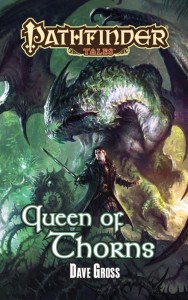
Queen of Thorns is the latest novel by Dave Gross in the Pathfinder Tales line from Paizo Publishing.This is Dave’s third novel for the Tales line, along with numerous short fiction pieces that grace the weekly Wednesday fiction blog post on Paizo’s site. In fact Dave’s work kicked off the Pathfinder Tales line with Prince of Wolves and later Master of Devils.

The trio of books has followed the same pair of characters half-elven Varian Jeggare and tiefling Radovan along with their animal companion Arnisant. The first novel found the pair in the nation of Ustalav within the world of Golarion. The next novel found them in the far reaches of Tian Xia.

The Story

This third novel finds the pair having reached Kyonin in efforts to have Varian’s elegant red carriage repaired from a previous misadventure. This seemingly simple task quickly transpires into an exciting journey amongst a web of elven politics through Kyonin in search of the missing druid who originally crafted the carriage.

Opening with their arrival in the elven nation of Kyonin, the reader gets a brief history of the elven race in Golarion as the story gets rolling. During the course of this introduction the reader is introduced to several elves that will play a role as the story unfolds.

Varian and Radovan quickly learn the person they seek is missing, and has been missing, from the elven nation for some time by the human count of years. An assistant to the druid remains behind however and provides a lead to track down the missing druid. With a small contingent of other elves to assist, the pair head off into the forests of Kyonin to search for the missing druid.

Demons have been stirring in the forests of Kyonin plaguing the journey of the search party along the way. During the course of these travels we learn a little more about each of the characters in the entourage that accompany Varian and Radovan.

The search moves from landmark to landmark as the group looks for traces of the missing druid. The search culminates in an area thought to be forgotten by many elves as events come together for an exciting climax.

How was it?

The third novel continues to use the first person form, alternating chapters between Varian and Radovan. This alternating style took me a bit to get used to when I first read Prince of Wolves. In fact I would have even called it jarring to me at the time. This feeling passed quickly and I have come to really enjoy this alternating view. I attribute a lot of this to how the author really captures the feel of each character in their chapters. Each character has their own very unique personality and the author is able to convey this quite well in each chapter through speech style, mannerisms and thoughts. I now find myself looking forward to this writing style in each of the Varian and Radovan books.

As a regular reader of the Pathfinder Tales line, it feels like coming home to pick up another volume by Dave Gross. Varian and Radovan feel very familiar now and I look forward to the banter and mannerisms between the two as the story unfolds. Queen of Thorns continues to deliver in this regards.

The pacing of the story keeps a steady, engaging clip throughout. From gaining insight to the elves of Golarion as we are introduced to the other key players and as the story leads us from Kyonin landmark to Kyonin landmark as the journey unfolds to its culmination.

Overall I would consider Queen of Thorns my favorite of the three Varian and Radovan novels. Whether that is due to the author really hitting his stride with this set of characters or whether it be my eagerness to read more about this pair I cannot be sure. In either case Queen of Thorns is at the top of my list when it comes to novels in the Pathfinder Tales line.

5 out of 5 Tankards