Random Table: Goblet Descriptions

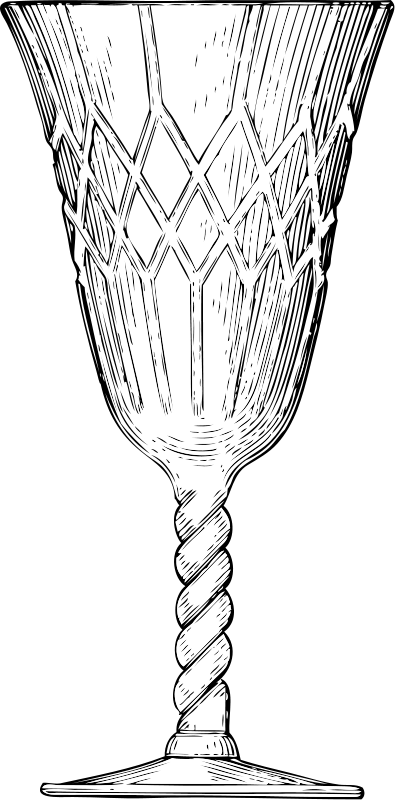
Goblet CrystalThis week’s table for Random Table Thursday brings us goblets! Goblets are everywhere – treasure hoards, at the local tavern, or at the King’s table. Today’s post includes 20 random goblet descriptions to liven up your descriptions. The King no longer drinks from a goblet, he drinks from a goblet of daggers!

As always The Iron Tavern welcome suggestions for next week’s random table. If you have suggestions for next week’s table feel free to leave a comment to this post or over on Google+!


Roll (d20) Goblet Description
1 crafted from smooth black and red marble, the thick stem rises to an oversized bowl
2 slender and smooth pewter colored base rising to thin crystal glass
3 crafted from intricately carved wood the goblet depicts a cluster of feathers forming the stem holding a bowl appearing as a nest of twigs and straw
4 pewter colored metal form the base and stem, giving way to a crystal glass bowl clutched by a trio of crow’s claws
5 crafted of white bone, possibly human, the stem appears as three femurs intertwined, topped by a bowl embossed with dozens of human skulls
6 made of a blue-toned metal, the stem rises to a bowl depicting a great sailing ship on heavy seas
7 made of a blue-toned metal, the stem rises to a bowl depicting a great sailing ship on heavy seas
8 dark metal comprises this goblet, the stem is fashioned to look liked a dozen daggers point up balancing the smooth bowl
9 made of polished silver, the goblet is devoid of any engravings save for the initials ‘LZM’ at the base of the stem
10 green tinged copper depicts two serpents entwined at the stem of the goblet, spiraling upwards to form a coiled bowl
11 the base material of this goblet is gold, though the entire vessel is covered with gems of a myriad of colors obscuring the underlying material
12 made of blown glass, the base and stem fade from an orange hue to a deep black bowl
13 made from resin covered woven fabric, this goblet stands 6″ in height
14 silver goblet with wide bowl engraved with a repeating series of triangular shapes
15 crafted from a ram’s horn, the goblet follows the natural curve of the horn with white and black marbling
16 a thin skeletal hand rises as the stem, grasping an ivory bowl with carvings of carrion birds circling it
17 stem of goblet carved to look like a wolf howling upwards, bowl balanced on wolf’s open maw
18 faded to time, dulled gold forms the goblet, a series of rubies circle the center of the bowl, two of which are chipped
19 a wide base moves up into a slender stem and barely expanding bowl, made of polished purple-hued crystal, a silver band covers the lip of the bowl
20 a black metal forms the bulk of the goblet with a gold elk on either side of the oversized bowl


Awarding XP

MathI have seen several discussions on how people award experience points for their system of choice. Some dole out the experience points by their system’s guidelines. Some make tweaks to the system or do it in a manner completely their own.

When I got back into gaming after a decade long lapse, I came with with D&D 3.x. I followed the experience point system religiously. Calculating challenge ratings, encounter levels and then handing out the appropriate amount of experience. A decent portion of my prep time was being spent with an experience point calculator so I could hand out experience points “correctly”.

My comeback as GM ended after about 6 months thanks to a TPK at the hands of an arachnid mouther. One of the other guys, a long time GM, in the newly formed group took up the reins as GM. He didn’t assign XP. He just told you when it was time to level up. It took just a little bit of getting used to, after all we were so used to recording experience points and watching that progression from week to week. But once we got used to this level up when the GM says, it worked out just fine.

The next time I GM’ed I ran a Paizo Adventure Path. I did not award XP at the end of each session. This alone frees up a good amount of time from bookkeeping. Time that can be better spent in other weekly preparation tasks. Of course with an Adventure Path this is a very easy method to use. Each installment of the AP tells you what level the characters should be at the beginning and at the end. This makes it very easy to keep pace without all of the overhead of calculating XP from week to week.

I adopted this same method for the Dungeon Crawl Classics game I am running online. I do not track XP there either. Characters hit 1st level once the 0-level funnel was complete. From there they level when I say it is time to hit the next level. We’ve been playing since late July, early August and they are 3rd level at the moment.

This method seems to have worked well for this DCC RPG group as well. It saves me a lot of time that can now be spent prepping fun things for the sessions instead of accounting tasks.

The Future

As I continue my closer look at several other OSR type rule systems it appears I may need to change my ways. With character classes frequently reaching their level advancement points at different XP amounts it will be a little harder to tell everyone to level-up at the same time.

I suspect as I finally settle in on an OSR system (or my own unique blend of them) I will end up handing out XP once again. I do not see myself going back to the meticulous accounting I used back in D&D 3.x, but a quick eyeballing, counting of treasure, and roll from there in handing out XP.

Finding this happy medium between arbitrary leveling up and meticulous accounting of XP I think the blend will help give players a feeling of achievement while still keeping my overhead as GM down.

I would much rather spend my limited time prepping the fun parts of adventures than playing accountant via complicated XP systems!

Random Table: Helm Descriptions

Art by Johnny Automatic

Art by Johnny Automatic

Helm descriptions. That is this week’s random table. The descriptions below can be used to give the Gamemaster a quick description for either a magical or non-magical helm. Maybe you just need an identifying feature about the castle guard to spice up your description. Or maybe the heroes have just found a great magical helm that needs some extra flavor.

Have suggestions for next week’s table? Feel free to leave some ideas in the comments of this post or over on Google+!

Roll (d20) Helm Description
1 silver, open-faced helmet with engraved, spiraling design etched into the metal
2 thick metal helmet, nose protecting band, band around the base with carved dwarven runes
3 goldish-hued helm with caged visor.
4 bronze helmet open-faced helmet with layered waffle pattern
5 helmet made of elk’s skull minus antlers, brown with discoloration
6 dark gray helmet, conical in shape with gold trim around base edges
7 open-faced metal helmet, plume made of black horse hair
8 wooden helmet, iron band around base and across the top
9 black visored helmet, visor fashioned into shape of skull
10 bright, mirror-like metal helmet, full-faced
11 boiled leather helm, studded iron band around the base
12 full-faced helm with ornate engraving of an eagle on each side
13 pewter colored metal, open-faced with band to protect nose
14 chain helmet, drapes to shoulders
15 boiled leather helm, a snake has been engraved into the leather, wrapping around the helmet
16 black metal open-faced, helmet, reinforced banding with raised gold decoration around edges
17 full-faced pewter gray helmet, visor has horizontal slits for and edged with black leather
18 battered metal helm, detachable chain face covering
19 boiled leather helm, thick leather bands with low profile metal studs
20 blood red full-faced helm, metal studs dot the helmet


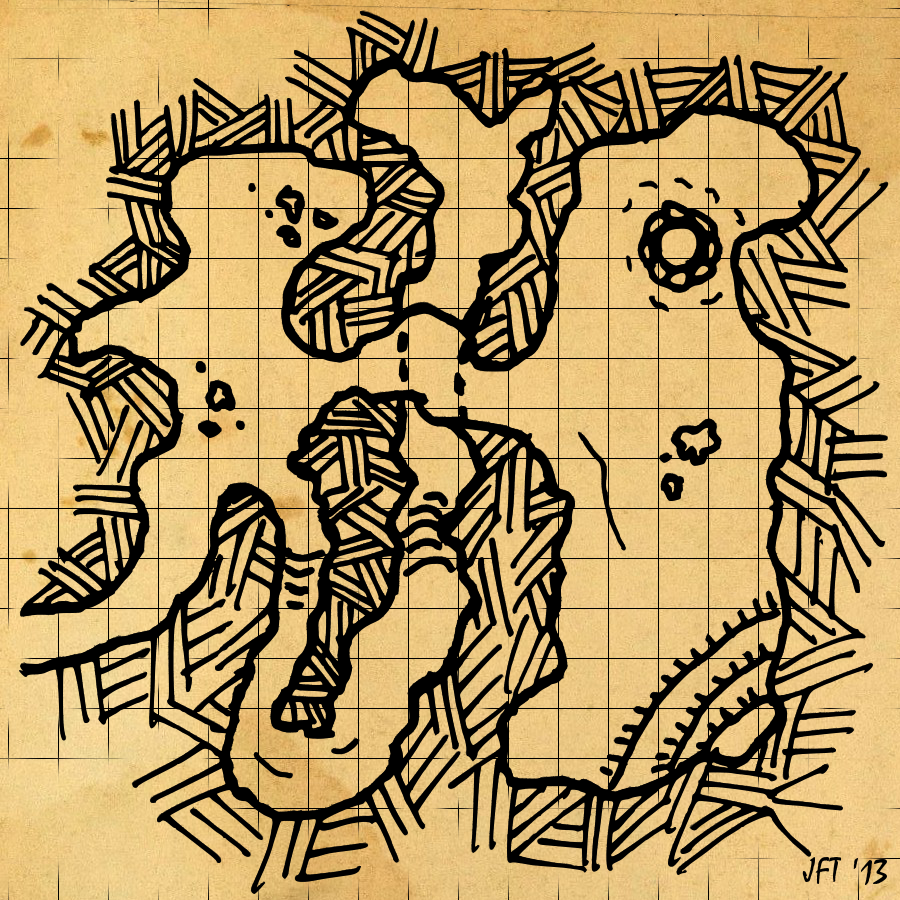
Map: Wishing Well Cave

I have several irons in the fire at the moment, so today’s post will be short! But, given this is Wednesday and Wednesday has become a semi-regular map day, I present a micromap!

This map was originally done on a Post-It note. I used Sharpie Pens for the inking. The Post-It was scanned in and subsequently manipulated in Gimp and Inkscape for the final result. I have a whole collection of these micromaps, but I have not quite decided what I am going to do with them yet.

We’ll call this one The Wishing Well Cave…

Wishing Well Cave

Review: Interludes – Brief Expeditions to Bluffside

brief_exp_bluffside_coverThe Iron Tavern received a copy of Interludes: Brief Expeditions to Bluffside (IBEtB) last week to review. This is a supplement for the Castles & Crusades system published by Samurai Sheepdog and written by Jeff Quinn and Peter Schroeder. This product is a conversion of the original supplement for the Bluffside setting which was d20 D&D 3.x compatible.

The PDF is 42 pages in length, including appendixes and OGL license information. The product is in black and white. The adventure is designed for 2nd level Castles & Crusades characters.

The product includes an extensive Table of Contents. Every major encounter area, NPC, and player handout is included in the table of contents. Each clickable to jump right to the correct location.

Next follows the adventure summary and background and then a course of the adventure section. These are quite handy for a CK to quickly see the flow of the adventure and make reading the rest of the adventure a little easier by having this overview in mind. The adventure centers around a kidnapping of a family from a small village named Kirkwood. The PCs will be investigating and tracking down just who orchestrated this kidnapping.

The rest of the book is broken up into three main sections. Kirkwood, The Holy Grove, and The Crossroads. Each area is well detailed with buildings, NPCs, and maps throughout. The level of detail makes the area feel more like a mini-campaign setting than a single adventure. The detail has both good and bad points, though the bad points can be easily turned into good depending on the CK’s approach the module.

After reading this adventure I felt like there was almost too much going on and this product would be better marketed as setting than an adventure. With the amount of detail and NPCs for even the village of Kirkwood a CK could easily use it as a base of operations and an instantly populated town with interesting people and rumors. The main adventure almost felt secondary.

The adventure arc was good, it just felt a little lost amongst the other detail. A kidnapping with a twist and one that ties a couple of power groups together. I felt the adventure was very solid and would be an enjoyable play.

The module strikes me as better if the CK goes into it with expectations of it being a mini-setting with an already provided adventure with several additional plot-hooks and suggestions for future adventuring in the area. Kirkwood could provide many, many sessions of adventuring between the as written adventure, rumors, and suggested adventure opportunities.

The product is lightly illustrated with a handful of graphics appearing within. There are numerous maps of the area, buildings, and such. The maps suffice, but I think they could have been of higher quality, the resolution seems a little low for several of them. It does not impact the usability of the map though, just the overall appearance.

Overall the product seemed a little rough around the edges, but given just a little bit of work and prep from the CK offers an excellent starting point for a campaign. The town of Kirkwood is wonderfully detailed. There are plot hooks sprinkled throughout via rumors and there are numerous NPCs for a CK to use to generate building their own. While it appears the PCs are meant to pass through the village, it seems like a good place for low-level PCs to call a base of operations.

If you are need of a lower level C&C adventure and possibly a place for your PCs to call home for a bit I think Interludes: Brief Expeditions to Bluffside is a good purchase. Just be aware that it needs just a little polish from the CK to really make it sing and make it your own.