Brainsqualling Techniques

Brainsqualling

Photo by Leszek.Leszczynski @ Flickr

Brainstorming. The term is thrown around enough these days you’d think it would solve all your problems while cleaning your house and cooking you a gourmet five-course meal. It can be done alone or in groups and be quite effective. But it boils down to thinking, talking things out, or doodling on paper or on the computer to come up with or flesh out ideas.

That said, instead of “storm,” I prefer the word “squall.” Storms can last hours or days and may affect larger areas. Squalls pop up quickly, affect a smaller area, blow things around, shake things loose, and rattle the walls… then they’re gone just as fast. That’s more what brainstorming is to me.

So let’s call it “brain-squalling” for now, shall we? And yes, I am getting to a point.

How do you come up with ideas for your adventures or campaigns? Inspiration? A muse? Alien transmissions? And what happens when those sources dry up and you are generating material for the next session? Does the world suddenly stop? Probably not. There’s always another session to plan for!

What I want to cover here is three different techniques I use to rattle things loose in my brain pan when I get stuck… Mind maps, lists, and talking to myself. Hopefully they’ll help you generate ideas as well.

Let’s start with mind maps. In case you’ve never heard of a mind map, here’s a good description. Basically it boils down to using a bit of a graphical approach to draw on both sides of the brain, combining art (circles and lines, so don’t panic) and words (or phrases) and discovering relationships between them.

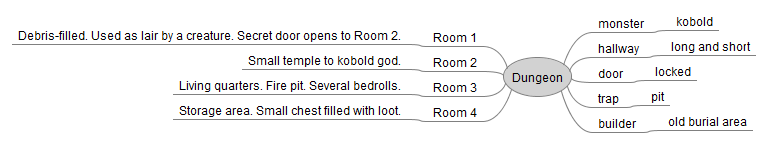
It’s really easy to get started. Get a piece of paper. Write down a word (let’s start with “dungeon” here) and draw a circle around it. Think of the first thing that comes to mind about a dungeon and write that down somewhere close to “dungeon” and draw a circle around it. Then draw a line between “dungeon” and your second term. If more words come up for “dungeon”, add them and circle them. If a word comes up for one of the secondary terms, write it down and connect the two via a line. Eventually you’ll end up with prickly beasts of words surrounded by circles and connected to other circles. Each connection denotes a relationship of some sort. And before long you might have your idea for a dungeon or a session or a whole campaign.

Here’s a sample mind map I came up with for a dungeon (using FreeMind – a free mind map tool)…
RPG Mindmapping

Next up… Lists. They’re everywhere. Whether it’s a list of names, items, or words; or a list of questions to get you thinking about a topic from another direction – sometimes we just need that spark to get us going. Do a quick search on the Internet for “world builder questions” and you’ll come up with a half dozen lists right away including the exhaustive Patricia C. Wrede Worldbuilder Questions or 13 Worldbuilding Questions from Veronica Sicoe (a little more recent), you should get somewhere quickly by coming up with answers for yourself. If you’d rather look at some of the awesome products from Lee’s Lists at DriveThruRPG and other folks – everything from prophecies to monsters, names, artifacts, food, and more.

And there’s always the classic list – Who, What, When, Where, Why, and How? If you’re designing a dungeon, here are a few questions you might ask yourself:

  • Where is it? Above-ground, below-ground, mixed?
  • What’s it made of? Stone? Brick? Wood?
  • Who built it? Miners? Slaves? Contractors? Priests?
  • Why was it built? Honor the dead? Hide treasure? Secret lair?
  • When was it built? Is it ancient? New?
  • How was it built? By hand? Magic? Alien technology?

Lastly, I’ve had great results just talking to myself out loud. There’s something about how the brain processes spoken language vs. how it processes written language that gets entire chunks of the brain in gear that don’t always fire when you’re just reading and writing. I don’t recommend doing it in a crowded place or you may get a few funny looks from your unintended audience, but if you have a few minutes of alone time in a place where you can talk openly it’s made a difference for me.

Use some of the different techniques together… Why not mind map the answers to some of the questions that you’ve asked yourself out loud? Looking at a single problem from multiple angles sometimes reveals interesting creative tidbits.

Hopefully you’ll find one or more of these techniques useful. And if you do use them, let us know how it went!

Brian “Fitz” Fitzpatrick is a Software Engineer who manages (or is that mangles) Game Knight Reviews and tinkers with writing game materials via his Moebius Adventures imprint. When he’s not writing about gaming, he’s actually gaming or at least thinking about gaming in some capacity. During the non-writing, non-gaming time he’s likely trying to keep up with his wife and two daughters or wrangling code for a living!
Random Table: Enemy Organizations

photo by ARendle @ Flickr

photo by ARendle @ Flickr

It is random table day at The Iron Tavern again! This week I bring you 20 enemy organization names. These organizations could be minor groups of people struggling and clawing to make a name for themselves or very complex groups secretly in control of the local government.

The names below can be used as inspiration for campaign plotting or when you simply need a name on the fly.

The Iron Tavern welcomes suggestions for next week’s random table. If you have suggestions for next week’s table feel free to leave a comment to this post or over on Google+!

Roll (d20) Enemy Organization Names
1 Brothers of Blood
2 The Crossed Daggers
3 Society of Purple Pawns
4 The Weeping Willows
5 Slate Society
6 The Rapid Rats
7 Sisterhood of the Wolf
8 Order of the Scarlet Viper
9 The Lone Crow Society
10 The Ember Society
11 The Gray Souls
12 Order of the Six Branches
13 The Hooded Lanterns
14 The Shadow Nobles
15 The Terrible Trinity
16 The Ascendant Society
17 The Corrupt Celestials
18 The Skeletal Crew
19 Order of Wayward Orphans
20 Brotherhood of the Azure


The New Classics: Stonesky Delve

stonesky_coverThere is a shared experience in gaming that I miss.  When I meet adult gamers I can usually talk about Tomb of Horrors or the Sinister Secrets of Salt Marsh and even if we’ve never gamed together we can talk about what it was like to play or run these classic modules.  Even for gamers that never played them they have at least heard of them.

Today that shared experience is more difficult to find.  There are so many different kinds and versions of RPGs people play and countless adventures for them all that it even if I talk about adventures from the largest companies like Wizards of the Coast or Paizo the chance that others have played the same modules is rather small.  With that in mind I humbly offer the following as a new classic.  A module that I feel people should play and have fun with.

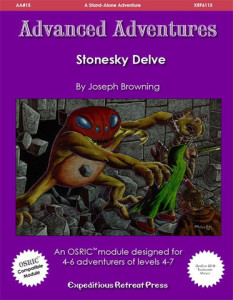
Stonesky Delve is an OSRIC module written by Joseph Browning and published by Expeditious Retreat Press.  It is the fifteenth in their Advanced Adventure line.  At the risk of sounding biased Joe is a friend of mine whom I have gamed with on many occasions. I was a play tester for this module and when Stonesky Delve was first published it was run as a tournament at Gen Con 2010 and I was one of the DMs Joe asked to help him with the tournament.  I enjoyed the module immensely and when I was running Dungeon Crawl Classic RPG earlier this year this was one of the few modules that I had to run for that group.

Before I get farther in there will be spoilers but not a lot.  There will be talk of some specific encounters but mainly just the general themes and feel of the module.

Stonesky Delve is a module for six to ten adventurers of levels four through seven.  The front cover says it is for four to six adventurers and I think that is a misprint but while challenging I think you could go through this with fewer characters.  The setup is rather simple.  A new cave has been discovered and needs explored.  In the beginning text it does have a time limit as it is a module for a tournament, but that can be ignored without significant impact to the module.  The time limit does help keep the PCs moving and the way the module is presented makes that an interesting factor.

The module is designed to run in two sessions.  The first session is cave exploration.  It is really well designed to do this.  There are small spaces that are difficult to fit through.  Instead of many passages branching off left and right most of this module is up and down making it unlike other modules.  Climbing is very important.  The first part of the module contains animals, vermin and monsters one might find in a typical fantasy world cave.  This goes a long way to making the cave feel real but also makes it tough on an adventurer’s pocket book.  There is treasure within, but it is not obvious and not easy to find.

The second part of the module is part of an ancient Dwarven temple connecting to the caves.  This area is not very large so it exploration in a four hour session and does feel more like a more traditional dungeon crawl.  There are some places a TPK can happen and one of them is with a Dwarven wizard that can really be a problem.  There are in module reasons for allowing a dwarf to cast spells, so do not worry about that.  What I really like about the encounter is there are ten rounds of suggested actions for the villain.  These actions are well thought out using the environment as well as the powers of the wizard.  This guy should and will give the PCs fits, but it is also one of those great memorable encounters.   The module also has one of the few encounters with a Flail Snail that I can recall.

Much of the treasure found is not coins.  There are paintings and valuable pieces of furniture and many books.  This creates a new problem as the group has to climb out of here and part of that climb includes a waterfall.  The climb is much more difficult with a bed strapped to one’s back.

The module does have a few new monsters to keep even experienced players on their toes.  My favorite is the Gampoge Hulk cousin to the Umber Hulk and is featured on the front cover of the module.

The module is good for parties that want to explore and fight and to face some different problems like how to safely climb down when the party runs out of rope.  It is not a module that offers a lot of role playing opportunities or mysteries.  There is a riddle to solve but most encounters are going to start and end in bloodshed.

When I ran it for DCC RPG I ignored the level requirements.  The party was full of first and zero level characters, many who died with failed climbing checks.  The monsters descriptions remained the same, but behind the screen the mechanics were mostly the same for each monster.  They only had a few hit points and attacked with just a d20 roll and did maybe a d4 or d6 damage.  Some encounters like the Wizard I prepped for, but most of the conversions were done at the gaming table behind the screen.

Stonesky Delve is a good adventure that offers something a bit different to most fantasy games.  It makes mundane actions like climbing more important and challenging and focuses on the exploration and discovery more so than just wanton killing, though there is that too.  There are rules for tournament scoring so you can keep track of what the PCs do and score them accordingly.  It is a newer module and one I declare as a new classic.

What other more recent modules do you think would be great for other groups to play to get back some of that shared experience?

Chris Gath.  I’ve been gaming since 1980 playing all kinds of games since then.  In the past year I’ve run Pathfinder, Dungeon Crawl Classic, Paranoia, and Mini d6.  My current campaign is mini d6 and we are using that for a modern supernatural conspiracy investigative game.  On some forums I’m known as Crothian and I’ve written a few hundred reviews though I took a sabbatical from reviewing for a few years as it burnt me out.  I was also an judge for the Gen Con awards (ENnies) six times.  Jeff, the owner of this blog, is one of my players and a good friend.

By Way of Introduction

The name is Alan Kellogg, you may call me Mythusmage. I’ve been  around since 1954, with my first RPG being D&D in 1975. Currently a blogger and now revising and expanding the Mythus RPG for eventual self-publication sometime around 2015. I’m opinionated, and ready to post in this blog on various matters, most of which will have something to do with roleplaying games.

Among the subjects to be covered; roleplaying, games, game balance, storytelling, presentation, player-GM interaction, goals, success, and failure. My take on these subjects do differ from that of other people, so be expected to disagree. I am looking forward to substantial discussions, but please don’t flat out contradict me without showing some sign you know what you’re talking about. Above all, no profanity. Explain yourself, and understand that I’m trying to explain myself the best I can. Above all, just because I disagree with you is no sign I must be wrong.

Coming up in the future here are some post topics I have in mind.

  1. How it’s not a game.

  2. Why story has nothing to do with RPGs

  3. Encouraging participation without insisting on balance

  4. Goals vs. victory conditions

  5. Taming the wild ego freak

  6. Engaging the players

  7. What to do when the kobolds kick your butt

More coming, and I look forward to suggestions from you. See you in a week’s time.

Mythusmage

Alan Kellogg. I am a blogger and a gamer, and I opine on various subjects and topics. I believe that you should do your best at what ever you do, and I refuse to cheat on your behalf simply because you refuse to try. Personal initiative is what I believe in, and I’ll do what I can to make your adventures interesting. Demand special treatment for any reason and you’re apt to get stomped on by your enemies and opposition. Give it an honest try, and while you may not succeed, others are apt to extend you some respect.

I live in San Diego CA, have been gaming since 1964 (board games) and 1975 (RPGs). Have credits in Dangerous Journeys: Mythus and have helped out with a few other projects (Charlemagne’s Paladins for TSR for instance). Currently working on a revision of Mythus for possible publication.

Why Pathfinder?

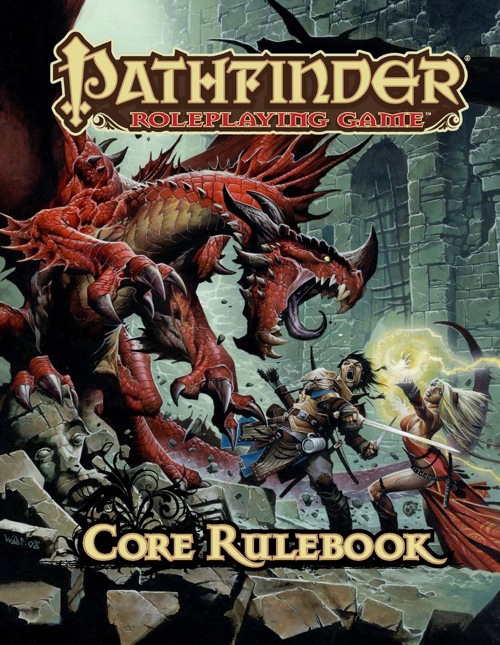
Pathfinder RPG Logo

Of all the fantasy settings I could be playing I most commonly find myself reaching for my Pathfinder books. I run two Pathfinder campaigns, one in person and the other via Google+ Hangouts and play in a third one in person. I find this totally surprising as it was only a chance conversation that even made me aware of the game. Prior to this I had been running a “Play By eMail “ (PBeM) for the Earthdawn system and I also spent some time running in person Dungeons and Dragons (D&D) 3.0 games and was heavily into D&D 4.0 at the time Pathfinder got mentioned to me.

I think the reason that I missed the whole Pathfinder band wagon when it kicked off was that I ignored D&D 3.5 when it came out. I was not impressed with third edition which we had waited for with insane anticipation and rather than seeing 3.5 D&D as an improvement on the system I chose to (foolishly) believe it was another assault on our wallets. So as I was not hugely invested in D&D 3.5 material I missed the transition phase that lead into the D&D 4th edition and the branching path that Pathfinder took. In fact when 4th edition D&D came out a mate of mine and I were ready to give D&D a go again so with blind faith we bought the new books and started playing the tabletop board game with roleplaying elements that D&D had become. But it was a game we had invested heavily in so we persevered.

I live in a small rural town so when my wife and I went to Melbourne (Australia) for a weekend away I went on a journey to the game store that I get all of my RPG mail orders from. I bought a large pile of D&D books to take home with me when I met an old friend for a drink or two. We were talking about role playing at the time and I talked about how ordinary we thought 4th edition D&D was and he asked if we had considered Pathfinder. It was the first time I had ever heard of the game. Two weeks after getting home I had a copy of the main rulebook and I read it in a day. This was the game that 4th edition D&D should have been in my opinion and I soon had my players transferring their characters into Pathfinder having never opened a single one of the 4th edition D&D books I had bought on that trip.

So that is how I came to Pathfinder. I never looked back either and have now sold off every 4th edition D&D manual I had. But what was it about Pathfinder that made me turn away from a huge investment in books and time that I had with 4th Edition (and for that matter Earthdawn and a variety of other games)? In essence I can tell you that it was the fact that Pathfinder rules made sense. They resonated with me and were very easy to read. The emphasis was taken away from what you could do on a map (although there were map rules if you chose to use miniatures) to again being an open ended role playing game. You were free to imagine how a skill combined with a spell worked rather than being locked into a menu selection of abilities that you could choose from.

The benefit of this all was it basically was D&D as well. Thanks to the Open Source Licence of 3rd edition here was a game that felt familiar to roleplayers everywhere. Armour Class, Hit Points, Saving Throws! Familiar creatures were abundant as were the spells. Of course some of them lost their flavour text because it was Wizards of the Coast Intellectual Property and some vanished altogether (like Beholders grrr…) but on a whole it was a system that you felt you understood from the start. And what an impressive start! The core rulebook was where I began, 576 pages in glorious full colour with excellent artwork! It is a big tome of information but it is beautifully presented and professionally laid out.

The main rulebook has all of the races and the classes that you would want to see available! Also the main rulebook contains most of what you need to play. There is a Gamemasters Guide but it is not needed to run the game. It deals with information helping Gamemasters to build their worlds and make their NPC’s appear fleshed out. Don’t get me wrong, it is a great resource and contains some extra material that really enriches the game but it is not really needed to play. The only other book that is really needed to play in a Fantasy setting is the Bestiary. When I came to the game they had just released the Advanced Players Guide which I picked up as well. It contains some great options for the core classes and some great new classes to flesh out the game with and provide all kinds of options to players across the board.

New books continue to evolve the system and setting. Above I have only spoken about the Core rule books (which now include Ultimate Magic, Ultimate Combat, Ultimate Equipment, NPC Codex, Bestiary 2, Bestiary 3 and the Advanced Race Guide) but there is so much more to the game. Each month they release an Adventure Path module, two whole adventure path’s are released in a 12 month period (6 modules per path) and numerous campaign support material books flow out of Paizo making it one of the most prolific, well supported settings that I have ever seen. The official Pathfinder has the core world of Golarion with an established Pantheon and area of play that has a great diversity of adventuring potential for all tastes.

pathfinder_core_coverIt is not just the materials that Paizo presents for its Pathfinder range but also the third party support for it. Being an open licence system there have been many other games and worlds that have aligned themselves with the Pathfinder Role Playing Game System (PFRPGS) and Paizo manage a store where the third party publisher can sell their own products along with Paizo’s own work. Paizo also freely advertise what they think are great additions to their game in their own products suggesting third party products along with their own if it enriches the game. I purchased a product from a third party publisher purely on the foreword of one of the adventure path modules where the Paizo employee explained how great the product made his game! This gives me the feeling that the people at Paizo are gamers making games for gamers.

Now for the final bonus. In a world that is driven by technology what do Paizo do? They release all the rules and guidelines from the Core rulebooks for free on the internet. No need for a subscription, all you need is access to the internet and a web browser. The complete rules set (less any Intellectual Property to the world of Golarion) is up for everyone to use at http://paizo.com/pathfinderRPG/prd/ which means you can play this game without shelling out a cent for the books. There are apps that turn this website into an offline source of information for iOS and Android phones and tablets also meaning you need not lug all your rulebooks or computer around to wherever you play. I am a lover of books though and the quality of the art and the hardback books is in my opinion well worth the cost. I rarely use the books, relying instead on an iPad App but on occasion I love designing with all the books open around me or showing my players one of the excellent illustrations of a creature that is about to eat them.

So, in this world of Indie developed rules lite games many may call Pathfinder a bit out of fashion. The question also hovers about how D&D Next will affect what is now the most popular tabletop roleplaying game of the moment. I have just signed up for the playtest of D&D Next and from what I have read so far it will be an interesting time as release of 5th Edition D&D comes closer. To my eyes though Pathfinder has provided a wonderful setting backed by an excellent set of rules and a variety of play options. It may be rules heavy, but this aspect of the game never feels overwhelming which to me means they got it right. I just get the feeling that Paizo are going from strength to strength at the moment. They listen to the community carefully and they respond at an individual level.

So I challenge you. If you have not given Pathfinder a look yet, why not? Go to the Pathfinder Reference Document and have a poke around. I am sure you will not be disappointed.

Mark Knights is  39 year old guy living in a small rural town called Elliott in Tasmania, Australia.  I have been role playing since I was 11 years old playing the original versions of Dungeons and Dragons, MERP, Elric, Dragon Warriors and the like amongst other genre games.  I played D&D 2nd Edition through the 90’s but I ran Earthdawn for my fantasy setting and loved it as a GM.  When 3rd Edition came out for D&D I tried it but found it too heavy on rules.  I ignored the 3.5 edition of DnD in favour of Earthdawn (big mistake) as I thought it was just a money spinner.  When 4th Edition DnD came on my players and I gave it a red hot go but hated what it had dumbed the game down to be.  On a trip to Melbourne to buy some 4E stuff from a hobby store an old mate of mine pointed me at Pathfinder and in a Fantasy setting I have never looked back.

Welcome New Bloggers!

Quill BooksLast week The Iron Tavern put out the call to add a few bloggers to the pages here. I felt there was more going on in the fantasy RPG community than one single blogger could keep up with. I have experimented with guest blogger posts in the past with great success. The Iron Tavern has been able to provide reviews and commentary on other fantasy gaming systems I might not have found time to give the attention to.

By adding bloggers it also presents the opportunity for new perspectives and ideas to be offered on a regular basis at The Iron Tavern.

I had several people interested in blogging for The Iron Tavern as a result of the call I put out last week. I have chosen four of those people to being regular posts. This week will be an exciting week as we see the first of those posts start to appear.

Today I wanted to introduce the new folks. I asked each of them to write a brief bio about themselves for today.

Mark Knights

I am a 39 year old guy living in a small rural town called Elliott in Tasmania, Australia.  I have been role playing since I was 11 years old playing the original versions of Dungeons and Dragons, MERP, Elric, Dragon Warriors and the like amongst other genre games.  I played D&D 2nd Edition through the 90’s but I ran Earthdawn for my fantasy setting and loved it as a GM.  When 3rd Edition came out for D&D I tried it but found it too heavy on rules.  I ignored the 3.5 edition of DnD in favour of Earthdawn (big mistake) as I thought it was just a money spinner.  When 4th Edition DnD came on my players and I gave it a red hot go but hated what it had dumbed the game down to be.  On a trip to Melbourne to buy some 4E stuff from a hobby store an old mate of mine pointed me at Pathfinder and in a Fantasy setting I have never looked back.

Currently I run a couple of Pathfinder campaigns (one on Google+ and the other in person) and a Classic Traveller campaign (on Google+).  I am finishing the alpha version of my own game which is highly confidential at the moment.  I run my own blog at www.thepathfinderchronicles.com which initially was going to be a Pathfinder only blog but has broadened since its start in October last year.  In real life I still don’t know what I want to be when I grow up, but I am currently working as a teacher of all things Computer!

Brian Fitzpatrick

Brian “Fitz” Fitzpatrick is a Software Engineer who manages (or is that mangles) Game Knight Reviews and tinkers with writing game materials via his Moebius Adventures imprint. When he’s not writing about gaming, he’s actually gaming or at least thinking about gaming in some capacity. During the non-writing, non-gaming time he’s likely trying to keep up with his wife and two daughters or wrangling code for a living!
Alan Kellog

The name is Mythusmage. More formally, Alan Kellogg. I am a blogger and a gamer, and I opine on various subjects and topics. I believe that you should do your best at whatever you do, and I refuse to cheat on your behalf simply because you refuse to try. Personal initiative is what I believe in, and I’ll do what I can to make your adventures interesting. Demand special treatment for any reason and you’re apt to get stomped on by your enemies and opposition. Give it an honest try, and while you may not succeed, others are apt to extend you some respect.

I live in San Diego CA, have been gaming since 1964 (board games) and 1975 (RPGs). Have credits in Dangerous Journeys: Mythus and have helped out with a few other projects (Charlemagne’s Paladins for TSR for instance). Currently working on a revision of Mythus for possible publication.

What will my blog posts here be about? Better gaming, better play, making your adventures more involving and involve more. You’ll learn more as the posts progress. So welcome, and I hope you find what I write interesting, informative, and useful.

Crothian

Well known for his reviews from the glory days of EN World, Crothian brings his wealth of reviewing experience to The Iron Tavern. In addition to reviews Crothian has years decades of gaming experience that often causes him to experiment wildly with game rules to push the limits. From feats at every level in D&D 3.5 to starting a Pathfinder adventure path with existing 9th level characters, Crothian explores the boundaries of various gaming systems.

The Iron Tavern welcomes the new bloggers!

Castles & Crusades Weekend Sale

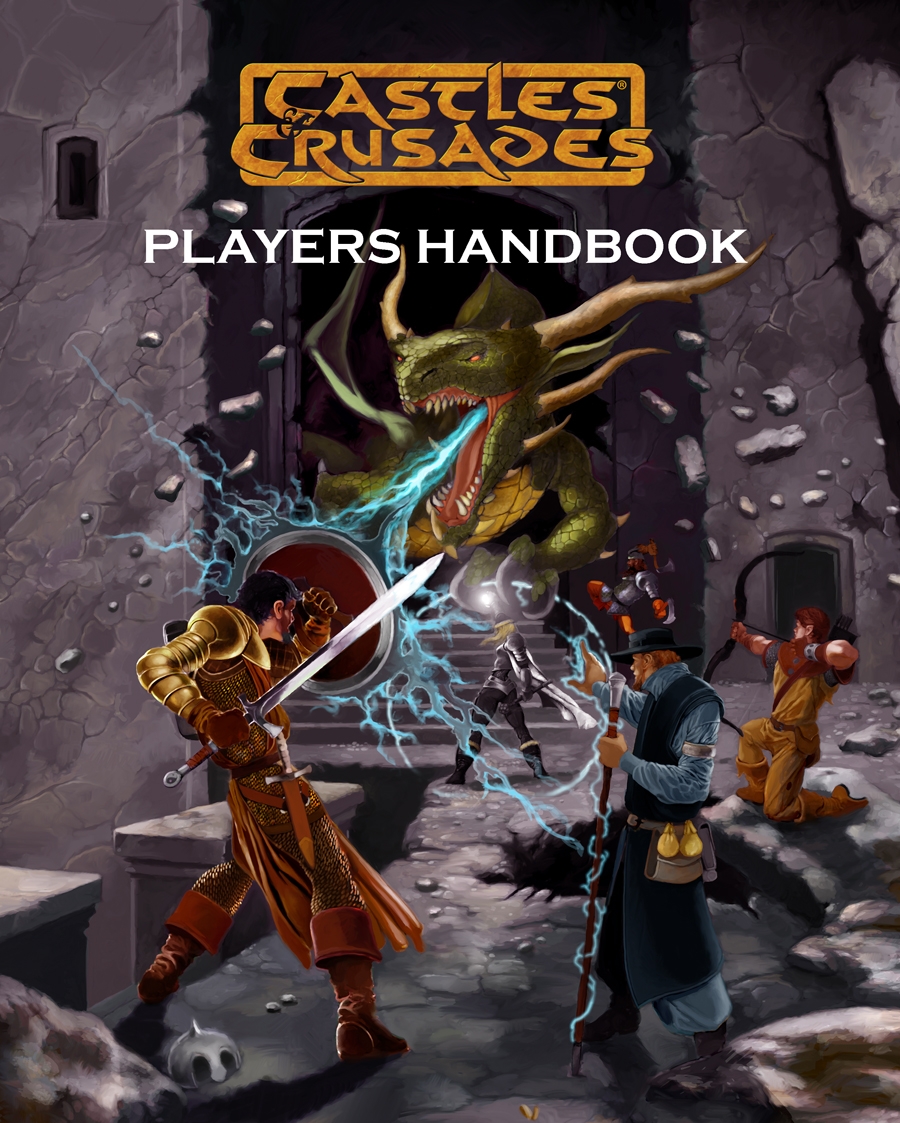
Castles and Crusades Players Handbook CoverTroll Lord Games is having a 50% off sale on their Castles & Crusades PDFs this weekend over at RPGNow! This is a really good deal for someone looking for an inexpensive way into the Castles & Crusades system or hooked at their last sale and ready to pick up some more supporting material.

Included in the sale are the Players Handbook, Castle Keepers Guide, and Classic Monsters.

Castles & Crusades is a great rules-light, but still robust, system if you are feeling weighed down by hefty tomes of rules from more recent rule systems. I wrote a little about Castles & Crusades late last year here at The Iron Tavern.

Note: The prices on the main listing pages seem to reflect the discount correctly, the individual product pages are not. Once you add them to your cart the discounted price is reflected.

Map: Deerpond Village

Over the past few months I have been working to improve my mapping skill and made reasonable progress along the way. Earlier this week I was asked how much I worked with color. I thought for a moment and realized all of my maps are quite black and white save for the backgrounds I drop in behind them.

I am not sure why it had not occurred to me to play with color and my maps. I think a lot of it is because I like the old school feel of the black and white maps and the hashing. I think they come off looking clean and are by their very nature printer friendly.

I decided I wanted a village to toy around with coloring in the map. One day at lunch this week I drew up a small village near a pond. This was done in Sharpie Pens. I skipped the pencil step for this map as I was just letting things flow and was not necessarily trying to recreate something I already had in my mind beyond the bare basics.

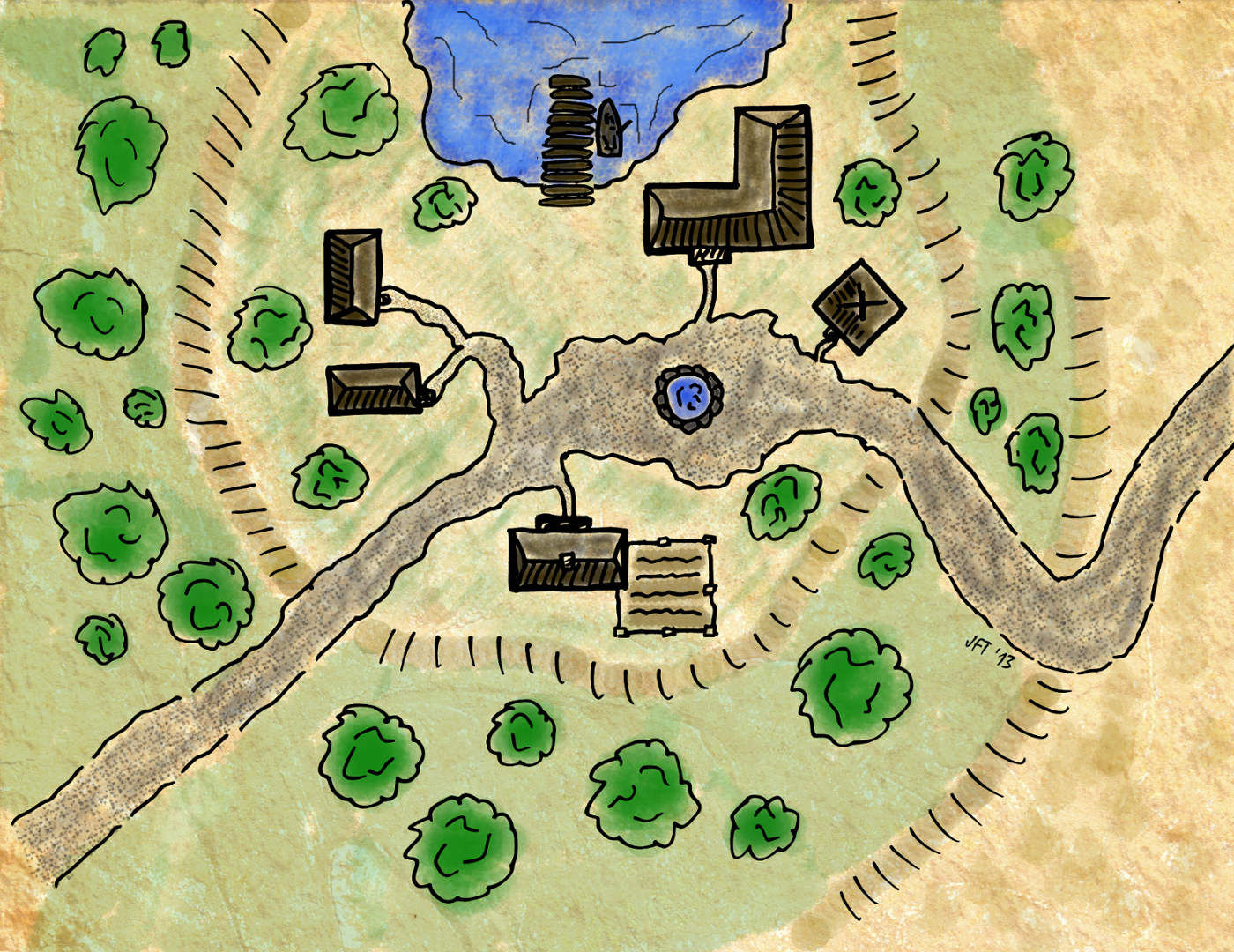
Once the map was complete I scanned it in at home that evening and cleaned it up a bit and tossed in the background. From there I used Gimp and some watercolor brushes to color the following map.

I think it came out fairly well for my first real attempts at playing with color with my maps. And with that, I present you with Deerpond Village:

Deerpond Village

Deerpond Village

Deerpond village takes its name from the small pond to the north of town. On many an early morning several deer can be seen drinking from the pond. The village sits on top of a small rise, gaining a good view of the surrounding low rolling hills.

The village is a very small community, home to a handful of houses and a large inn, The Scarlet Pheasant. The inn serves several roles for both the villagers and travelers through the area providing lodging, food, and acting as a community center for Deerpond Village.

The residents of the village primarily make their living off the land with excess furs and meat from hunting being traded and sold. The folk are a good people and enjoy the tough life in the near wilderness.

Plot Hooks

  • Recently the hunters have been returning from their hunts reporting finding large humanoid footprints coming down from the more rugged hills several miles away. The hunters believe the hill giants are wandering further from their homes than normal. Each week the prints get a little closer to the location of the village. Is something chasing the hill giants from the hills or are the hill giants expanding their area of control?
  • A day to the west lies a larger city. On a bi-monthly basis a pair of wagons leaves Deerpond Village to carry goods to the city for trade and bring back items the villagers cannot produce on their own. Over the past months bandit activity on the road west has been growing. There is talk among the village they may be forced to stop their trade to the west until the bandit issue is dealt with.
  • Just east of town past the switchback in the road is a small graveyard. The graveyard has been used for many years with gravestones predating any local knowledge of the current residents. Last week two of the gravestones dated from over 150 years ago were found tilted askew and the earth appearing freshly turned. Skeletal footprints were seen leaving the gravesite and then disappearing. Some of the finest hunters have tried to track the prints and failed. None are brave enough to dig up the two graves and confirm if the bodies are still laid to rest.

Random Table: Shield Coat of Arms

Shield Coat of ArmsIt is Thursday again at The Iron Tavern, which means another random table! This week I focused on coat of arms for shields. I purposefully left the shape and size of shield out of the description and focused on the actual coat of arms. The ideas below could be used when you need to spruce up a description or even as seeds for ideas about a particular NPC.

The Iron Tavern welcomes suggestions for next week’s random table. If you have suggestions for next week’s table feel free to leave a comment to this post or over on Google+!

Roll (d20) Shield Coat of Arms
1 a field of stars over the ocean with high waves
2 black tower on a forest green background
3 The head of a great elk on a pale gold background
4 a brown lute across a light green background
5 crossed silver hammer and axe on a black background
6 a three headed crow sitting on a limb of a leafless tree
7 a solid scarlet line runs down the left side against a gray background, a long spear and helmet grace the right side
8 the head of a roaring red dragon painted against a silver background
9 a silver skull with two crossed great axes on a black background
10 foaming tankard of ale on a tan background
11 a purple worm breaking up through a pile of rocks on a black background
12 broadly painted blue lines cross the shield, one on the far right and one across the top, a script letter ‘S’ is in the lower left quadrant
13 a wolf howling skyward on a rocky outcropping
14 a gold crown on a black background, the shield rimmed in gold
15 two broad black diagonal stripes with a silver key intersecting them on a white background
16 A black serpent coiled around a polearm against a yellow background
17 A tall oak tree set against a light blue background
18 a knight with lance on a white charger on a purple background
19 A pair of crossed arrows burned into the wood of the shield
20 a hilt up two-handed sword against a red background


Blogger Wanted

Writing with a QuillThe Iron Tavern is looking for a blogger interested in contributing a regular weekly post to the site. My guest blogger experiments in the past have been a positive experience and now I would like to expand that role a bit.

What can I blog about?

Regular readers of The Iron Tavern know the site is primarily dedicated to the fantasy genre of roleplaying games. Articles tend to track with my current gaming system interest. This is one of my primary motivators for adding a blogger to The Iron Tavern’s author pool, to keep the variety of posts up at the site.

Blog posts can be commentary, recent news in various fantasy RPG systems, commentary fantasy RPGs, or anything else that is related to fantasy RPG systems. Specific areas I would like to see more coverage on regularly is the Pathfinder system, how the D&D Next playtest is going, or your OSR system of choice. If one of those topics sounds like something you would like to write about then send me an email and lets talk.

Why would I want to blog for The Iron Tavern?

This is not a paid blogger position. This is a position for someone that loves to talk about fantasy RPGs and would like to tap into an already established (and growing) audience.

Maybe you are a blogger with your own site who wants a regular guest article at another site to increase your own audience. The Iron Tavern can be the vehicle to help facilitate that.

Or maybe you have wanted to start your own blog but not wanted to handle the maintenance and administration of the site. Or thought you couldn’t keep an audience because you weren’t ready to commit to the number of postings needed to do that per week. The Iron Tavern is an already established blog that can act as your platform.

I am looking for someone that can provide one blog post per week, but maybe you are a more prolific writer than that. The blogger chosen will certainly be allowed to post more than one article a week if you have quality content to provide!

Now what?

Interested in blogging for The Iron Tavern? Contact me at the email address I list in the About page of this blog. Please provide me a brief rundown of writing experience you may have. A short writing sample or links to other blog posts you may have made in the past are fine. Don’t forget to mention what types of topics you think you will cover as you get rolling. If things look to be a good match I will review the flow of providing posts to the blog and we will go from there!