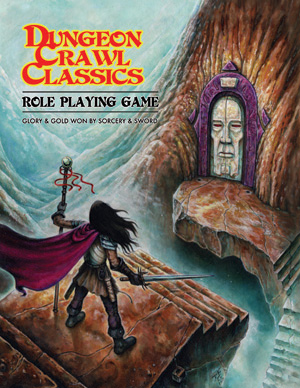
DCC RPG: The Halfling

We are in the home stretch now for my weekly series of looking at each of the Dungeon Crawl Classics RPG character classes a little closer. The Iron Tavern is down to just the Halfing, the Wizard and the Elf left for further review. In previous weeks we have looked at the Warrior, the Thief, the Dwarf and the Cleric.

This week I put up a poll and let the readers decide which character class to look at this week. It was a close race between the Halfling and the Wizard for most of the polling period. In fact, I had planned to close the poll at 5pm on Wednesday but the two classes were tied! I ended up extending the poll another four hours for last minute voting. The Halfling pulled it off, bringing in 48.15% of the vote!

The Class

The Halfling is a creature of comfort in Dungeon Crawl Classics RPG. Typically found in country environments and preferring peace and quiet. Halflings generally seek to avoid interacting with the “tall folk” unless some need drives the need for interaction. They prefer a life of simple crafts – gardening, farming, trinket making and such.

The adventuring Halfling is frequently one that is a trader, necessitating the need for contact with the “tall folk” or a Halfling that has fallen out of graces with his Halfling community. Even then the intrinsic desire for community and family tend to keep their alignments in the Lawful side of things, with the rare case a Neutral alignment. Chaotic Halflings are quite rare, though not necessarily unheard of.

Halflings are of small size ranging in size between two feet and four feet with a smallish hit die of a d6. This small size do get Halflings a bonus on stealth checks allowing them to add a bonus that progresses as their character level increases. Halflings do get infravision, though not to the range a dwarf character has. The movement for a Halfling is at a 20′ rate as well.

One of the class features a Halfling receives in DCC RPG is the ability to wield two weapons effectively regardless of the character’s Agility score. A Halfling is always able to wield two weapons and only suffers a -1 die penalty (i.e. they roll d16 on both attacks instead of a d20). A Halfling is able to fight with two equal-sized weapons, so you can play a dual short sword wielding Halfling if you wish. Another fun perk is that the Halfling only fumbles if both rolls come up 1.
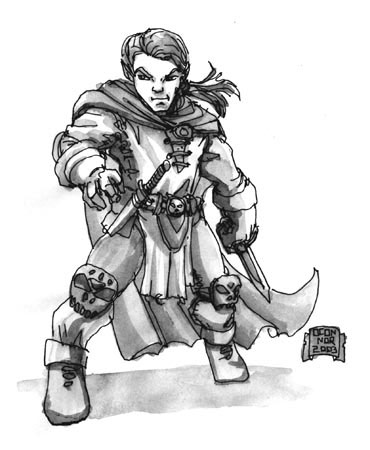
Courtesy deathbstrd at DeviantArt

The Halfling also has an ability known as the ‘Good luck charm’.  Halflings are able to make use of luck in several more ways than a typical DCC RPG character. First, a Halfling receives a bonus of 2 for every point of luck spent as opposed to a one-to-one ratio. Halfling’s also have the ability to recover luck, similar to a Thief. Each night a Halfling can recover luck equal to the Halfling’s level.

And finally, because Halflings are so lucky they can spend luck to aid other party members. The only requirement is that the person the Halfling wishes to aid must be visible and nearby. Only one Halfling per party can act as the luck charm of the party.

My Impression

The interesting portions of the Halfling to me rest mainly in the ability to use two-weapon fighting easily and their ‘good luck charm’ mechanic.

Two-weapon fighting granted as a class ability is quite fun. Granted you have to roll d16’s when attacking with two weapons, but that is not a horrible penalty. For some reason a Halfling fighting with a pair of daggers or short swords just feels right to me. It also gives a small statured Halfling some form of being capable in combat.

The luck mechanic for the Halfling is also a great boon for the class or even any adventuring party that includes a Halfling. One thing to remember is that the decision to expend luck can be made after the initial roll has been made. With a Halfling that can recover luck on a nightly basis, that is fairly significant and greatly improves the Halfling’s odds of survival given their slight stature.

Couple this with their ability to not only spend luck at a 2 for 1 ratio, they can also aid other party members as needed. A Halfling in the party could really affect the survivability of certain encounters if the Halfling party member can spend luck to help boost some of their rolls.

The Halfling in DCC RPG might be underestimated as a character class. I think DCC RPG has done a good job of making the Halfling a viable character race. Between two-weapon fighting and the incredible luck mechanics the Halfling can really help turn the outcome of an encounter in this game.

I think the one thing that could make the Halfling a little better in DCC RPG is to allow them to pick up some basic Thief skills. I do not know why, but when I think Halfling I always tend to think of a small, agile thief type character.

So… How does the Halfling work in actual play? I judged a game with a Halfling and the player seemed to have a great time with the character. The most memorable moment of a game with a Halfling in it was the “rolling ball of Halfling death”. With two-weapons the Halfling chose to roll out past a shield wall and amidst the middle of some attacking rats. While luck did not really come to play that round, it certainly could have and exemplified the possibilities for this character class.

Once again, despite sounding like a broken record, I think Dungeon Crawl Classics has hit the essence of a character class quite well with the Halfling character class. While I do think some thieving type skills might put it a little more on the mark, the class is still fun to play and is certainly in the ballpark as to how I think playing a Halfling should feel.

Addendum

Next week is Gen Con week. While The Iron Tavern’s Gen Con plans are up in the air, I will likely skip next week in my look at DCC RPG character classes since I suspect a lot of my readers will be at Gen Con. I will continue my look at character classes on Friday, August 24th with a look at the Wizard!
AetherCon August Update

AetherCon has been hard at work preparing for their Online Convention this Fall. Here are the latest updates for their event from the past three weeks:

Press Release

We’d like to welcome Ethan Parker and Jon Gibbons to the AetherCon staff. Mr Parker, the organizer for KantCon, has signed on to take the position of GM Coordinator. Mr. Gibbons (AEG, PEG) has been named to the Art Directors post.

The following games have been added to our schedule:

  • William T. Thrasher – Call of Cthulhu Tournament – “The Wounded Sky
  • Julian Constantino – Pathfinder – “Justice For All

William has also been recently tapped by Paizo to do some writing on an upcoming project.

The following games and GMs have recently been confirmed:

  • Greg McClendon – Dark Heresy
  • Roger French Jr – Macho Women with Guns
  • Sherman Sheftall – Runequest 6th Ed

The following game publishers have been added to our supporters by either contributing prize support, guests for the Fest Hall, or taking a booth in our Vendors Hall:

  • 4 Winds Fantasy Gaming
  • Chapter 13 Press
  • Crafty Games
  • d Infinity
  • Silver Gryphon Games
  • Thistle Games
  • White Haired Man

You can see the growing list of companies adding to our prize list by going ‘To The Victors’.

We would also like to thank DriveThru RPG for stepping up and facilitating the prize bundles for our event.

At this time we can also confirm that Ennie nominated Chapter 13 Press, Skirmisher Publishing, and The Design Mechanism will be among those featured in our inaugural convention program.

Among the latest artist news Bradley K. McDevitt has been commissioned by Goodman Games for illustration on an upcoming release.

Our latest wallpaper Grendorey Hu Maggrath by Canadian Will O’Brien has just been released.

Coming Soon:

  • Izael ‘Deeds’ McBride by Patrick McAvoy
  • Billoby Windwarble by Fiona Meng
  • Kruultok Azgratugaar by Eric Lofgren

You can find all of our free downloadable wallpapers here.

The following RPG blogs have joined the Bell & Scroll:

The following Conventions have joined the

Current games confirmed for AetherCon include:

  • All Flesh Must Be Eaten
  • A Thousand and One Nights
  • Atomic Highway
  • Call of Cthulhu
  • Castles & Crusades
  • Dark Heresy
  • Dresden Files
  • Eclipse Phase
  • Fantasy Craft
  • Labyrinth Lord
  • Legends of the Five Rings
  • Leverage
  • Macho Women with Guns
  • Mouse Guard
  • Mutants and Masterminds
  • Palladium RIFTs
  • Paranoia
  • Pathfinder
  • Pathfinder Society
  • Runequest 6th Ed
  • Savage Worlds
  • Shadowrun
  • Star Wars (D6 WEG)
  • Swords and Wizardry
  • Time Lord

Top five cities in North America for unique visitors to our main site to date: Chicago, Ill; San Francisco, Cal; New York, NY; Houston, Tex; Austin, Tex.

Top five cities in Europe for unique visitors to our main site to date: London, U.K.; Nuremberg, Ger; Helsinki, Fin; Moscow, Rus; Hamburg, Ger.

Top five cities in ports abroad for unique visitors to our main site to date: Wellington, N.Z.; Brisbane, Aus; Sydney, Aus; Melbourne, Aus; Florianopolis, Bra.

We are currently looking for GMs to run the following games:

  • Pathfinder
  • Savage Worlds
  • Shadowrun
  • Call of Cthuhlu

As well as these cult favorites:

  • Barbarians of Lemuria
  • Cyberpunk2020
  • Gamma World (Pre-D20)
  • GURPS
  • Halcyon
  • Marvel Heroic Roleplaying
  • Spycraft
  • Star Frontiers
  • Traveler
  • All Flesh Must Be Eaten
  • Atomic Highway
  • Dresden Files
  • Eclipse Phase
  • Fantasy Craft
  • Legends of the Five Rings
  • Macho Women with Guns
  • Mutants and Masterminds
  • Palladium
  • Paranoia
  • Runequest 6th Ed
  • Dark Heresy
  • Serenity
  • Star Wars (D6 WEG)

If you have a cult favorite you’d like to see or run, let us know!

All of our Game Tables and Booths are now linked to Roll20 making it easier than ever for you to try out the engine of AetherCon.

Stephen J. Holodinsky
Event Manager – AetherCon

Vote for Friday’s DCC RPG Character Class Review!

There are only three character classes left in The Iron Tavern’s review of Dungeon Crawl Classic RPG character classes. We have looked at the Warrior, the Dwarf, the Thief and most recently the Cleric so far. For this Friday we will look at either the Halfling, the Elf or the Wizard!

Today I am putting up a quick poll for people to choose which class they would like to see The Iron Tavern take a closer look at. Take a moment and vote for which one you would like to see. I have had some mentions of the Halfling or Wizard so far, but we will see how the poll shakes out!

This poll is only running for a little over 24 hours and I will tally the results tomorrow evening (August 8th), sometime after 5pm Eastern time.

[polldaddy poll=6446507]

Updated Guide to Pathfinder Society Organized Play

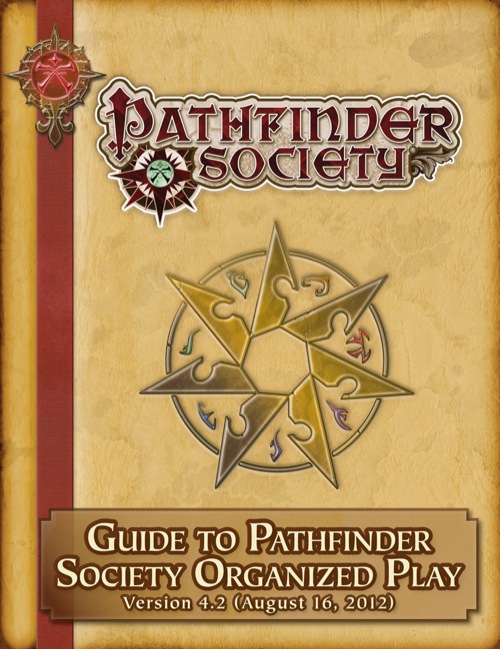
Late yesterday afternoon Paizo released version 4.2 of the Guide to Pathfinder Society Organized Play. Pathfinder Society (PFS) Organized Play is Paizo’s form of organized play for the Pathfinder Roleplaying Game. The Guide is the “rulebook” for participating in PFS. The Guide sees updates throughout the year with the larger one typically coming shortly before Gen Con. This year has proven no different with the release of this version 4.2.

There were several major changes made with this release of the guide along with general clarification of rules in the guide. The major changes were listed on the Paizo Blog and a complete change log was posted to the Pathfinder Society Forums. I encourage you to check those locations for the complete details of the changes as I only intend to mention the larger changes and a couple of the smaller changes.

The larger changes that Paizo calls out on their blog are as follows:

  • Added three new races to character creation for all players to choose from: aasimar, tengu, and tiefling.
  • Scenarios and sanctioned module now have one unified set of rules for applying Chronicle sheets to pregenerated characters.
  • Added all hardcover rulebooks to the Core Assumption for GMs and advised that GMs can refer to the Pathfinder Reference Document for rules from any books they don’t own.
  • Updated text so GMs are now allowed to take boons when they are offered on a Chronicle sheet.

I am glad to see the scenarios and sanctioned modules having a unified set of rules for applying chronicle sheets to pregens. That just helps simplify things and make things a little easier to understand and handle correctly. I also think it is great that GMs can now take boons when they are offered on a Chronicle sheet. GMs work hard and it is good to see a GM able to get rewards to apply to their own character.

I am certainly not thrilled about the addition of the three races. I know a lot of people do like that change, but I have never really grown use to what I still consider “fringe” races. I am not a fan of GMing those races and even less of a fan of playing a character next to one of those races. My dislike of this rule is of course a personal bias. I suspect Mike Brock and Mark Moreland have heard frequent requests for these races and are just listening to the community.

While adding all hardcover books to the core assumption is likely a good thing, it does really increase the hurdle for a new GM to PFS. It is nice that Paizo says the PRD is a valid source for the rules removing the monetary hurdle of needing to own all of them, it still is a lot of rules for a new GM to PFS to be expected to know.

With this release of the PFS Guide several archetypes were cut from allowed for play:

  • Gravewalker Witch
  • Master Summoner
  • Synthesist Summoner
  • Undead Lord Cleric
  • Vivisectionist Alchemist

These archetypes are being removed either for not fitting with Golarion thematically or for power imbalance within organized play. I can respect that and think it is good that the campaign takes steps to correct some of these imbalances. I know I have heard numerous complaints about the Synthesist Summoner and it being ripe for abuse.

Let’s take a look at some of the changes from the change log that stand out to me.

First up:

“The leadership of this campaign assumes that you will use common sense in your interpretation of the rules. This includes being courteous and encouraging a mutual interest in playing, not engaging in endless rules discussions. While you are enjoying the game, be considerate of the others at the table and don’t let your actions keep them from having a good time too. In short, don’t be a jerk.”

I love this addition! So many times rule discussions can turn into something that sounds like two lawyers tearing apart the language used to make their case. Really, at the end of the day, Paizo just wants us to have fun playing this game. While the English language can be torn down to a finite point, use some common sense and try to realize we are here to play the game and have fun. The rules should facilitate that. Great addition!

Another added section is in regards to the Pathfinder Society Community:

You may not simply ignore rules clarifications made by the campaign leadership, including the campaign coordinator and campaign developer, on the paizo.com messageboards. GMs are not required to read every post on the messageboards, but GMs familiar with rules clarifications made by the campaign leadership (which have not been superseded by the Guide to Pathfinder Society Organized Play or FAQ) must abide by these clarifications or rulings. If it is a significant clarification, it will be updated in the FAQ, and later in the Guide to Pathfinder Society Organized Play if necessary.

I think this is a good move at trying to determine how the rulings on the message board are to work. Pretty much if you know something has been clarified on the message boards, but hasn’t made it to the FAQ yet, still follow it. Every effort will be made to add significant items to the FAQ which all GMs are responsible for knowing and following.

First Level retraining is noted in the change log. This is a pretty big deal and a good move for those getting their feet we with Pathfinder or Pathfinder Society in general. This allows a character to change anything they want with their character between adventures and before they hit 2n level as long as the PFS number remains the same. Exceptions to this rebuild will be listed in the PFS FAQ.

A couple of allowed to carry-over spells were added:

A character may have one each of the following spells that carries overs from scenario to scenario: continual flame, masterwork transformation, secret chest, and secret page.

Another good change in my opinion. The continual flame question seems to arise a lot on the message boards. In following with the common sense reading of rules above it only makes sense that continue flame be allowed to last from session to session.

There are numerous other small changes listed in the change log that I am not mentioning here. I have covered what I consider to be the highlights along with some of my commentary on them.

The look and feel of the guide has really improved over the years as well. The layout and feel continue to more closely emulate one of Paizo’s normally released books. Very crisp and clean. The additional attention to the look and feel is important I think as people new to Paizo’s organized play system will have this guide as their first contact with the system.

While I am not a fan of the new races, there are a lot of good changes in the Guide this time around. Whether I agree with the new races or not it does show the Paizo staff is listening to feedback and not afraid to make changes. I do believe they have the best interests of PFS in mind when they make these changes.

Review: Toys for the Sandbox – The Old Pier

Author:  Quinn Conklin
Art: Teo Commons; Rodney Ruppert
Publisher:  Occult Moon Games
Price:  $1.99
Pages:   12

Occult Moon Games is already up to Issue #30 with their Toys for the Sandbox line. I admit, I’ve been following these Occult Moon guys on various social media networks and heard the name Toys for the Sandbox, but never really looked very closely. Recently though a couple of review copies from this line came my way.  It seems I have been missing out.

The Toys for the Sandbox line is described by Occult Moon as a framework for a GM to work from.  The product is system-less and provides the GM with a snack-sized chunk of a location that can be dropped into nearly any fantasy campaign world. Each issue contains a location with a map and flavor text, four NPCs with some background information, six plot hooks with twists to change them up a bit, and typically a table that includes rumors or encounters.

I was able to take a look at two different issues of the Toys for the Sandbox line, #23 The Pirate Island and #30 The Old Pier. As noted above, each contains a location with map, description, NPCs, and plot hooks. Both have enough story to get a GM up and running quickly for an evening’s diversion, without being tied too much to a particular setting. With that said, The Old Pier is written to fit in on the island described in The Pirate Island issue, but it could be transplanted to another city with minimal effort.

Each product described the location with enough detail for a GM to have an excellent starting point to drop the location into their own campaign. The NPCs included in each also had enough detail that a GM could read them with minimal prep and be ready to run them. The plot hooks, along with three twists per plot hook, were also wonderful time savers for a GM that needs to come up with something on the spur of the moment.

The maps in both products I reviewed were drawn by Teo Commons. Both were very well done, but the map in The Pirate Island was stunning. The map very clearly depicted the island as described and the color with aged effect was excellent.

Issue #30 has seen a page count increase and an improved layout. This issue contains a bookmarked table of contents. I find the bookmarks in the PDF valuable and a good improvement over Issue #23. One minor quibble was the font used for the text. The font looked nice, but I found it difficult to read.

Overall these are great resources when a GM needs to come up with something quickly for an evening of play. A GM that is planning ahead and simply wants a drop-in location with a lot of the heavy lifting already done can also use them. Being system-less is an added bonus. I will certainly be keeping a closer eye on this line from Occult Moon.

Angels, Daemons, and Beings Between: A Patron Sourcebook for DCC RPG

Patrons are an interesting aspect of Dungeon Crawl Classics RPG. Wizards work their magic by drawing from supernatural places and beings. In times of great need or desperation a Wizard can seek to call upon the powers of a patron directly. Doing so can be risky, but can have immense payoffs.

In DCC RPG each patron comes with a realm of influence or responsibility and have several tables that pertain to the Invoke Patron check, Patron Taint, Patron Spells, and spellburn options.

While the patrons included in the DCC RPG core rules are well detailed and set the example, many people have asked for more patrons to choose from. The rules encourage a judge to create their own patrons, but many gamers struggle to find time to prep adventures, much less design more patrons for their game.

For the judges that are looking for more patrons, you need to take a look at the Angels, Daemons, and Beings Between project over at indiegogo. The project has already met its initial funding goal with a little more than a week left to hit some of the stretch goals.

The project will be published by Dragon’s Hoard Publishing. The book will be 32 pages long and be available in PDF and Print depending on which level you join at. For each of the stretch goals that are reached an additional 16 pages will be added to the book.

If you are a DCC RPG judge that feels like they do not have time to tackle creating your own patrons, swing by indiegogo and take a look at this project. There is still a little over a week and a half to get in on this one.

DCC RPG: The Cleric

We have reached the fourth installment of my weekly series taking a closer look at the Dungeon Crawl Classics RPG character classes. So far I have looked at the Warrior, the Thief, and the Dwarf. This week I opened up voting to readers of the blog, the Google+ community and Twitter as to which character class I would be looking at. I suspected the Wizard would win, but it seems folks want to read about the Cleric! So this week we take a closer look at the Cleric character class.

The Class

The Dungeon Crawl Classics cleric draws his or her power from their god as a reward for their service to their deity. In DCC RPG The Old Ones established Law and Chaos which the gods fall under. The cleric follows his god, seeking to find relics and do battle with enemies of the faith or the beliefs of law or chaos.

A cleric gets a d8 for their hit dice. Their weapon training varies depending on which deity they worship, a chart is included that shows which weapons the followers of a specific deity use. A cleric can wear any type of armor.

The cleric’s deity is chosen at first level. The alignment of the cleric must match that of the deity they select. With three alignments in DCC RPG the cleric can choose to follow the path of Law, Chaos or Neutral. The cleric following the neutral path seeks a path of balance.

Clerics call upon their god for their magic. If the cleric is in good standing with their god and their god hears their request for divine aide and they approve of the request the cleric can cast their spell. Mechanically this is handled through a spell check. Roll a d20, add a couple of modifiers and check the chart that goes with the spell you are casting. A successful spell check means the spell is successful and your god grants you the aide through the spell.

There are some additional rules for cleric magic. A natural 1 on your spell check roll results in disapproval. This results in the spell being cast failing and a roll on a disapproval table. The disapproval table contains various results. These results typically are penalties or penalties until atonement has been achieved.

If a cleric fails their spell check roll, this increases the chance for a disapproval. For example, if a spell check is failed the cleric character now will need to roll on the disapproval table if they roll a 1 or a 2 on the d20 spell check. If they fail another spell check later in the same day then the disapproval chance increases to a 1, 2, or 3 on the d20 and so on and so on. A night’s rest will reset the disapproval chance back to a natural 1 on a d20.

A cleric can offset an increasing disapproval rating through a sacrifice to their deity. A cleric could also see a more rapid increase in their disapproval number if their deity perceived them doing something sinful or against the god’s beliefs.

A cleric also has a Turn unholy ability which is essentially another spell check to turn unholy creatures. There is a rather extensive chart to help adjudicate this check. A cleric can fail this check and increase their disapproval as well.

The cleric also has the ability to lay on hands to provide healing to other party members. The lay on hands mechanic is a bit complex with several variables to it. It requires a spell check to determine how many possible hit dice the cleric can roll to heal. This value is affected by whether you are healing someone of like alignment. If the cleric tries to heal someone to an adjacent alignment then the penalty is not as great. To heal someone of opposed alignment reduces the number of dice rolled further and generates sin for the cleric. Lay on hands also can allow a cleric to heal conditions instead of hit points.

Clerics also have an ability to seek out divine aide. This is aide above and beyond what they can already tap into through their spells and lay on hands ability. This check is made against a DC and imposes a significant penalty on the disapproval rating for future spell checks. Seeking divine aide is not to be taken lightly.

My Impression

As is readily evident by just the length the class description above, there is a lot going on with the DCC RPG cleric. Spells, lay on hands, the importance of alignment and how that affects various things can be a lot to grasp. Most of the class works around a series of spell checks for the various abilities which does help keep things straight. It is just a matter of getting used to what the cleric can do and how alignment may or may not affect certain abilities and keeping the disapproval mechanic in the back of your mind.

I like how alignment matters and has a mechanical aspect. A lawful cleric has an actual penalty for healing a chaotic party member in that the healing is less effective and they will be committing a sin in their god’s eyes. I suspect this will either lead to great roleplaying or we will see a lot of neutral clerics in play.

Another possibly overlooked item that I like about the cleric is in the caster level section. There it states caster level is generally the cleric level. But it leaves the door wide open for quests for the cleric to find items or other means to increase their caster level. I think this is great and just a rather pointed example that if you or your players don’t like how something work in the DCC RPG game, develop a quest for that character to break some barrier you see the rules putting forth.

In actual game sessions I have run one where a cleric was present and another where a cleric was not. The party with the cleric certainly had an easier time, still tough, but at least there was some means of adventuring on. The party that did not have a cleric was pretty beat up by the end of the adventure. DCC RPG certainly seems to be a game where having a cleric along is of great benefit, though not necessarily required.

The cleric in DCC RPG once again does a great job representing what a cleric “should” feel like to me. Alignment matters, they have the ability to heal multiple times per day and can have a slightly different feel based on the deity they choose to follow.

Next Week

This week’s character in-depth look was decided by the readers of this blog via feedback from comments here, Twitter and Google+.  Once again I am leaving it up to readers of The Iron Tavern to vote for which class they would like to see me look at next. I have covered the Warrior, Thief, Dwarf and now the Cleric.

Which character class should I look at next? Post a comment here, on Google+ or Twitter!

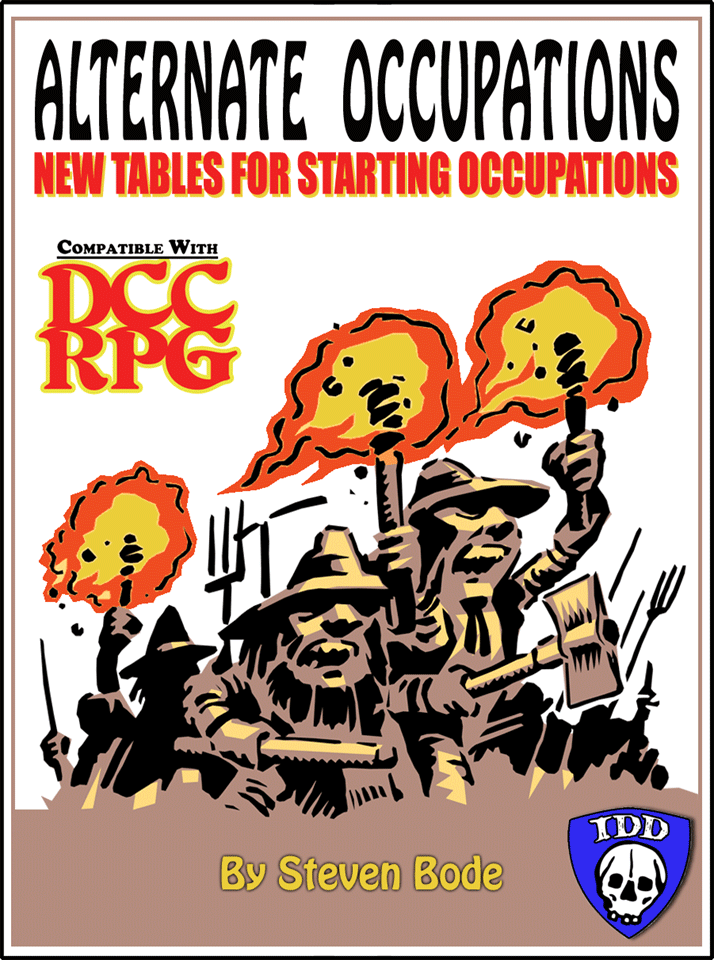
Review: Alternate Occupations

Author:  Steven Bode
Publisher:  IDD Company
Price: PDF $2.00
Pages:   17
Tankard Rating:  4/5

Dungeon Crawl Classics RPG has seen a lot of support from the 3PP scene. There are several areas within the Dungeon Crawl Classics RPG that are ripe with opportunity for judges to unleash their full creativity. With this comes areas for 3PP’s to fill in some gaps for those of us with a little more limited time can cherry pick the fun ideas from them.

The Book

Today I take a look at Alternate Occupations from the IDD Company, written by Steven Bode. Some observant folks noticed it pop up on RPG Now a couple of days ago and a thread recently surfaced on the Goodman Games forums about this product. This PDF is a book of tables for starting occupations for players generating characters for a DCC RPG funnel adventure.

The tables are sorted into a Main Occupation table that has nearly 200 occupations on it. Each line item includes an occupation, race, trained weapon and trade good. There is overlap with the occupation table from the main DCC RPG rulebook, but that simply means you can roll on this larger table and not miss something from the rulebook’s occupation table. A die rolling mechanic is included on how to generate a number from 1 to 200.

While random determination of many items in DCC RPG is the essence of the game, there will be people that want to play a specific race or class. Racial tables include Human, Elf, Halfling, and Dwarf tables. Class tables include Cleric, Fighter, Rogue, and Wizard tables. If a player knows they would rather play a certain race or class if they survive the funnel adventure they can choose to role on a specific race or class table, provided the judge allows it.

The PDF also define several of the more obscure occupations as well. I found this pretty handy, as I know I looked up a couple of professions from core DCC RPG rulebook. This is a handy little feature to be included.

The Reaction

I like how this supplement has expanded the starting occupations. The Main Occupation table it includes will ensure that the multitude of 0-level characters setting off to make a name for themselves will have varying occupations for variety. The tables are easy to read, the rolling mechanic is clear and concise.

At the moment I am embracing the pure randomness of the game. I suspect as time goes on I might want to have a better shot at playing a demi-human from the start of a game instead of trusting fate. The racial tables will be great for letting me roll up a starting occupation on a certain races table. These tables I am sure will become more valuable over time.

Overall, this PDF is a good buy for a quick and easy way to add more occupations to your DCC RPG game. The tables are cleanly formatted and easy to read and offers some fun occupation options to the game. Alternate Occupations is yet another strong product from a 3PP for DCC RPG.

Tankard Rating
4 tankards out of 5 tankards

DCC RPG Critical Hit Trap Table

During a recent Dungeon Crawl Classics RPG game session we had a trap with an attack roll spring. A natural 20 was rolled for the trap’s attack and we checked for a Critical Table for Traps. We did not find one and I improvised and used a roll off the Monster table.

That moment got us talking and we thought maybe a Critical Table for Traps was in order. Several traps require attack rolls and it only seems reasonable that they get their own table!

There are several types of traps that typically get attack rolls – swinging scythes, rolling boulders, poison needle traps, etc. In designing this table I built it so it could be applicable to poison based traps or slashing, bludgeoning, or other types of traps.

To accomplish this I made the even numbered results applicable to slashing, bludgeoning or other types of traps that cause outright damage. Odd numbered entries are more poison oriented – whether that be poisoned needles, spear tips, or whatever devious traps DCC RPG judges can come up with. When rolling on the table if you get an odd number, but the trap is not a poison based trap, just drop down one result to get an applicable item.

For example, you roll a 20 an a poisoned needle and get a 16 on the critical roll. Just drop down and read the result from the 15 entry and you have a relevant and similarly damaging result.

Determining which dice to roll on a critical roll is the more subjective part on the Judge’s part. I am tempted to base it off of attack modifier to some degree, though those will rarely scale to the upper ends of the table. This would likely need to blend with the level of the adventure the judge is running. I think the dice progression used for ‘All Other’ from the Monster table is appropriate. I just need something other than HD to figure out which dice to roll.

I am still debating how to figure that portion out. Feel free to pop in with what you think in the comments. Until then, here is the Trap Critical Table I came up with.

Traps – Critical Table

Evens are slashing, bludgeoning, piercing, etc.
Odds are poison based traps

1 or Less: Trap sprung nearly perfectly! Add 1d3 damage.
2: The trap leaves the PC with blurry vision from the blow. +1d3 damage, -1 Reflex Saves for 6 hours.
3: The poison acts quickly, dulls reflexes. +1d3 damage, -1 Reflex Saves for 6 hours.
4: The trap scores a solid hit, penetrating deep into the PC’s body. +1d6 damage.
5: The poison burns as it enters the PC’s body! +1d6 damage.
6: The blow from the trap knocks the wind out of the PC. +1d6 damage, 1d2 temporary Stamina damage until healed.
7: The poison causes convulsions. +1d6 damage, 1d2 temporary Stamina damage until healed.
8: The trap causes bleeding that is difficult to stop. +1d8 damage.
9: Poison lingers unusually long in the PC’s body. +1d8 damage.
10: The trap strikes a central nerve. +2d4 damage, DC 14 Fort Save or fall unconscious.
11: The poison overwhelms central nervous system. +2d4 damage, DC14 Fort Save or fall unconscious.
12: The trap lands an overpowering blow. +1d12 damage.
13:  The poison has a brief, but very powerful chilling effect on the PC’s muscles. +1d12 damage
14: Trap cracks multiple ribs. +2d6 damage.
15: The poison causes the PC’s spleen to rupture. +2d6 damage.
16: The trap crushes the PC’s knee. PC’s movement rate is reduced by 5′.
17: The poison causes paralyzation in the PC’s arm.  PC loses use of one arm until healed by cleric 3rd level or higher.
18: The trap causes a sudden and extreme amount of blood loss. +1d16 damage. DC 16 Fort Save or fall unconscious.
19: The poison speeds its way to the PCs heart causing +1d16 damage. DC 16 Fort Save or fall unconscious.
20: The blow from the trap damages the optical nerve. PC is permanently blind.
21: The poison fogs the vision causing permanent blindness.
22: The trap delivers a stunning blow to the head causing irreversible vestibular system damage. 1d6 Agility damage.
23: The poison affects the PC’s core brain function. 1d6 Intelligence damage.
24: The trap’s blow causes severe damage to the PC’s spinal column causing complete and permanent paralysis.
25: The poison targets the PC’s central nervous system and causes complete and permanent paralysis.
26: The trap flays the flesh and exposes a wide swath of muscle to open air. +3d12 damage.
27: The poison has an acidic reaction with the PC’s blood stream causing extreme pain and anguish. +3d12 damage.
28: The trap damages multiple organs with a single strike causing immediate PC death.
29: The poison sends the PC’s heart rate into impossible to maintain numbers causing it to explode in the PCs chest, killing him.
30 or More: The gods frown upon the PC as the trap springs with uncanny execution and kills the PC outright in an extreme fashion.